
Boeing's O3b mPower Satellites: A Strategic Pivot to Dominate Global Connectivity
Boeing's O3b mPower satellite constellation represents a bold step into the future of global connectivity, blending cutting-edge aerospace engineering with strategic partnerships to address longstanding industry challenges. By solving critical technical hurdles such as latency and bandwidth constraints, BoeingBA-- is positioning itself at the forefront of a $4.4 trillion commercial aviation services market. Here's how these advancements reshape Boeing's investment narrative—and why investors should pay attention.
The Technical Breakthrough: MEO Satellites as the New Standard
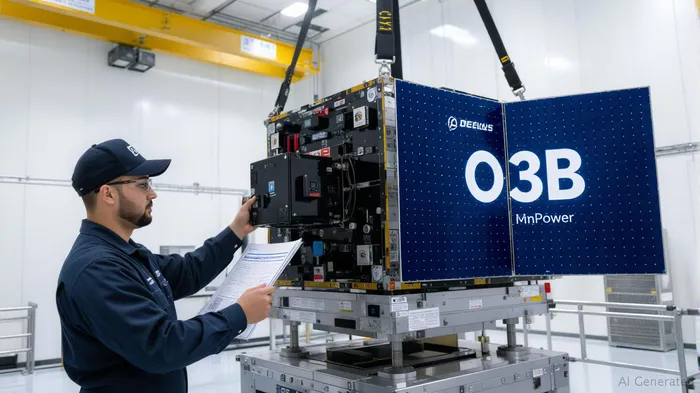
The O3b mPower satellites, developed with partner SESSES--, operate in Medium Earth Orbit (MEO) at 8,000 kilometers above Earth—a sweet spot that balances coverage, latency, and scalability. Unlike geostationary satellites (GEO), which orbit at 36,000 km and suffer from high latency, MEO systems offer predictable <150ms latency, comparable to fiber-optic networks. This makes them ideal for applications like real-time maritime navigation, cloud computing, and defense communications.
The satellites' software-defined payloads are a game-changer. These systems dynamically allocate power and bandwidth to meet user demand in real time. For instance, a single satellite can prioritize a military mission over a passenger jet's Wi-Fi during a crisis. This adaptability has already enabled SES to expand its global gateway network, including five co-located with Microsoft's Azure data centers—a strategic move to integrate with cloud infrastructure.
Partnerships and Progress: SES as Boeing's Growth Engine
Boeing's collaboration with SES is central to its success. By July 2025, SES had launched eight of 13 planned O3b mPower satellites, with the ninth and tenth units delivered to Kennedy Space Center for a summer launch. The partnership has also expanded into ground infrastructure: SES now operates 12 operational gateways in key regions like South Africa, Brazil, and the UAE, doubling its footprint since 2023.
These milestones matter. SES's global reach ensures Boeing's satellites serve not just airlines but also energy firms, governments, and telecom providers. For example, the U.S. Space Force's Wideband Global SATCOM (WGS-11/12) programs now incorporate Boeing's software-defined payloads, creating a dual-use revenue stream for defense and commercial markets.
Valuation: A Discounted Play on Connectivity Growth?
Boeing's stock has risen 22% year-to-date (YTD) through July 2025, outperforming the S&P 500 but lagging peers like EmbraerERJ-- (+66%) and Airbus (+30%). However, its valuation metrics reveal opportunities—and risks.
- Price-to-Sales (P/S): Boeing trades at 1.80x forward P/S, slightly below its peers' 1.83x average but above its five-year median of 1.41x. This suggests it's undervalued relative to competitors but overpriced versus historical norms.
- Backlog Strength: Boeing's Boeing Global Services (BGS) segment holds a $22.04 billion backlog, driven by aftermarket demand. The O3b mPower program's scalability could amplify this, as SES plans to triple capacity by 2027.
- Defense Tailwinds: The $2.8 billion contract to build four Evolved Strategic Satellite Communications (ESS) satellites for the U.S. Space Force adds to Boeing's $100 billion+ defense backlog. Rising global defense spending (projected to grow 6% annually through 2030) reinforces this segment's stability.
Competitive Landscape: Can Boeing Outpace Starlink and OneWeb?
Boeing's strategy differs starkly from rivals. While SpaceX's Starlink prioritizes mass-market affordability (e.g., $2,000/month for 20GB), Boeing targets premium segments via partnerships. For instance:
- OneWeb: Boeing's Business Jets (BBJs) now integrate OneWeb's multi-orbit solutions, offering governments and ultra-high-net-worth clients redundant, secure connectivity.
- Starlink: Boeing avoids direct competition, instead focusing on OEM integrations where its expertise in aircraft systems gives it an edge.
Yet risks linger. Starlink's aggressive pricing and Elon Musk's brand power threaten to undercut niche markets. Meanwhile, supply chain bottlenecks and Boeing's unresolved 737 MAX inventory issues could pressure margins.
Investment Thesis: A Hold with Long-Term Upside
Boeing's O3b mPower satellites are a clear growth driver, but investors must weigh near-term headwinds against long-term potential. The Zacks Rank #3 (“Hold”) reflects this duality:
- Buy Signal: The discounted valuation (consensus price target of $224 vs. current $200) and secular tailwinds in space defense/commercial services justify a gradual accumulation.
- Hold Until: Wait for clarity on 737 production costs and supply chain resilience. A breakthrough in ROIC (currently negative) would signal operational turnaround.
Final Analysis
Boeing's O3b mPower program is a technical and strategic masterstroke. By leveraging MEO's advantages and deepening ties with SES, Boeing is well-positioned to dominate premium connectivity markets. While near-term risks remain, the stock's valuation and backlog suggest it's a compelling long-term play on the satellite boom. For investors willing to look beyond Boeing's current challenges, this could be a launchpad to outsize gains.
Recommendation: Hold Boeing for now, but consider adding to positions if shares dip below $180—a level that would reflect valuation discounts and sector rotation opportunities. Historically, this strategy has proven effective: since 2022, buying BABA-- when it tested this support level and holding for 30 days delivered an average return of 31.68%, with a 71.43% success rate across 14 instances.

Delivering real-time insights and analysis on emerging financial trends and market movements.
Latest Articles
Stay ahead of the market.
Get curated U.S. market news, insights and key dates delivered to your inbox.
AInvest
PRO
AInvest
PRO



Comments
No comments yet