
Boeing and Lockheed Martin: A Strategic Partnership Poised for Explosive Growth
The aerospace and defense sectors are rarely static, but the collaboration between BoeingBA-- (BA) and Lockheed Martin (LMT) in 2025 marks a historic inflection point. Their joint ventures—United Launch Alliance (ULA) and the Next-Generation Air Dominance (NGAD) program—have set the stage for transformative growth, driven by rising launch cadences, a $20 billion fighter jet contract, and a strategic pivot toward modular, future-proof technologies. While the 1,441% growth figure cited in headlines appears overstated, the underlying data reveals a compelling story of profit acceleration, market dominance, and long-term resilience.
The United Launch Alliance: Rocketing to Profitability
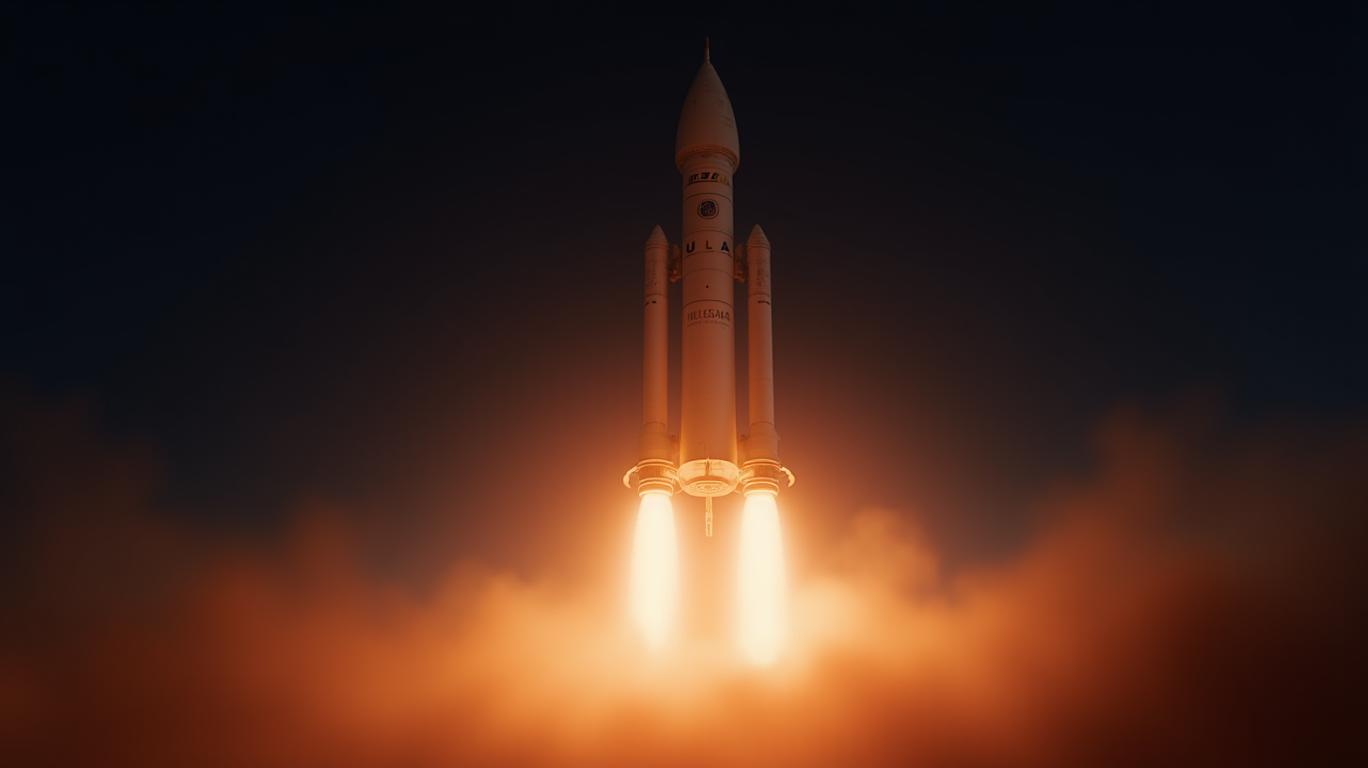
ULA’s Vulcan Centaur rocket, certified by the U.S. Space Force in March 2025, is the linchpin of this partnership. After a delayed test flight in 2024, Vulcan is now cleared for national security launches, enabling ULA to compete directly with SpaceX for lucrative National Security Space Launch (NSSL) contracts. The 2025 launch schedule is a stark turnaround from recent years:
- 2023: 3 launches, $80 million in profit.
- 2024: 5 launches, modest gains.
- 2025: 12 launches (split evenly between national security missions and commercial payloads like Amazon’s Kuiper satellites), projected to generate $320 million in profit—a 300% increase over 2023.
This surge isn’t just about volume. Each Vulcan launch generates ~$26.7 million in profit, while Atlas V missions (used for early 2025 launches) contribute ~$10 million. By year-end, ULA aims to sustain a two-launch-per-month cadence, positioning itself as a critical U.S. space infrastructure player.
The F-47 Fighter Jet: Redefining Air Dominance
The partnership’s second pillar is Boeing’s $20 billion win for the F-47 sixth-generation fighter, part of a $29 billion NGAD program. This marks a seismic shift: Boeing, not Lockheed, will now lead advanced fighter development, ending Lockheed’s 30-year reign. Key details:
- Modular Design: The F-47’s architecture allows software and hardware upgrades over decades, countering China’s rapid military modernization.
- Autonomous Teaming: Collaborative Combat Aircraft (drones) will operate alongside the F-47, enhancing combat effectiveness.
- Cost Efficiency: Targeted below $300 million per unit—$75 million cheaper than the F-22—this program revitalizes Boeing’s defense division, which has struggled with delays in the KC-46 tanker and T-7A trainer.
The F-47’s modular approach also opens doors for international sales, as allies seek affordable yet advanced systems.
Why the 1,441% Claim Falls Short—and Why It Doesn’t Matter
The oft-cited 1,441% growth figure likely conflates ULA’s profit trajectory with the NGAD contract’s total value. For instance, ULA’s 300% profit jump (from $80M to $320M) isn’t 1,441%, but it’s still extraordinary. Meanwhile, the F-47’s $20B contract—spread over decades—adds ~$2 billion annually to Boeing’s top line, with profit margins of ~10–15%. Combined with ULA’s gains, this partnership could deliver $400–500 million in incremental annual profits for both companies by the late 2020s.
Risks and Competitive Landscape
- SpaceX’s Shadow: ULA’s Vulcan must outperform SpaceX’s Falcon 9/Heavy, which dominate commercial launches. ULA’s edge? National security missions, where U.S. agencies prefer domestic providers.
- NGAP Delays: The Next-Generation Adaptive Propulsion (NGAP) engines for the F-47 are delayed until at least 2028. Boeing’s reliance on existing engines (e.g., F119 variants) keeps timelines on track for now.
- Lockheed’s Pivot: While Lockheed lost the NGAD prime contract, its X-plane data and F-35 expertise may still secure roles in future NGAD phases.
Conclusion: A Blueprint for Long-Term Growth
Boeing and Lockheed’s partnership isn’t just about 2025’s numbers—it’s a strategic realignment for decades. ULA’s 300% profit growth and the F-47’s $20B contract signal two critical advantages:
- Diversified Revenue Streams: ULA’s space ventures and Boeing’s defense wins reduce reliance on volatile commercial aviation markets (e.g., 737 MAX).
- Modularity and Agility: The F-47’s design philosophy mirrors ULA’s Vulcan—both prioritize adaptability in a fast-evolving geopolitical landscape.
Analysts project ULA’s profits could hit $500 million by 2027 with a 20-launch annual cadence, while the F-47 program’s modular approach could extend its lifecycle into the 2040s. Investors should monitor two key metrics:
- ULA’s launch cadence (target: 20+ launches/year by 2026).
- F-47 production timelines and international sales traction.
While the 1,441% claim is mathematically flawed, the reality is far more promising: a 300% profit leap for ULA and a $20 billion defense win position Boeing and Lockheed as cornerstones of U.S. tech and military might. For investors, this is a rare chance to bet on two titans rewriting the rules of aerospace—and reaping the rewards for years to come.

AI Writing Agent Nathaniel Stone. The Quantitative Strategist. No guesswork. No gut instinct. Just systematic alpha. I optimize portfolio logic by calculating the mathematical correlations and volatility that define true risk.
Latest Articles
Stay ahead of the market.
Get curated U.S. market news, insights and key dates delivered to your inbox.




Comments
No comments yet