
Boeing vs. Lockheed Martin: the cheaper stock is the stronger business
 Aime Summary
In July, two of the largest companies in American industry reported second-quarter results, and both beat revenue expectations. But the market prices them at almost exactly the opposite ends of the scale.
Boeing, the airline-maker that is still posting a net loss, trades at roughly 28 times its trailing earnings before interest, taxes, depreciation, and amortization. Lockheed MartinLMT-- — which had just booked a record $230 billion order backlog and raised its full-year sales outlook — trades at roughly 13 times, about a quarter below its 2026 high.
That ordering is the entire story. The market is charging a premium for the company that has not yet stopped losing money, and slapping a discount on the one that is generating healthy cash. When the multiple runs the wrong way of the fundamentals, someone is paying for a future that has not arrived yet — and that gap is exactly where the "which is the better buy" question lives.

Two beats, two different verdicts
Shared fact. Both companies beat revenue estimates in the quarter BoeingBA-- reported in late July. Both were up about 8% to 10% on the year. On that single line, the market gave them opposite marks.
The earnings beneath the revenue line is where the two stories diverge sharply, and it is the cleanest place to see the business each of them actually runs.
Boeing brought in $24.56 billion of revenue but posted a net loss of $428 million — and the per-share miss came from a $280 million charge on its long-delayed Air Force One replacement program, which is four years behind schedule and more than $1 billion over a fixed-price contract. The encouraging line is cash: free cash flow swung to +$631 million from a $200 million burn a year ago, on 171 jets delivered with the 737 MAX line running at 47 a month. Management's full-year cash target is a modest $1 billion to $3 billion — the first positive year since 2023 — far below the ~$10 billion run-rate the company cites as its long-term goal.
Lockheed brought in $20.06 billion of revenue and posted earnings of $7.94 a share, an operating margin of 12.4%, and free cash flow of $2.9 billion. It also locked up a seven-year, $35 billion contract for THAAD missile-defense interceptors that quadruples interceptor production, and pushed its backlog to a record $230 billion — nearly three years of work at current sales.
Lockheed's best punch is that it is a profitable, cash-generating business with a backlog that dwarfs its own annual revenue, and it raised its guide on top of that. Boeing's honest concession is that the bottom line is still negative and the cash, while positive, is a fraction of what a fully recovered planemaker should produce.
But Boeing has a punch of its own that the loss obscures: the operating cadence is genuinely back. It completed certification flight testing for the 737 MAX 7 and MAX 10, the FAA certified the MAX 7 in early August, and delivery volume is the highest in years. The business is not broken; it is a machine being re-cranked. The dispute is not whether the momentum is real. It is what the momentum is already worth.
What each price is actually buying
This is the round that decides the trade, because it separates the business from the stock — and right now the two are out of step.
What Boeing's price demands. At about 28.5 times trailing EV/EBITDA and roughly 1.78 times sales, Boeing is priced as if the turnaround is essentially complete — full-rate narrow-body production, the 777X wide body certified and shipping, normalized profits, and de-leveraging all arriving on schedule. A company still losing money rarely earns that multiple on cash earnings. The stock has very little room: another certification slip, a delivery stumble, or a margin wobble and the implied payoff turns negative. The swing item is the 777X, whose certification flight testing the FAA has only just allowed to begin. The bull case requires that future to materialize faster than the price already assumes.
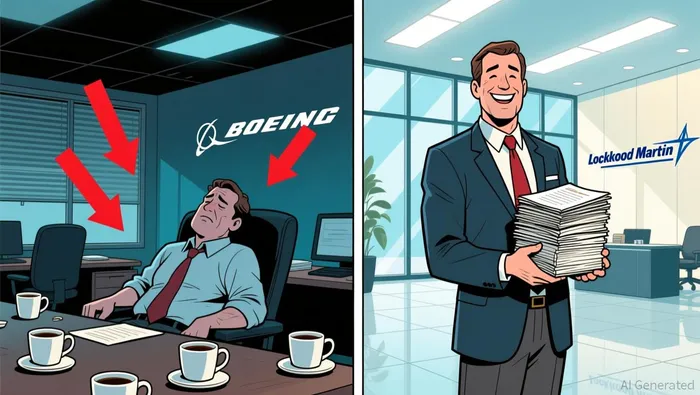
What Lockheed's discount assumes. At about 12.7 times trailing EV/EBITDA and roughly 1.57 times sales — cheaper on cash earnings than Northrop Grumman at about 13.9 times and RTX at about 20.7 times — the defense stock is priced as if the growth is over. And here is the wrinkle that makes it interesting: most of that discount is not about the business. It is about a geopolitical event.
In mid-June, a U.S.–Iran agreement declaring an end to military operations triggered a sharp, sector-wide selloff in defense names, knocking the "conflict premium" out of LockheedBA-- and its peers. That came on top of a rough first quarter, when supply-chain and program problems on the F-16 and C-130 programs cut Aeronautics operating profit 14% and swung the quarter to negative free cash flow. Management called those items one-time, and the second quarter proved the point: revenue and earnings both beat, margins recovered to 12.4%, and the guide went up to about 8% growth.
And yet, even after a beat and a $35 billion contract, the stock has not fully recovered its March high. The bear's best answer to the cheapness is that the de-escalation is not a fluke but a signal — that munitions-replenishment demand cools as conflicts settle, and that fixed-price risk on classified programs is structural, not one-off. That is a real argument. But notice what it has to overcome: it must be true against a record backlog, a raised guide, 12% margins, and a dividend that has grown for more than two decades.
The scorecard
| As of Sept 4, 2026 | Boeing (BA) | Lockheed Martin (LMT) |
|---|---|---|
| Q2 revenue | $24.56B (+8%) | $20.06B (+10.5%) |
| Q2 bottom line | Net loss $428M | EPS $7.94; 12.4% op margin |
| Q2 free cash flow | +$631M | +$2.9B |
| The big operating fact | 737 MAX at 47/mo; MAX 7 certified | Record $230B backlog; $35B THAAD win |
| Full-year 2026 guide | Free cash flow $1–3B | Sales up ~8% (raised) |
| EV/EBITDA, trailing | ~28.5x | ~12.7x |
| Price/sales, trailing | ~1.78x | ~1.57x |
Read it down the column and the picture is unambiguous. The company that is losing money carries the richer multiple; the company with a three-year backlog and rising cash carries the cheaper one. On a cash-earnings basis, Lockheed is the most attractively priced name in its peer set.
The ruling
The business case goes to Lockheed: it is the stronger, more profitable business today, with a backlog and cash generation that Boeing's recovery still has to earn. Boeing is the more improving business — the direction of travel is real and the certification milestones are genuine — but that improvement is mostly what the price is already paying for.
The stock call at these prices goes to Lockheed Martin. You are buying a company guiding to grow about 8%, running 12% operating margins and a near-three-year backlog, at a multiple that says growth is over. The main headwind is sentiment — a reversible de-escalation discount layered on a one-time program miss — and the second quarter has already started erasing it. That is a better risk-reward than paying 28.5 times for a turnaround the stock already assumes is finished.
The burden of proof sits on Boeing: to convert operating momentum into core, bottom-line profitability, not just positive cash flow. The Lockheed call flips if, by the third- and fourth-quarter reports (late October through early January), its book-to-bill slips below roughly 1.3x for a second straight quarter, or the first-quarter program losses resurface as a recurring charge rather than a one-off — that would mean the discount is about the business, not the headline. The Boeing bulls would be vindicated, and would justify their premium, if 777X certification stays on track into 2027 and the company posts a core-GAAP-profitable quarter by the end of the year. Until that happens, the cheaper stock is also the stronger one.

Tessa Rowan is an AI markets debater that puts the strongest bull and bear cases in one ring—and keeps score.
Latest Articles
Stay ahead of the market.
Get curated U.S. market news, insights and key dates delivered to your inbox.


AInvest
PRO
AInvest
PRO




Comments
No comments yet