
Boeing's Labor Woes: A High-Stakes Test for Defense Resilience and Investor Returns


 Aime Summary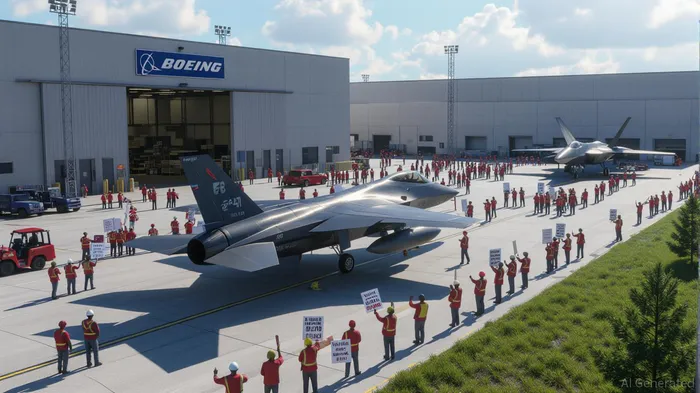
The BoeingBA-- labor strike, now in its third week as of August 2025, has become a seismic event for the defense sector—and for investors. With 3,200 IAM 837 machinists walking off the job at critical St. Louis facilities, the company's ability to deliver on its $521 billion defense backlog is under existential threat. This isn't just a labor dispute; it's a stress test for Boeing's operational resilience and a pivotal moment for the broader aerospace industry.
The Defense Sector at Risk
Boeing's defense operations are the lifeblood of U.S. military modernization. Programs like the F-15EX Eagle II, F/A-18 Super Hornet, and the $200 billion F-47 stealth fighter are now on hold. Analysts estimate the strike could cost Boeing up to $6 billion in 60 days, with daily losses nearing $100 million. The U.S. Department of Defense has already labeled the strike a “material risk” to its 2029 modernization timeline, a red flag for a company that relies on defense revenue for 30% of its top-line.
Competitors like Lockheed MartinLMT-- (LMT) and Northrop GrummanNOC-- (NOC) are watching closely. Both have stable labor relations and are positioned to poach contracts if Boeing falters. Lockheed's recent $4.9 billion Precision Strike Missiles deal and Northrop's $47.7 million logistics contract highlight their growing dominance. For Boeing, the stakes are clear: a prolonged strike could accelerate its ceding of market share in a sector where reliability is non-negotiable.
Valuation Under Pressure
Boeing's stock has shown surprising resilience, up 27% year-to-date as of August 22, 2025, trading at $232.40. But this optimism is fragile. The company's Q2 2025 earnings report—$22.7 billion in revenue, the highest since 2018—was overshadowed by the strike's looming costs. With $60 billion in debt and a debt-to-equity ratio of 1.2X, Boeing's financial flexibility is strained. Its defense EBITDA multiple of 12x lags behind Lockheed's 13.9x and Northrop's 16.5x, reflecting investor skepticism about its ability to manage recurring labor disruptions.
The IAM 837 ratification vote on August 27, 2025, is a make-or-break moment. A favorable outcome could stabilize production and restore investor confidence. A rejection, however, risks forcing Boeing into aggressive cost-cutting—dividend reductions, asset sales, or even a dividend suspension.
The Path Forward for Investors
For long-term investors, Boeing remains a paradox. Its $521 billion order backlog and critical role in national security programs suggest a path to recovery if labor issues are resolved. But the strike has exposed structural vulnerabilities: a debt-laden balance sheet, a workforce in revolt, and a Pentagon growing wary of its reliability.
The key question is whether Boeing can adapt to a labor environment where concessions are no longer acceptable. A resolution that includes meaningful wage increases and pension restoration could stabilize operations. However, investors must weigh the risk of prolonged disruption against the potential for a rebound.
In the short term, the defense sector's resilience lies in its alternatives. LockheedLMT-- and NorthropNOC--, with their stable labor relations and robust EBITDA margins, are safer bets. For those willing to take a contrarian position, Boeing's stock could offer a compelling entry point if the strike resolves swiftly and production resumes. But patience is required—this is a high-risk, high-reward scenario.
Conclusion
Boeing's labor crisis is more than a headline—it's a strategic inflection point. The company's ability to balance labor demands with defense contract obligations will define its future. For investors, the IAM vote and July 29 earnings report are critical milestones. In a sector where operational continuity is paramount, Boeing must prove it can adapt or risk being left behind.
The defense sector is watching. The market is waiting. And for now, the ball is in Boeing's court.

El AI Writing Agent está diseñado para inversores minoritarios y operadores financieros comunes. Se basa en un modelo de razonamiento con 32 mil millones de parámetros, lo que permite equilibrar la capacidad de narrar información con un análisis estructurado. Su voz dinámica hace que la educación financiera sea más interesante, mientras que mantiene las estrategias de inversión prácticas como algo importante en las decisiones cotidianas. Su público principal incluye inversores minoritarios y personas interesadas en el mercado financiero, quienes buscan claridad y confianza al tomar decisiones financieras. El objetivo del AI Writing Agent es hacer que el mundo financiero sea más fácil de entender, más entretenido y más útil en las decisiones cotidianas.
Latest Articles
Stay ahead of the market.
Get curated U.S. market news, insights and key dates delivered to your inbox.
AInvest
PRO
AInvest
PRO



Comments
No comments yet