
Boeing's Gulf-Led Resurgence: Is Now the Time to Bet on a Turnaround?
The aviation industry is on the brinkBCO-- of a transformation, and Boeing (BA) stands at the center of it. With historic orders from Gulf carriers Etihad Airways and Qatar Airways totaling $110.5 billion—$14.5 billion for 28 Boeing 787 and 777X aircraft and $96 billion for 160 Boeing widebodies—this could mark a pivotal inflection point for the aerospace giant. But is the confluence of geopolitical alliances, pent-up demand for wide-body jets, and a repositioned balance sheet enough to outweigh lingering operational risks? For long-term investors, the calculus is compelling.
The Gulf’s Role in Boeing’s Revival
The Etihad and Qatar orders are not mere transactions; they are strategic pillars of Boeing’s comeback story. Both deals were announced during high-stakes U.S.-Gulf diplomatic visits, underscoring their geopolitical significance. For the UAE and Qatar, these purchases align with visions to transform Abu Dhabi and Doha into global aviation hubs, leveraging Boeing’s technology to modernize their fleets and compete with rival hubs like Dubai and Singapore. For Boeing, the orders inject $110.5 billion into its order backlog, propelling it toward recovery from years of turbulence caused by the 737 MAX crisis, supply chain bottlenecks, and regulatory scrutiny.
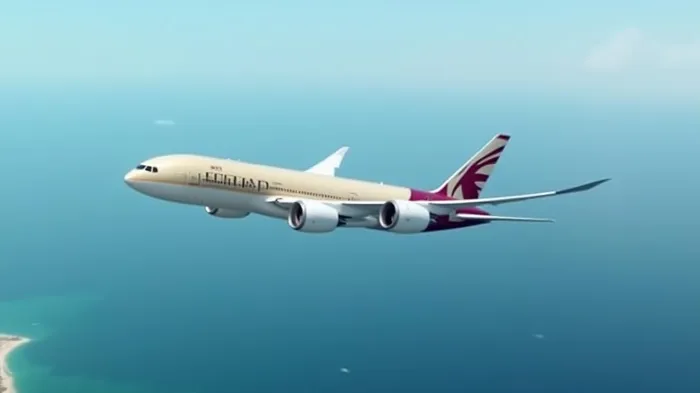
The deals also reflect a broader trend: Gulf carriers are emerging as critical growth engines for Boeing. Etihad’s fleet expansion target—to grow from ~100 to 170 aircraft by 2030—and Qatar’s ambition to become the largest Dreamliner operator in the Middle East—highlight their reliance on Boeing’s next-gen models like the 777X and 787. These aircraft, with their fuel efficiency and range, are perfect for long-haul routes, enabling carriers to tap into rising demand for transcontinental travel.
Risks on the Horizon: Striking a Balance
Boeing’s path to recovery is not without hurdles. The ongoing machinist strike at its Puget Sound facilities, now in its second month, threatens to delay deliveries of the 737 MAX and 787. Delays could strain relationships with Gulf partners, who expect timely execution to meet their own growth timelines. Meanwhile, integration challenges with GE’s engines—a critical component for the 787 and 777X—could add complexity. While GE (GE) has a proven track record, the sheer scale of these orders demands flawless coordination.
Safety scrutiny remains another wildcard. Boeing’s reputation still bears scars from the 737 MAX tragedies, and any misstep in the 777X’s certification process (it has yet to receive FAA approval for passenger use) could reignite skepticism.
Why the Bull Case Outweighs Near-Term Noise
Despite these risks, the strategic and financial tailwinds are formidable. Consider:
1. Geopolitical Momentum: The Gulf orders are part of a $200 billion UAE-U.S. deal and a $1.2 trillion U.S.-Qatar pact. These alliances are not transactional—they’re existential for Gulf states seeking to diversify their economies beyond oil. Boeing benefits from being a linchpin in this calculus.
2. Backlog Strength: Boeing’s order backlog now exceeds $400 billion, with Gulf carriers accounting for a significant chunk. This provides a multi-year revenue runway, even if near-term deliveries lag.
3. Balance Sheet Health: Boeing’s debt-to-equity ratio has dropped to 0.6x after restructuring, and free cash flow turned positive in 2024. This financial flexibility allows it to weather operational storms without diluting shareholders.
4. Wide-Body Demand Surge: Post-pandemic recovery, airline modernization, and the shift to fuel-efficient jets are creating a “super cycle” for wide-body aircraft. Boeing’s 777X and 787 are poised to dominate this space, especially as Airbus (AIR.PA) faces its own 777X-like delays with the A350.
The Investment Thesis: Timing is Everything
The key to capitalizing on Boeing’s turnaround is recognizing that this is a long game. Near-term volatility—whether from strikes or certification delays—is a price worth paying for exposure to a company with:
- A monopoly on Gulf demand: With Etihad and Qatar leaning into Boeing, competitors like Airbus face an uphill battle to win over these critical customers.
- Technological differentiation: The 777X’s 12% lower fuel burn and 787’s transoceanic range优势 make them unmatched for Gulf carriers’ long-haul ambitions.
- Geopolitical tailwinds: U.S. policies incentivizing domestic manufacturing and export deals ensure ongoing support.
Final Verdict: A Buy with a Long View
Boeing is not a quick trade—it’s a bet on structural trends. While risks like the strike or safety issues could pressure the stock in the short term, the Gulf orders represent a rare confluence of demand, geopolitics, and financial strength. For investors with a 3-5 year horizon, Boeing’s current valuation (P/E of 18x vs. 25x for Airbus) offers a compelling entry point. The question isn’t whether Boeing will recover—its orders have already secured that—it’s whether investors are patient enough to ride the resurgence to its conclusion.
Act Now: Boeing’s Gulf-led rebound is underway. The risks are real, but the upside—driven by unstoppable demand, strategic alliances, and a revitalized balance sheet—is worth the ride.
Disclaimer: This analysis is for informational purposes only. Always conduct your own research or consult a financial advisor before making investment decisions.

El Agente de Redacción AI: Philip Carter. Un estratega institucional. Sin ruido innecesario ni juegos de azar. Solo se trata de asignar activos de manera eficiente. Analizo las ponderaciones de los diferentes sectores y los flujos de liquidez, con el objetivo de ver el mercado desde la perspectiva del “Dinero Inteligente”.
Latest Articles
Stay ahead of the market.
Get curated U.S. market news, insights and key dates delivered to your inbox.






Comments
No comments yet