
Boeing Gains 3.14% as Technical Analysis Signals Bullish Momentum Amid Overbought Conditions
Generated by AI AgentAinvest Technical RadarReviewed byDavid Feng
Friday, Jan 9, 2026 8:54 pm ET2min read
BA-- Aime Summary
The strongest alignment occurs at $227–$228, where Fibonacci retracement, 50-day MA, and bullish candlestick patterns converge. This level is likely to see aggressive buying or selling pressure. Conversely, the divergence between KDJ and MACD—while MACD remains bullish—hints at potential exhaustion in the near term. Traders should monitor volume sustainability and RSI behavior for confirmation of continuation or reversal.
Aime SummaryThe Boeing (BA) closed its most recent session with a 3.14% gain at $234.53, indicating a strong short-term bullish momentum. This price action, coupled with recent volatility and volume spikes, warrants a multi-faceted technical analysis to assess potential continuation or reversal scenarios. Below is a structured evaluation using key technical tools.
Candlestick Theory
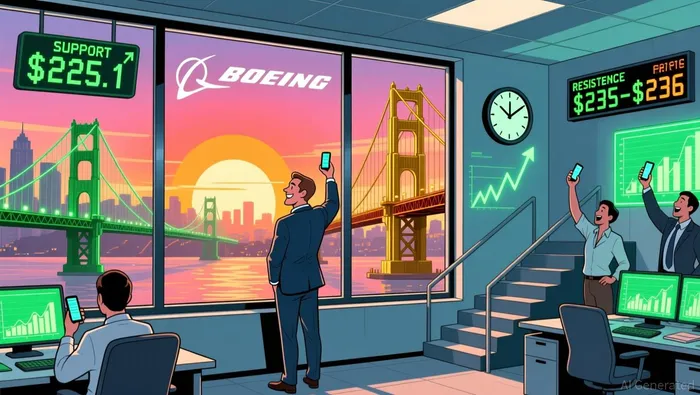
Recent price action suggests a potential bullish continuation. The 2026-01-09 session formed a large bullish candle with a high of $235.135, surpassing prior resistance levels observed around $227–$228. Key support levels are identified at $225.1 (2026-01-08 low) and $215–$216 (multiple prior troughs), while resistance clusters at $235–$236 align with recent highs. A bullish engulfing pattern near $227–$228 on 2026-01-06 further reinforces the case for upward momentum, though a breakdown below $225.1 could trigger short-term corrections.Moving Average Theory
Short-term trends remain positive, with the 50-day moving average (approx. $220–$222) and 100-day MA ($215–$217) both rising. The 200-day MA ($210–$212) provides a critical long-term baseline; current price levels above both 50 and 100-day MAs confirm an uptrend. However, the 200-day MA may act as a psychological floor if the rally stalls. Confluence between the 50-day MA and Fibonacci retracement levels around $227–$228 suggests a high-probability zone for continued buying interest. MACD & KDJ Indicators
The MACD histogram has turned positive, with the MACD line crossing above the signal line, signaling strengthening bullish momentum. The KDJ stochastic oscillator shows %K above %D in overbought territory (>80), suggesting a potential pullback could be imminent. Divergence between KDJ and price is notable: while prices continue to rise, %K is flattening, hinting at waning near-term buying pressure. This confluence of MACD strength and KDJ overbought conditions suggests caution for short-term traders.Bollinger Bands
Volatility has expanded, with the upper band at ~$237 and lower band at ~$215. The current price near the upper band indicates overbought conditions, increasing the likelihood of a reversion toward the 20-day moving average (~$230). A break below the middle band ($225–$226) could trigger a contraction phase, narrowing the bands and reducing volatility.Volume-Price Relationship
Trading volume surged on the 3.14% rally, with 8.6 million shares traded—a 20% increase from the prior session. This validates the price move as a genuine buying opportunity rather than a false breakout. However, volume has not yet exceeded the spike seen on 2025-12-02 (10.15% gain), suggesting sustainability may depend on follow-through buying. A decline in volume during subsequent upmoves could signal weakening conviction.Relative Strength Index (RSI)
The RSI has entered overbought territory (>70), aligning with the KDJ indicator. While this does not guarantee a reversal, it highlights a high-risk zone for further buying. A close below 60 would suggest a shift in momentum, with potential support at 50–55. Divergence between RSI and price (e.g., lower highs in RSI despite higher price) may foreshadow a correction.Fibonacci Retracement
Key retracement levels at 38.2% (~$228) and 61.8% (~$221) are critical. The current price near $234.53 suggests a 23.6% retracement from the 2025-04-09 low ($160) to the 2026-01-09 high ($235), reinforcing the idea that $228–$229 is a confluence of support from both Fibonacci and moving averages. A breakdown below 61.8% could trigger a retest of the $215–$216 level.Confluence and Divergence
The strongest alignment occurs at $227–$228, where Fibonacci retracement, 50-day MA, and bullish candlestick patterns converge. This level is likely to see aggressive buying or selling pressure. Conversely, the divergence between KDJ and MACD—while MACD remains bullish—hints at potential exhaustion in the near term. Traders should monitor volume sustainability and RSI behavior for confirmation of continuation or reversal.
Probabilistic Outlook
The Boeing’s near-term bias remains bullish, with a high probability of testing $235–$236 resistance. However, overbought conditions and divergences in momentum indicators suggest caution. A pullback to $225–$228 would present a high-probability reentry opportunity, while a breakdown below $215 would signal a deeper correction. Position sizing should account for volatility, with stops placed below key support levels.
If I have seen further, it is by standing on the shoulders of giants.
Latest Articles
Stay ahead of the market.
Get curated U.S. market news, insights and key dates delivered to your inbox.
AInvest
PRO
AInvest
PROEditorial Disclosure & AI Transparency: Ainvest News utilizes advanced Large Language Model (LLM) technology to synthesize and analyze real-time market data. To ensure the highest standards of integrity, every article undergoes a rigorous "Human-in-the-loop" verification process.
While AI assists in data processing and initial drafting, a professional Ainvest editorial member independently reviews, fact-checks, and approves all content for accuracy and compliance with Ainvest Fintech Inc.’s editorial standards. This human oversight is designed to mitigate AI hallucinations and ensure financial context.
Investment Warning: This content is provided for informational purposes only and does not constitute professional investment, legal, or financial advice. Markets involve inherent risks. Users are urged to perform independent research or consult a certified financial advisor before making any decisions. Ainvest Fintech Inc. disclaims all liability for actions taken based on this information. Found an error?Report an Issue


ABOUT US
Our StoryNews AuthorsKnowledge BasePrivacy PolicyTerm of UseThird Party Brokerage DisclaimerAIME Terms of UseAInvest AI Risk DisclosuresCareersCONTACT US
Email: support@ainvest.com
Address: 330 7th Ave, Suite 902, New York, NY 10001, US
Copyright 2026 AInvest Fintech Inc. All rights reserved.


Comments
No comments yet