
Boeing's Financial Turnaround and Strategic Momentum: A Path to Sustainable Shareholder Value?
 Aime Summary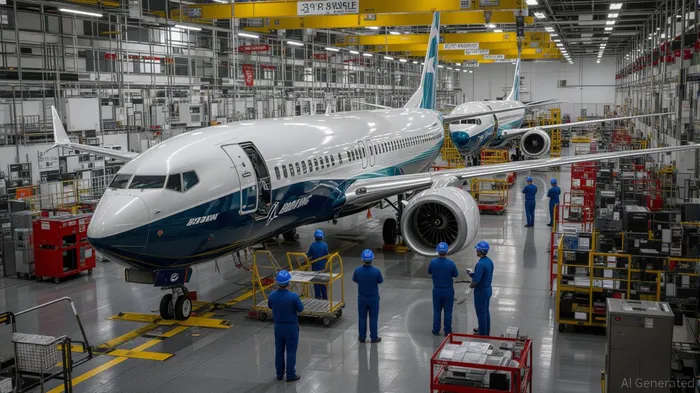
The BoeingBA-- Company (NYSE: BA) has long been a bellwether of the aerospace industry, but its recent struggles with safety crises, production bottlenecks, and regulatory scrutiny have tested its resilience. However, under the leadership of CEO Kelly Ortberg, Boeing appears to be navigating a delicate but meaningful recovery. For investors, the question now is whether this turnaround is sustainable—and if the company's strategic initiatives can translate into durable value creation for shareholders.
A Debt to Discipline: Cash-Flow Improvements Take Shape
Boeing's Q2 2024 financial results marked a turning point. The company reduced its cash burn to $200 million, down from $2.3 billion in the previous quarter and $4.3 billion in Q2 2023. This improvement, while still far from profitability, signals a critical shift in operational discipline. The reduction was driven by production adjustments, tighter cost controls, and a renewed focus on safety and quality—key pillars of Ortberg's turnaround strategy.
The 737 MAX production rate climbed to 38 aircraft per month in Q2 2024, inching closer to the 42-per-month target for mid-2024 and 47 per month by year-end. Commercial deliveries rose to 150 jets in Q2 2024, up from 130 in Q1 and 92 in the same quarter of 2023. While these numbers are still below pre-2023 levels, the trajectory is encouraging. The company's cash reserves stood at $23.0 billion at the end of Q2 2024, a modest decline from Q1 but a stark improvement from previous quarters.
Strategic Shifts: Defense and Innovation as Stabilizers
Boeing's defense segment has emerged as a critical pillar of its financial stability. In Q2 2025, the segment generated $6.4 billion in revenue, a 6.3% year-over-year increase. Long-term contracts like the $14.6 billion KC-46A tanker program and the F-47 fighter jet initiative provide a buffer against the volatility of the commercial aviation sector. This diversification is not just a short-term fix—it's a strategic rebalancing that positions Boeing to capitalize on global defense spending trends.
Meanwhile, the company is investing heavily in digital supply chain forecasting and lean manufacturing processes. These initiatives aim to mitigate risks from supplier volatility and raw material shortages. Boeing's collaboration with the FAA and European regulators to rebuild trust in its safety culture is equally vital. While the Air India 787 crash in June 2024 introduced new scrutiny, the company's proactive approach to quality audits and workforce training may help insulate it from future setbacks.
Shareholder Value: A Cautious Optimism
For shareholders, the path to value creation hinges on Boeing's ability to sustain its current trajectory. The company's 2025 projections suggest a return to positive free cash flow by 2026, which would unlock the potential for dividend reinstatement and buybacks. With a commercial backlog of $544.74 billion, Boeing has a clear runway for future revenue, provided it can maintain production stability.
However, risks remain. The FAA's current production cap of 38 737 MAX units per month must be lifted to meet the 42-per-month target. Delays in certifying the 737 MAX 7 and MAX 10 models could also hamper customer demand. Additionally, the company's debt load—$53.3 billion as of Q2 2024—remains a drag on financial flexibility.
The Verdict: A High-Risk, High-Reward Proposition
Boeing's turnaround is far from complete, but the progress made in 2024 and 2025 is tangible. The reduction in cash burn, the gradual ramp-up in production, and the diversification into defense and space contracts all point to a more disciplined and resilient Boeing. For investors willing to stomach short-term volatility, the company's long-term potential is compelling.
Investment Advice:
- Buy for the long term: If Boeing can maintain its production momentum and continue reducing costs, its $544.74 billion backlog and $10 billion+ projected free cash flow by 2026 could drive significant shareholder value.
- Monitor regulatory progress: The FAA's approval of higher production rates and certification of new models will be critical milestones.
- Diversify your exposure: Given the sector's cyclicality, consider pairing Boeing with more stable aerospace peers like GE AerospaceGE-- or RTX to balance risk.
In the end, Boeing's story is one of reinvention. If the company can prove it has learned from its past missteps and built a sustainable model for the future, it may yet reclaim its position as an industry leader. For now, the path is narrow—but the destination is worth the climb.

Stay ahead of the market.
Get curated U.S. market news, insights and key dates delivered to your inbox.
AInvest
PRO
AInvest
PRO



Comments
No comments yet