
Boeing's Financial Turnaround: A New Era of Stability?
 Aime Summary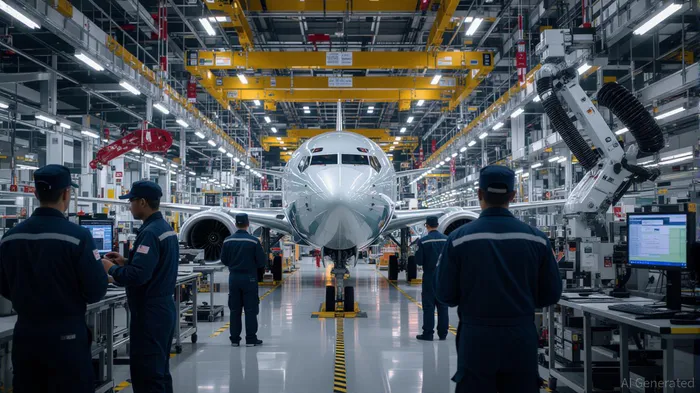
The aerospace giant BoeingBA-- has long been a symbol of both American industrial might and the perils of corporate complacency. For years, its financial health teetered on the edge of collapse, battered by the 737 MAX grounding, pandemic-driven demand shocks, and mounting debt. But recent developments suggest a cautious pivot toward stability. As the global aerospace industry begins to recover, investors are asking: Can Boeing's recent cash flow improvements sustain a long-term turnaround, and is this the right time to bet on its future?
The Cash Flow Comeback: A Mixed Bag
Boeing's 2024 cash flow statement was a disaster, with a net outflow of $14.31 billion driven by operational costs and capital expenditures. By Q2 2025, however, the company nearly halted its cash outflow—a sign that CEO Kelly Ortberg's cost-cutting and production ramp-up strategies are starting to take hold. This shift is critical. While Boeing's stock has surged 34% year-to-date, reflecting optimism about its turnaround, the underlying fundamentals remain fragile.
The company's ability to stabilize cash flow hinges on two pillars: operational discipline and external financing. Boeing has slashed costs through supplier renegotiations, inventory optimization, and AI-driven efficiency tools. For instance, generative AI is now being deployed in forecasting and reporting, reducing manual errors and accelerating decision-making. These measures have trimmed operating costs, but they're a temporary fix. The real test will be whether Boeing can maintain these savings while scaling up production of the 737 MAX and 787 Dreamliner to meet a backlog of over $545 billion in unfilled orders.
Financing the Future: Debt, Equity, and the Risk of Dilution
To survive 2024, Boeing raised $24 billion through equity sales and convertible debt—a move that stabilized its balance sheet but diluted shareholder value. Now, the company is pursuing a $15 billion capital raise, including $10 billion in new shares and $5 billion in mandatory convertible bonds, supported by a $10 billion credit line from Bank of AmericaBAC--, Citibank, Goldman SachsGS--, and JPMorganJPM--. While this provides liquidity, it also raises red flags. Boeing's debt-to-EBITDA ratio is still unhealthily high, and further equity issuance could erode investor confidence.
The company's financing strategy is a double-edged sword. On one hand, it buys time to rebuild cash reserves and service debt. On the other, it exposes Boeing to volatile market conditions. If interest rates remain elevated or demand for commercial aircraft wanes, the cost of refinancing could become prohibitive. For now, Boeing's focus is on reducing leverage by channeling operating cash flow into debt repayment. But with $87.5 billion in inventory on its books, the margin for error is slim.
Production Ramp-Up: A Race Against Time
The key to Boeing's long-term viability lies in its ability to scale production. By mid-2025, the company aims to produce 42 737 MAX units per month—a 50% increase from 2023 levels. This ramp-up is critical for generating the cash flow needed to service debt and fund R&D. However, production bottlenecks, quality control issues, and supply chain constraints could delay these goals.
A recent agreement with the FAA to streamline certification processes offers hope, but the Air India crash in 2025 has reignited regulatory scrutiny. Any further production delays or safety-related setbacks could derail Boeing's turnaround. Investors must also consider the competitive landscape: Airbus, with its stronger balance sheet and more consistent production rates, is gaining market share.
Strategic Diversification and ESG Commitments
Beyond commercial aviation, Boeing is pivoting toward high-margin defense and space contracts, which offer more predictable cash flows. Its recent $12 billion acquisition of a satellite communications firm underscores this shift. Additionally, the company has committed to making its aircraft 100% sustainable aviation fuel (SAF)-capable by 2030—a move that aligns with global ESG trends but requires significant upfront investment.
While these initiatives are promising, they come with risks. Defense and space contracts are capital-intensive, and SAF technology is still unproven at scale. For Boeing to succeed, it must balance short-term survival with long-term innovation—a tightrope walk that has defined its recent history.
Investment Implications: Caution and Opportunity
For investors, Boeing presents a high-risk, high-reward proposition. The company's stock has rallied on the back of improved cash flow and production optimism, but its fundamentals remain shaky. Key metrics to watch include:
1. Free cash flow generation: Can Boeing exceed $10 billion in 2025 as projected?
2. Debt reduction: Is the company on track to lower its debt-to-EBITDA ratio to pre-2020 levels?
3. Regulatory and operational risks: How will the Air India crash and production challenges impact its reputation and costs?
If Boeing can execute its turnaround successfully—scaling production, reducing debt, and maintaining operational discipline—it could reclaim its position as a leader in aerospace. However, any misstep could reignite the financial crisis that nearly sank it in 2024.
Final Verdict: A Calculated Bet
Boeing's recent cash flow improvements are encouraging, but they're just the first step in a long journey. The company's ability to sustain its turnaround will depend on its execution of production plans, its management of debt, and its adaptability in a rapidly evolving industry. For risk-tolerant investors, Boeing offers a compelling story of resilience and reinvention. For others, the risks of regulatory, operational, and financial headwinds may outweigh the potential rewards.
In the end, Boeing's “new era of stability” is far from guaranteed—but if the company can clear its remaining hurdles, the rewards could be substantial.

Stay ahead of the market.
Get curated U.S. market news, insights and key dates delivered to your inbox.




Comments
No comments yet