
Boeing Claims Top Spot in Trading Volume as Sell Rating Hits Stretched Valuation
 Aime Summary
Market Snapshot
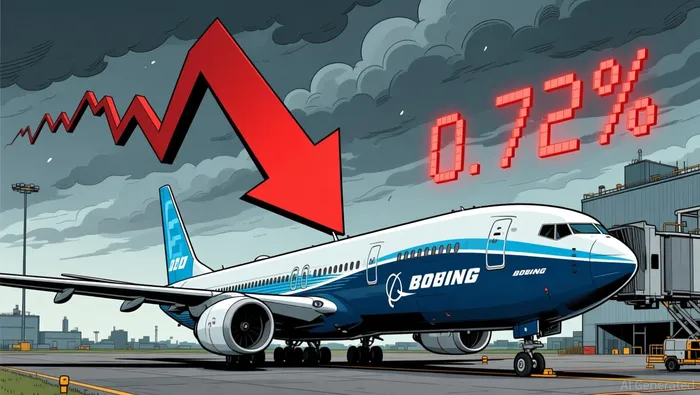
The BoeingBA-- Company (BA) experienced a modest decline in trading activity on September 8, 2026, as the aerospace giant’s stock closed down 0.72%. Despite the downward price movement, the company remained at the center of market attention, recording a total trading volume of $0.93 billion. This substantial turnover placed Boeing’s stock at the number one position for trading volume across the broader market for the day, indicating heightened investor interest and significant liquidity in the shares. The divergence between the high trading volume and the slight negative price action suggests a period of active repositioning among market participants, with sellers maintaining a slight edge in the immediate short term. The heavy volume underscores the continued scrutiny facing the company, as investors weigh operational challenges against long-term industrial demand, resulting in a trading environment characterized by intense debate rather than passive holding.
Key Drivers
The primary catalyst for the recent shift in sentiment surrounding Boeing’s stock is a significant downgrade in analyst ratings, which has introduced a layer of caution to the investment thesis. Specifically, The Boeing CompanyBA-- has been cut to a "Sell" rating, a move driven by concerns regarding the company’s current valuation metrics and its underlying cash flow generation capabilities. Analysts have pointed out that the stock’s valuation appears stretched relative to its fundamental performance, suggesting that the market may have priced in optimistic scenarios that are not yet supported by the company’s financial reality. This downgrade serves as a critical signal to the market, highlighting a disconnect between the stock’s price level and the actual cash generation efficiency of the business operations. The emphasis on "stretched valuation metrics" implies that previous gains may have outpaced the company’s ability to deliver corresponding operational improvements, leading to a reassessment of its fair value.
Compounding the valuation concerns is the broader narrative of lagging cash flow generation, which stands in stark contrast to the robust financial health seen in other sectors of the technology and industrial markets. While Boeing remains a dominant player in the aerospace industry, the recent analyst commentary suggests that the company’s operational execution has not translated into the robust cash flows that investors typically demand for premium valuations. This lag creates a vulnerability in the stock’s profile, as it relies heavily on future growth expectations rather than current financial strength to justify its market cap. The downgrade to "Sell" reflects a strategic shift in perspective, where the focus moves from long-term industry tailwinds to immediate financial metrics that are currently underperforming. This shift forces investors to reconsider the risk-reward ratio of holding Boeing stock in the current economic environment.
The market reaction to this downgrade is further amplified by the broader context of analyst movements across other major corporations, which helps to contextualize Boeing’s relative standing. In the same reporting period, other companies such as Dell Technologies and The Hershey Company received upgrades due to strong earnings beats, expanding margins, and positive guidance revisions. Dell, for instance, saw its rating upgraded to "Buy" following a massive jump in AI server backlog and a significant upward revision to its fiscal year guidance. Similarly, Hershey was upgraded to "Bullish" due to easing commodity pressures and strong execution. In contrast, Boeing’s downgrade to "Sell" highlights a divergent path where operational and financial headwinds are outweighing the positive momentum seen in peers that are successfully executing on their strategic plans.
Furthermore, the contrast with other downgrades, such as that of The Coca-Cola Company, provides additional insight into the market’s current valuation sensitivity. Coca-Cola was also downgraded to "Sell," but for reasons centered on high valuation multiples relative to historical averages and concerns over long-term sustainability due to health regulations and changing consumer preferences. While the specific reasons for Boeing’s downgrade differ, focusing on cash flow and operational valuation rather than regulatory risks, the parallel action by analysts underscores a broader market trend of tightening standards. Investors are increasingly scrutinizing companies for both valuation discipline and operational efficiency, leaving less room for companies that exhibit stretched metrics without clear, immediate justification in their cash flow statements.
In conclusion, the combination of a 0.72% price decline, record-high trading volume, and a new "Sell" rating based on stretched valuations and weak cash flow generation defines the current narrative for Boeing. The market is responding to a recalibration of expectations, where the premium previously associated with the aerospace leader is being challenged by fundamental financial realities. As trading volume remains elevated, the stock is likely to face continued volatility as investors digest the implications of the downgrade and assess whether the company’s operational turnaround efforts are sufficient to close the gap between its current valuation and its actual cash generation performance.

Stay ahead of the market.
Get curated U.S. market news, insights and key dates delivered to your inbox.


AInvest
PRO
AInvest
PRO




Comments
No comments yet