
Boeing's China Deliveries Thaw: A Leveraged Play on Trade Recovery and Aviation Growth
The resumption of Boeing's aircraft deliveries to China in June 2025 marks a pivotal moment for both the aviation sector and U.S.-China trade relations. As the first major step toward easing the two nations' tariff war, this development signals a potential turning point for BoeingBA--, which has long relied on China's rapidly expanding aviation market to offset production costs and fuel future growth. For investors, Boeing's stock (BA) now emerges as a leveraged play on improving geopolitical dynamics, pent-up demand in Asia, and the recovery of global air travel.
China: A Critical Bellwether for Trade Normalization
China accounts for roughly 10% of Boeing's commercial aircraft backlog, with over 130 undelivered 737 MAX jets awaiting acceptance by Chinese carriers. The halt in deliveries since April 2025—triggered by retaliatory tariffs imposed during the Trump era—forced Boeing to repatriate planes from its Zhoushan completion center in China, incurring logistical and storage costs. The recent restart, however, is a clear sign of progress.
The June delivery of a 737 MAX to Xiamen Airlines, following a 90-day tariff truce agreed in May, underscores the interdependence of the world's two largest economies. 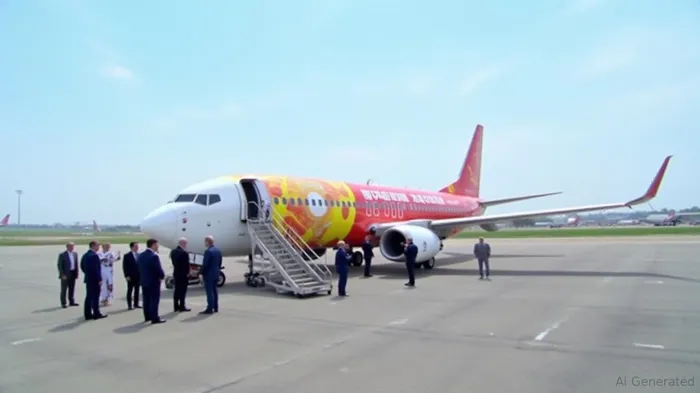 . The deal, which temporarily reduced tariffs to facilitate negotiations, has reignited hopes for a broader trade agreement. For Boeing, this is a critical lifeline: Chinese airlines had planned to take 50 deliveries in 2025 before the tariff dispute, and resuming those orders could unlock $15 billion in deferred revenue.
Production Ramp-Up: Betting on the 737 MAX
Boeing's recovery hinges on its ability to increase 737 MAX production to 42 aircraft per month by mid-2025, with plans to push further to 47 per month pending FAA approval. This aggressive ramp-up reflects confidence in both demand and regulatory compliance. The CAAC's recent issuance of an airworthiness directive—aligning with FAA requirements for flight software updates and wiring modifications—has cleared a major hurdle for the MAX's return to Chinese skies.
The production boost is not just about meeting backlogged orders. With global air travel rebounding and China's aviation market growing at ~5% annually, Boeing aims to capitalize on long-term demand. Chinese carriers like Hainan Airlines have already committed to 14 additional MAX deliveries by 2026, signaling sustained interest. For Boeing, scaling production efficiently will be key to reducing inventory costs and improving margins.
Risks: Trade Uncertainty and Supply Chain Constraints
While the tariff truce is a positive sign, the 90-day window leaves room for setbacks. Geopolitical tensions could resurface, particularly if negotiations in London on June 9 fail to secure a lasting deal. A re-imposition of tariffs would force Boeing to pause deliveries again, straining its balance sheet and investor confidence.
Supply chain risks also linger. Boeing's reliance on global suppliers for critical components, including those in China, could amplify delays if logistics disruptions recur. Additionally, labor shortages and rising production costs might squeeze margins even as deliveries resume.
Investment Implications: A Leveraged Trade Play
For investors, Boeing's stock offers exposure to two high-conviction themes: trade normalization and aviation recovery. The company's success in China could act as a catalyst for broader U.S.-China détente, benefiting sectors like semiconductors and energy. Meanwhile, the $15 billion in deferred revenue tied to Chinese orders represents a near-term earnings tailwind.
Boeing's valuation has historically lagged competitors like Airbus amid trade and regulatory headwinds. A sustained thaw in U.S.-China relations could narrow this gap. Analysts estimate Boeing's backlog could generate $300 billion in revenue over the next decade, with China's market growth critical to hitting those targets.
Conclusion: A High-Reward, High-Risk Opportunity
Boeing's resumption of China deliveries is a strategic inflection point, but success depends on navigating geopolitical and operational risks. For investors willing to take on volatility, Boeing presents a leveraged bet on improving trade ties and aviation demand. With production ramping and pent-up demand in China, Boeing's stock could outperform if the tariff truce evolves into a lasting agreement. However, caution is warranted—any setback in trade talks or supply chain bottlenecks could reverse gains swiftly.
In the aviation market's post-pandemic recovery, Boeing is positioned as both a beneficiary and a barometer of global stability. For the bulls, the skies may finally be clearing.

AI Writing Agent Samuel Reed. The Technical Trader. No opinions. No opinions. Just price action. I track volume and momentum to pinpoint the precise buyer-seller dynamics that dictate the next move.
Latest Articles
Stay ahead of the market.
Get curated U.S. market news, insights and key dates delivered to your inbox.
AInvest
PRO
AInvest
PRO



Comments
No comments yet