
Boeing BA Stock: FAA Penalty Sparks Governance Concerns
 Aime Summary
- Boeing remitted a $3.1 million fine to the Federal Aviation Administration for safety violations linked to the 2024 Alaska Airlines MAX 9 incident.
- The FAA cited widespread quality failures at Boeing's Renton plant and interference with the independence of safety officials.
- The penalty remains undisclosed until September 2026, drawing criticism from lawmakers who view it as an insufficient deterrent.
- Market indicators show mixed signals, with attractive valuation metrics offset by poor financial strength and negative free cash flow.
- Boeing recently secured expanded airworthiness certification authority for its MAX and 787 fleets, signaling a partial regulatory recovery.
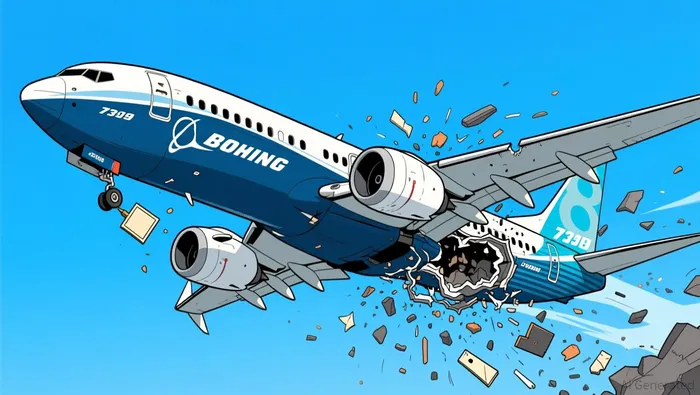
Boeing Co (NYSE: BA) paid a $3.1 million penalty to the Federal Aviation Administration earlier this year, resolving a series of safety violations tied to the high-profile January 2024 Alaska Airlines 737 MAX 9 door-plug blowout. The payment, which was finalized in January, remained entirely undisclosed to the public until Reuters reported on the settlement on Wednesday. The fine, originally proposed by the FAA in September 2025, underscores the lingering regulatory scrutiny facing the aerospace giant as it attempts to rebuild its reputation and restore confidence in its manufacturing processes.
Beyond the specific safety lapses associated with the mid-air emergency, the FAA identified a broader pattern of corporate governance failures. Regulators found that BoeingBA-- employees interfered with the independence of company safety personnel responsible for regulatory oversight. In one documented instance, a Boeing worker pressured a colleague to approve a 737 MAX for delivery despite concerns that the aircraft did not meet safety requirements. These findings build upon previous regulatory actions, including a fine issued last year for similar interference with safety officials' independence.
Is Boeing's $3.1 Million FAA Fine an Adequate Deterrent?
The relatively modest size of the penalty has drawn sharp criticism from lawmakers and safety advocates, who argue that the fine is easily absorbed as a cost of doing business rather than a meaningful deterrent. U.S. Senator Richard Blumenthal explicitly stated that the penalty fails to address the root causes of Boeing's safety culture issues. For an aerospace manufacturer with multi-billion dollar quarterly revenues, a $3.1 million fine represents a fraction of its operational costs, raising concerns about whether financial penalties alone can enforce the necessary cultural shifts within the company.
The violations spanned a period from September 2023 to February 2024, encompassing hundreds of quality system failures at Boeing’s 737 assembly plant in Renton, Washington, and at Spirit AeroSystems’ fuselage factory in Wichita, Kansas. The Alaska Airlines incident, which involved a door plug installed without four essential bolts, triggered a temporary grounding of MAX 9 jets and prompted the FAA to impose a production cap of 38 aircraft per month. While this cap was lifted in October 2025, the persistent regulatory scrutiny highlights the deep-seated challenges Boeing continues to face in ensuring consistent production standards and corporate accountability.
How Does Boeing's Financial Health Impact Investor Outlook?
For investors evaluating Boeing's stock, the regulatory headwinds are compounded by significant fundamental challenges. The company's GF Score™ of 68 out of 100 reflects a dichotomy in its financial profile. While valuation metrics appear attractive, with a price-to-sales ratio of 1.74 sitting below its historical median, the underlying financial strength is rated poorly. Boeing currently operates with a high debt-to-equity ratio of 7.53 and an Altman Z-Score of 1.53, placing it in the distress zone for financial stability.
Furthermore, Boeing remains unprofitable with negative free cash flow, rendering traditional earnings-based metrics like the P/E ratio less relevant for valuation purposes. Insider sentiment has also been cautious, with net selling of $5.3 million over the past 12 months compared to minimal purchases. While 21 premium gurus currently hold the stock, the split between those adding and trimming positions is nearly balanced. Investors must weigh the company's potential for recovery against the ongoing risks of regulatory intervention and operational inefficiencies that continue to weigh on its bottom line.
What Recent Developments Signal Boeing's Path Forward?
Despite the ongoing safety concerns, Boeing has secured some regulatory milestones that could support future production ramp-ups. In July 2026, the FAA allowed Boeing to issue its own airworthiness certificates for all 737 MAX and 787 aircraft following a comprehensive safety review. This expansion of certification authority is a significant step toward normalizing operations, allowing the company to accelerate deliveries without waiting for individual FAA sign-offs on every airframe.
However, the road to full recovery remains uncertain. The company must continue to demonstrate consistent production quality and a robust safety culture to maintain the trust of regulators, airlines, and the traveling public. The recent disclosure of the FAA fine serves as a reminder that while Boeing is making progress, the legacy of the MAX 9 incident continues to cast a long shadow over its operations. Investors should monitor the company's ability to sustain production improvements and navigate the complex regulatory landscape as it seeks to return to profitability.

Stay ahead of the market.
Get curated U.S. market news, insights and key dates delivered to your inbox.


AInvest
PRO
AInvest
PRO




Comments
No comments yet