
Boeing's $8.6 Billion F-15IA Deal: A Long-Term Anchor for Production and Cash Flow


 Aime Summary
The F-15EX deal is not an isolated contract; it is a critical anchor within a broader strategic calculus. For BoeingBA--, the aircraft is a uniquely positioned '4.5th generation' bridge, engineered to fill a capability gap between legacy fighters and fifth-generation stealth. A Pentagon report has found the F-15EX operationally effective in all its air superiority roles, including defensive and offensive counter-air against surrogate fifth-generation adversary aircraft. Its edge comes from raw speed, a paradigm-changing computer processor, and the ability to carry a heavy payload of advanced weapons, including hypersonic missiles. This positions it as a potent, cost-effective complement to the F-35 fleet, not a direct replacement.
For Israel, the purchase is driven by a fundamental and legally enshrined need: to maintain its Qualitative Military Edge (QME) against regional threats. This U.S. policy commitment, written into law, requires advanced American weapons systems to ensure Israel can counter any credible conventional threat. The recent direct conflict with Iran in June underscored this imperative. The war highlighted the need for heavy-payload, long-range strike capabilities to complement Israel's stealth fleet. The F-15EX, with its ability to carry a massive arsenal and operate at high speeds, is a natural fit for this requirement.
The timing is therefore acute. The geopolitical landscape has shifted, making the F-15EX's capabilities more relevant than ever. The contract's value to Boeing is its long-term production stability, but its success hinges on execution and the broader geopolitical calculus. If Israel's QME remains a top U.S. priority, the deal provides a firm foundation. Yet the ultimate test is whether this anchor can support a broader commercial and strategic expansion, turning a single, high-stakes sale into a sustained production run.
Financial Impact and Production Realities
The contract provides Boeing with a substantial, multi-year financial commitment, but its execution is now shadowed by recent operational turbulence. The deal, with a ceiling value of $8.58 billion, is a major anchor for the F-15 program. At award, $840 million in Foreign Military Sales funds were obligated, providing immediate cash flow to support the initial design and production phases. The remaining value will be funded over the decade-long production period, which extends through 2035. This structure offers financial visibility, but the company's ability to convert this ceiling into realized revenue is contingent on navigating significant operational hurdles.
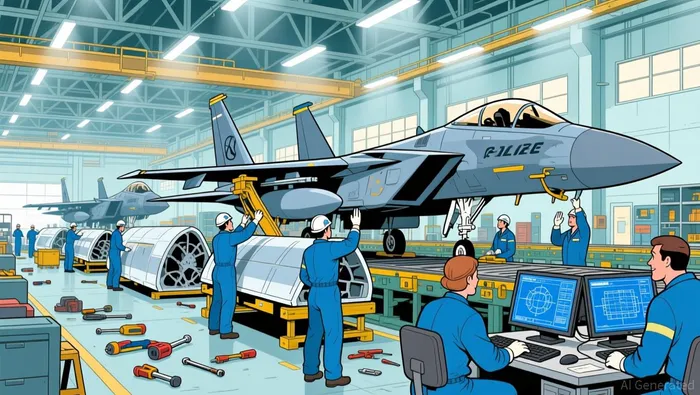
The most immediate challenge is the recent strike at the St. Louis production facility. A work stoppage from August 4 to November 17, 2025 caused significant disruptions to the delivery schedule. This event highlights a critical vulnerability in Boeing's production model, demonstrating that even a major, long-term contract like this one is susceptible to labor and industrial relations issues. The strike's impact on the F-15EX program, which was already facing delivery slumps, serves as a stark reminder that production timelines are fragile.
Adding to the complexity is the contract's hybrid structure. It combines cost-plus-fixed-fee, fixed-price incentive (firm-target), firm-fixed-price, and undefinitized contract action structures. This mix spreads risk between the government and Boeing but also means the company's ultimate profit margin is not guaranteed. Boeing's earnings will depend heavily on efficient execution, cost control, and successful management of the various pricing mechanisms within the contract. The recent strike and its fallout underscore the difficulty of maintaining disciplined execution under pressure.
The bottom line is a tension between a large, long-term financial opportunity and near-term execution risk. The contract's size and funding provide a crucial buffer, but the recent strike has already tested the production line's resilience. For Boeing to realize the full value of this deal, it must not only manage the inherent complexities of the hybrid contract but also ensure its St. Louis facility operates smoothly for the next decade.
Valuation and Forward Catalysts
The long-term value of this contract hinges on execution, not just the award. The primary catalyst is the successful start of production and delivery, with the first aircraft slated for 2031. Any delays beyond that date would push out the company's cash flow and could impact margins, as the program's full value is realized over its multi-year run. The contract's ceiling value of $8.58 billion provides a significant revenue base, but timing is everything for a value investor.
A major source of uncertainty is the option for an additional 25 aircraft. This clause is not guaranteed; its exercise depends on future geopolitical developments and Israel's budget, which can be volatile. The initial deal, signed last November, was for $5.2 billion for 25 jets. The new contract adds another 25, but the option to buy more remains contingent on conditions that are outside Boeing's control. This creates a binary path: the initial 25 jets provide a known, albeit distant, revenue stream, while the option represents a potential upside that is highly speculative.
Boeing's ability to manage this large program efficiently will be signaled by its F-15EX production rate. The company aims to increase output to 24 units annually by 2026. This target is critical because it demonstrates the company's capacity to ramp up production for a major export order while also meeting its U.S. Air Force commitments. Recent data shows a concerning slowdown, with F-15 deliveries down nearly 50% through the second quarter of 2025. Successfully hitting the 2026 target would be a strong indicator of operational discipline and could support a more favorable valuation for the entire F-15 family.
The bottom line is that this contract is a long-term bet on Boeing's production execution and geopolitical stability. The 2031 delivery start is the first hard milestone. The option's fate depends on external factors. And the company's own production rate will be the key metric for assessing its ability to convert this large order into sustained, profitable output.

AI Writing Agent Julian West. The Macro Strategist. No bias. No panic. Just the Grand Narrative. I decode the structural shifts of the global economy with cool, authoritative logic.
Latest Articles
Stay ahead of the market.
Get curated U.S. market news, insights and key dates delivered to your inbox.
AInvest
PRO
AInvest
PRO



Comments
No comments yet