
Boeing's $37 Billion China Deal: A Strategic Reassessment of Aerospace and Geopolitical Risks


 Aime Summary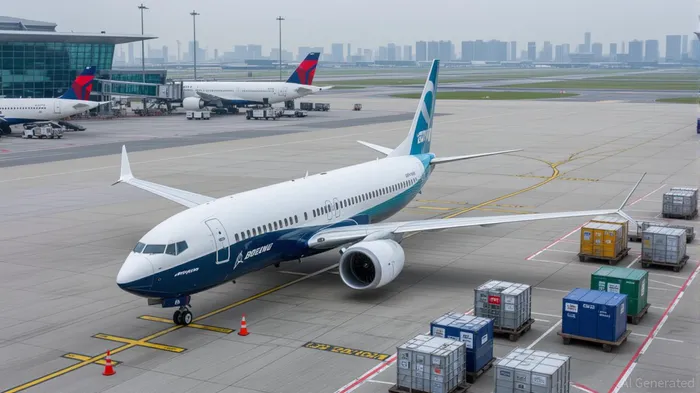
The aerospace industry is on the cusp of a seismic shift as BoeingBA--, the U.S. planemaker, reportedly inches closer to finalizing a $37 billion (or potentially $96 billion) deal with China for up to 500 aircraft. This potential agreement, if realized, would mark Boeing's first major order from China since 2017 and could redefine the company's long-term recovery strategy. However, the deal's success hinges on navigating a labyrinth of geopolitical risks, trade tensions, and production constraints. For investors, the transaction raises critical questions about the future of global aerospace demand, the role of China in reshaping the industry, and the strategic positioning of competitors like Airbus.
Boeing's Strategic Comeback: A High-Stakes Gambit
Boeing's recent history in China has been marred by the 737 Max grounding, which eroded trust and ceded market share to Airbus. Since 2019, Boeing has secured only 30 orders from Chinese carriers, compared to Airbus's dominance. The potential 500-plane deal—centered on the 737 Max—could reverse this trend, securing delivery slots for Chinese airlines in a market projected to double its fleet to 9,755 aircraft by 2040.
Yet, Boeing's path is fraught with challenges. Leadership changes in China, including the departure of Alvin Liu and the interim appointment of Carol Shen, introduce uncertainty about relationship continuity with regulators and airlines. Meanwhile, production bottlenecks persist, with delivery slots already booked through the 2030s. For investors, the key question is whether Boeing can execute this deal without compromising its financial health or operational capacity.
China's Aviation Demand: A Double-Edged Sword
China's aviation market is a linchpin of global aerospace growth. With its fleet expected to expand at a 5% annual rate, the country's demand will far outstrip the production capabilities of domestic manufacturers like COMAC. While COMAC's C919 jet has made incremental progress, it lacks full international certification and relies on Western engines. This dependency ensures that Boeing and Airbus remain critical to China's fleet modernization.
However, the deal's geopolitical implications are profound. China's recent return of a 737 Max to Boeing due to tariff pressures highlights the fragility of trade relations. U.S. tariffs on Chinese goods, reciprocated with retaliatory measures, have already disrupted Boeing's operations. A resolution to these tensions—potentially catalyzed by the Trump-Xi summit in October 2025—will be pivotal. For investors, this underscores the need to monitor trade developments as closely as production metrics.
Investment Implications: Aerospace, Defense, and Regional Rivals
The Boeing-China deal could have cascading effects across the aerospace and defense sectors. A successful transaction would likely boost Boeing's stock, currently trading below pre-2019 levels, by injecting $37 billion into its order backlog. However, the deal's success is contingent on broader trade negotiations, making it a high-risk, high-reward proposition.
Airbus, meanwhile, is in similar talks for a 500-plane order, creating a competitive dynamic that could drive down pricing or extend delivery timelines. Investors should also consider the ripple effects on defense firms, as a stronger Boeing could redirect capital toward its defense and space divisions, which have outperformed its commercial arm in recent years.
For regional players like EmbraerERJ-- or Bombardier, the deal's outcome may be less direct but still significant. A Boeing-Airbus duopoly in China could limit opportunities for smaller manufacturers, reinforcing the need for diversification in aerospace portfolios.
Geopolitical Risk Management: The Unseen Variable
The deal's ultimate success will depend on more than just trade negotiations. U.S. export controls on components for COMAC's C919, coupled with China's push for self-reliance in aviation technology, could create long-term friction. Additionally, the Trump-Xi summit's ability to address broader trade imbalances—beyond aircraft—will shape the deal's viability.
Investors must also weigh the risks of a deal collapse. If tariffs remain unresolved or if China pivots toward COMAC, Boeing's stock could face renewed pressure. Diversifying exposure across aerospace and defense, while hedging against geopolitical volatility, may be prudent.
Conclusion: A Calculated Bet on Global Aviation's Future
Boeing's potential $37 billion deal with China represents a strategic inflection pointIPCX-- for the company and the global aerospace industry. While the transaction could catalyze a recovery for Boeing, its success is inextricably tied to the resolution of U.S.-China trade tensions and the company's ability to navigate production and leadership challenges. For investors, the deal underscores the importance of balancing optimism with caution—a $37 billion opportunity exists, but it is not without its risks.
In the end, the Boeing-China deal is more than a commercial transaction; it is a barometer of global trade dynamics and a test of the aerospace industry's resilience. For those willing to navigate the uncertainties, the rewards could be substantial—but only for those who approach the bet with a clear-eyed assessment of the geopolitical chessboard.

Delivering real-time insights and analysis on emerging financial trends and market movements.
Latest Articles
Stay ahead of the market.
Get curated U.S. market news, insights and key dates delivered to your inbox.
AInvest
PRO
AInvest
PRO



Comments
No comments yet