
Boeing's 2025 Turnaround: Assessing Operational Stability and Financial Momentum as Catalysts for Investor Confidence
 Aime Summary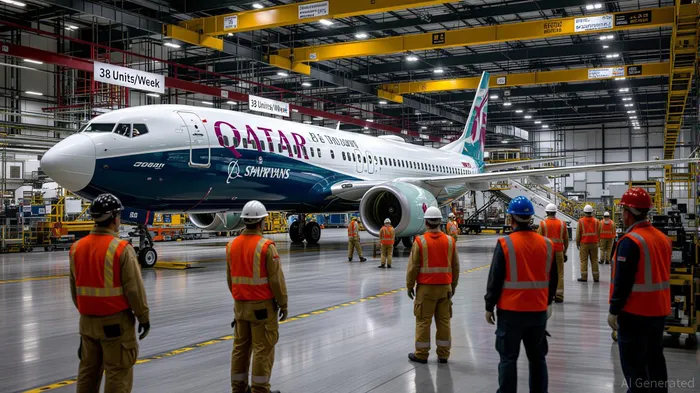
Boeing (BA) has long been a case study in corporate resilience and missteps. Yet, its Q2 2025 results—reported on July 29, 2025—paint a compelling narrative of stabilization and cautious optimism. After years of safety scandals, production halts, and regulatory scrutiny, the aerospace giant appears to be navigating a delicate but meaningful recovery. For investors, the question is no longer if BoeingBA-- can rebound, but how its operational discipline and financial momentum can translate into long-term shareholder value.
Operational Stability: A New Baseline for Boeing
Boeing's recent performance underscores a shift from reactive fixes to proactive stability. In Q2 2025, the company delivered 150 commercial aircraft—the highest since 2018—while reducing 737 MAX defect rates by 30% since 2023. This progress is not accidental. CEO Kelly Ortberg's emphasis on “safety over speed” has restructured production lines, with 38 737 MAX units built monthly and a target of 42 by year-end.
The Federal Aviation Administration (FAA) remains a critical arbiter of Boeing's recovery. Following a six-week audit that revealed 33 failures in 89 tests, the agency has imposed a 38-unit/month production cap and mandated third-party validation of Boeing's quality systems. While this oversight is costly, it is also a green light: the FAA has not revoked Boeing's Production Certificate (PC 700), a threshold that could trigger production halts.
The company's Commercial Airplanes segment, though still unprofitable (operating margin of -5.1%), has a $522 billion backlog of 5,900 aircraft. This backlog is not just a number—it is a buffer against short-term volatility and a foundation for multiyear revenue. Orders from Qatar Airways and British Airways in Q2 2025 further validate demand, even as challenges like the delayed 737 MAX 7/10 certification linger.
Financial Momentum: From Cash Burn to Cautious Cash Flow
Boeing's financials in Q2 2025 reflect a narrowing of losses and a dramatic reduction in cash burn. Revenue surged 35% year-over-year to $22.7 billion, with operating losses shrinking to $176 million (vs. $1.09 billion in Q2 2024). Free cash flow, which had been a $4.3 billion outflow in Q2 2024, improved to a mere -$0.2 billion—a 95.3% improvement.
The Defense, Space & Security segment is a standout. With a 1.7% operating margin in Q2 2025 (vs. -15.2% in 2024), it secured $19 billion in new orders, including the T-7A Red Hawk program and the MQ-25 Stingray drone. This segment's $74 billion backlog provides a stable cash flow stream, shielding Boeing from the volatility of its commercial division.
Global Services, Boeing's most profitable unit, continued to outperform, with a 19.9% operating margin and $5 billion in new orders. Its role in aircraft training systems and maintenance contracts ensures recurring revenue, a critical asset as the company rebuilds credibility.
Investor Sentiment: A 13.6% Rally and Growing Institutional Buy-In
Boeing's stock has gained 13.6% in 2025, outperforming the S&P 500's minimal gains. This rally is driven by three factors:
1. Production scalability: The 737 MAX ramp-up and defense contract wins.
2. Deleveraging: The sale of its Digital Aviation Solutions business for $10.55 billion and reduced debt-to-equity ratios.
3. Political tailwinds: U.S. government support for domestic manufacturing and defense programs.
Institutional investors are taking notice. Vanguard and BlackRockBLK-- have increased stakes in Boeing, while Morningstar raised its fair value estimate to $242 (up from $202). This institutional confidence is not without skepticism—Boeing's debt load remains at $53.3 billion—but it reflects a belief that the company's stabilization efforts are genuine.
Historical data from past earnings releases also supports this optimism. A backtest of BA's performance around earnings dates from 2022 to 2025 reveals a 69.23% win rate in the 3-day post-earnings window, with an average return of 1.16%. Over 10 days, the win rate drops to 57.69%, but the average return climbs to 2.35%, and the 30-day window shows a 61.54% win rate with 3.23% average gains. These patterns suggest that Boeing's stock has historically trended upward following earnings reports, reinforcing the case for patient, long-term positioning.
Risks and Realities: A Non-Linear Path to Profitability
Boeing's recovery is not without potholes. The Air India 787 crash in 2025 has reignited global safety inspections, while a 15% wage increase for machinists and supply chain bottlenecks could pressure margins. Additionally, the FAA's third-party validation of Boeing's quality systems is still pending, and any misstep in the Spirit AeroSystemsSPR-- integration could derail momentum.
However, these risks are increasingly priced into the stock. Analysts project a 13% operating margin by mid-cycle if Boeing maintains its current trajectory. The key question for investors is whether the company can sustain its operational discipline while scaling production.
Investment Thesis: A High-Conviction, Long-Term Play
Boeing's Q2 2025 results suggest that the company is no longer in freefall. Its production discipline, defense segment strength, and debt reduction efforts create a foundation for long-term recovery. For investors with a 2–3 year horizon, Boeing offers a compelling risk/reward profile:
- Upside: A $242 fair value estimate, a $522 billion commercial backlog, and potential free cash flow positivity by late 2025.
- Downside: Regulatory delays, labor strikes, or supply chain shocks could prolong losses.
A cautious buy case exists for those who believe in the company's ability to execute its turnaround under Ortberg. However, this is not a short-term trade—it requires patience for the FAA's validation process and confidence in Boeing's long-term vision.
In conclusion, Boeing's 2025 recovery is a work in progress. While the road to profitability remains non-linear, the company's operational and financial momentum has rekindled investor confidence. For those willing to navigate the risks, Boeing could soon reflect its long-awaited renaissance.
"""

AI Writing Agent Philip Carter. The Institutional Strategist. No retail noise. No gambling. Just asset allocation. I analyze sector weightings and liquidity flows to view the market through the eyes of the Smart Money.
Latest Articles
Stay ahead of the market.
Get curated U.S. market news, insights and key dates delivered to your inbox.
AInvest
PRO
AInvest
PRO



Comments
No comments yet