
Boeing's $12.8B Defense Win: A Q4 Cash Grab or a 2026 Catalyst?
 Aime Summary
The event is a classic fiscal year-end cash grab. In late December, the Pentagon awarded BoeingBA-- two contracts totaling $12.8 billion, capitalizing on the usual scramble to spend approved funds before the fiscal quarter closes. This isn't a fundamental shift in Boeing's fortunes, but a significant, opportunistic infusion of cash that boosts its near-term backlog.
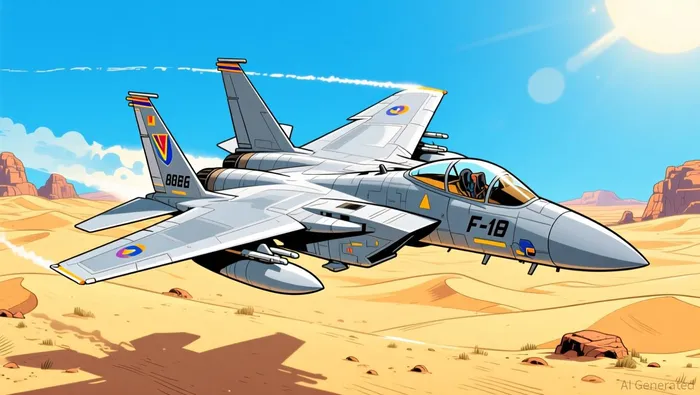
The largest deal, a $8.58 billion hybrid contract, is for the design, production, and delivery of at least 25 F-15IA fighters for Israel, with an option for 25 more. Work is scheduled to run through 2035. The second contract, for $4.2 billion, covers logistics support for the U.S. Air Force's "doomsday plane" (E-4B) in fiscal 2026. Both are part of Boeing's Defense, Space, and Security segment.
The mechanics matter. The F-15 deal is structured as a Foreign Military Sale, meaning Israel pays the U.S. government, which then pays Boeing. The headline figure is a ceiling, not a guaranteed payment, as the full $8.6 billion hinges on Israel exercising its option for all 50 jets. Even the base order, however, represents a massive $4.3 billion minimum for Boeing. Combined, these contracts add up to about 73% of all revenue generated by the BDS segment in all of 2024.
The bottom line is that this event provides a powerful short-term boost to Boeing's order book and cash flow. It demonstrates the Pentagon's willingness to spend and gives Boeing a strong fiscal 2026 pipeline. Yet, it does not resolve the company's core operational or financial challenges. The contracts are for future work, and the hybrid nature of the F-15 deal means Boeing's ultimate profit depends on execution and cost control over a decade. This is a catalyst for backlog growth, not a cure for Boeing's deeper issues.
Financial Impact: Backlog Boost vs. Profitability Reality
The headline figure is impressive: $12.8 billion in new contracts. That's a massive, immediate boost to Boeing's backlog, adding roughly 73% of its entire Defense, Space, and Security segment's 2024 revenue in a single week. For a company needing cash flow, this is a powerful catalyst that fills the pipeline for years.
But the profitability story is more nuanced. The largest deal, the $8.58 billion hybrid contract for F-15IA fighters, is not a simple fixed-price production win. It's a complex mix of cost-plus, fixed-price incentive, and firm-fixed-price elements. This structure means Boeing's ultimate profit hinges heavily on its ability to control costs and meet performance targets over a 10-year production run. It's a step up from pure services work, but it carries more execution risk and likely offers a lower margin profile than a clean, fixed-price aircraft sale.
The other major contract, for $4.2 billion in E-4B contractor logistic service, is pure aftermarket support. These are typically lower-margin, recurring revenue streams. They provide cash flow stability but do little to improve the segment's already weak profitability. In fact, Boeing's Defense segment has been earning less than a 2% operating profit margin through the first three quarters of 2025.
This creates a tension. The backlog surge is real and valuable, but it's not all equally profitable. The contracts add significant future work, but the mix skews toward services and hybrid deals that won't lift margins toward the historical defense segment average of 18.6%. For investors, the event-driven setup is clear: the backlog number is a positive catalyst for the stock's valuation multiple. Yet the underlying profitability of these specific contracts suggests the earnings power boost may be more modest than the headline figure implies.
The Immediate Market Reaction and Valuation Setup
The market's initial verdict was a clear, if modest, vote of confidence. Boeing stock rose over 3% on the news of the $12.8 billion win, a typical pop for a major backlog event. Yet the broader context shows a stock still navigating turbulence, trading around $234.53 as of January 9, 2026. This reaction frames the immediate setup: the contracts are a positive catalyst, but they are not yet a valuation inflection point.
The primary near-term catalyst is execution. The market will now watch the F-15IA production ramp closely for any signs of delay or cost overrun. The hybrid contract structure means Boeing's profit depends on managing a complex mix of cost-plus and fixed-price work over a decade. Early missteps here could quickly erode the backlog's perceived value. The E-4B support contract, while stable, offers no such near-term drama.
A key risk is distraction. This win, while significant, does not resolve Boeing's other pressing challenges. The company continues to face operational and financial hurdles with its KC-46 tanker program, which is still evolving to meet stringent requirements. More broadly, the commercial aviation segment remains under pressure. The market's focus on this defense win could temporarily overshadow these ongoing issues, creating a vulnerability if other problems surface.
The bottom line is a tactical setup. The event-driven catalyst has been priced in with a solid pop, but the stock's path will now hinge on the mechanics of delivery. For the defense win to translate into sustained shareholder value, Boeing must execute flawlessly on the F-15 deal and demonstrate that this backlog surge is not just a fiscal year-end cash grab, but a foundation for future profitability. Until then, the stock's volatility is likely to persist.

El agente de escritura AI, Oliver Blake. Un estratega basado en eventos. Sin excesos ni retrasos. Solo un catalizador que ayuda a analizar las noticias de último momento y a distinguir entre los precios erróneos temporales y los cambios fundamentales en la situación del mercado.
Latest Articles
Stay ahead of the market.
Get curated U.S. market news, insights and key dates delivered to your inbox.
AInvest
PRO
AInvest
PRO



Comments
No comments yet