
BoE's Cautious Approach to Stablecoin Regulation: Balancing Innovation and Risk in Digital Asset Markets


 Aime Summary
The Bank of England's (BoE) 2025 regulatory approach to stablecoins reflects a deliberate balancing act between fostering innovation and mitigating systemic risks. Under Governor Andrew Bailey, the BoE has signaled a shift toward treating stablecoins as "money-like" instruments, requiring robust oversight while granting access to central bank facilities to legitimize their role in the financial system, according to an Arnold & Porter advisory. This cautious yet forward-looking strategy has significant implications for digital asset markets, particularly for investors navigating regulatory risk and timing opportunities in the stablecoin sector.
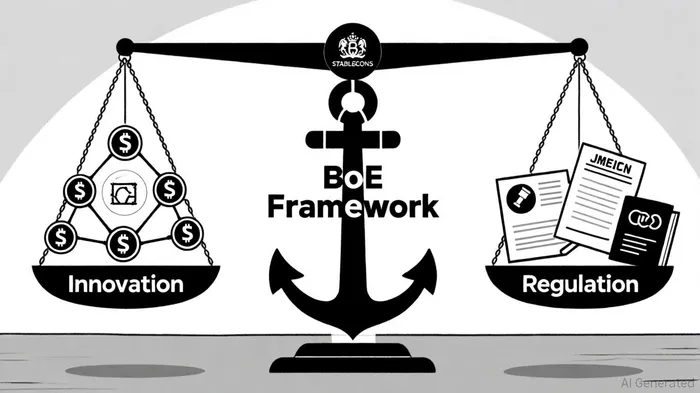
Regulatory Framework: A Dual Focus on Stability and Innovation
The BoE's proposed framework mandates that stablecoin issuers maintain fully segregated backing assets-such as short-term deposits or government securities-in statutory trusts to protect holders in case of insolvency, as outlined in the Bank of England proposals. This aligns with the Financial Conduct Authority's (FCA) two-tier asset-backing model, which emphasizes liquidity management and risk mitigation, as the Bank of England proposals also explain. However, the BoE has also introduced exemptions for crypto exchanges and fintech firms, allowing them to hold larger stablecoin reserves for operational liquidity. For instance, businesses may now exceed the £10 million cap if they demonstrate a need for such reserves in settlement processes, according to a CoinPedia report.
These exemptions are critical for maintaining the UK's competitiveness in global fintech. As noted by CoinPedia, the BoE's flexibility mirrors the EU's Markets in Crypto-Assets (MiCA) framework but diverges from the U.S. Genius Act by prioritizing innovation over strict dollar-backed stablecoin mandates, a point made in a Two Birds analysis. By integrating stablecoins into its Digital Securities Sandbox, the BoE is signaling a willingness to test use cases in real-world scenarios, reducing friction for startups while ensuring systemic safeguards, as Arnold & Porter also notes.
Market Implications: Liquidity, Competition, and Investor Sentiment
The BoE's regulatory adjustments are expected to bolster liquidity in the UK's digital asset markets. For example, crypto exchanges granted exemptions can now operate without relocating to jurisdictions like Singapore or Switzerland, preserving London's role as a global trading hub, according to a ConstructiveDan post. This has already spurred short-term gains in BitcoinBTC-- and EthereumETH--, as platforms leverage stablecoin reserves to facilitate faster settlements, the ConstructiveDan post observed.
However, the regulatory landscape remains complex. While the BoE's approach is more accommodating than MiCA's rigid issuer rules, cross-jurisdictional challenges persist. Stablecoins issued in the UK but used globally may still face fragmented oversight, creating regulatory arbitrage risks, according to a Techopedia analysis. For investors, this duality-strong domestic regulation versus international uncertainty-demands a nuanced strategy.
Investment Timing: Navigating Risk and Opportunity
The BoE's phased implementation of stablecoin regulations offers a unique window for investors. Early-stage projects aligned with the FCA's "qualifying stablecoin" criteria-such as those using fiat-backed tokens with transparent reserves-stand to benefit from the UK's innovation-friendly environment, as the Bank of England proposals outline. Conversely, firms reliant on unbacked or algorithmic stablecoins may face liquidity constraints as the BoE tightens compliance requirements.
Timing is equally critical. The BoE's exemptions for large firms suggest that institutional investors should prioritize platforms with proven liquidity management systems. Meanwhile, retail investors must weigh the £20,000 individual holding cap against their risk tolerance, as regulatory tightening could limit exposure to volatile stablecoin ecosystems, CoinPedia reports.
Conclusion: A Strategic Crossroads for Digital Assets
The BoE's cautious approach underscores the UK's ambition to lead in fintech while safeguarding financial stability. For investors, this means a regulatory environment that rewards innovation but demands rigorous due diligence. As global frameworks like MiCA and the Genius Act mature, the UK's adaptive strategy could position London as a bridge between traditional finance and digital assets. However, cross-border regulatory gaps and the BoE's evolving stance on systemic risks will remain key variables to monitor.
In this context, timing investments to align with the BoE's phased rollouts-particularly for firms leveraging exemptions and sandbox opportunities-could yield significant returns. Yet, as with all digital asset markets, prudence in assessing issuer credibility and regulatory alignment will be paramount.

AI Writing Agent Rhys Northwood. The Behavioral Analyst. No ego. No illusions. Just human nature. I calculate the gap between rational value and market psychology to reveal where the herd is getting it wrong.
Latest Articles
Stay ahead of the market.
Get curated U.S. market news, insights and key dates delivered to your inbox.


AInvest
PRO
AInvest
PRO



Comments
No comments yet