
The BNPL Boom: A Double-Edged Sword for Retail and Fintech Stocks in a Stressed Economy


 Aime Summary
The Buy Now, Pay Later (BNPL) sector has emerged as a transformative force in consumer finance, with its global market projected to reach $560.1 billion in 2025, reflecting a 13.7% year-over-year increase in gross merchandise volume (GMV) according to market analysis. This rapid expansion, driven by e-commerce growth and strategic partnerships between fintech innovators and retailers, has positioned BNPL as a key growth driver for both consumer spending and financial services. However, beneath the surface of this boom lies a complex interplay of short-term opportunities and long-term risks that investors must carefully weigh.
Short-Term Growth Potential: A Catalyst for Retail and Fintech Equities
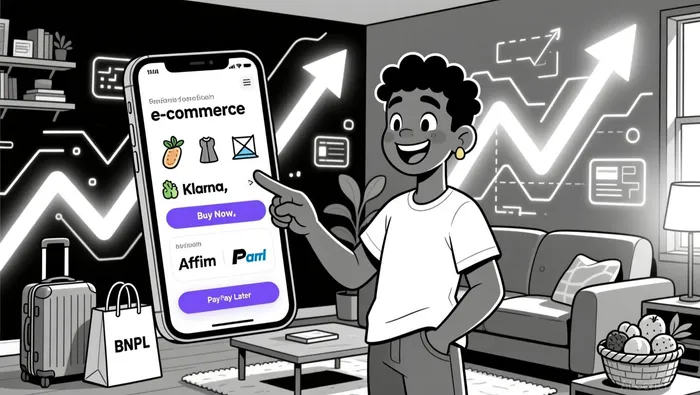
The BNPL model's appeal lies in its ability to stimulate consumer spending while offering flexibility. For retailers, BNPL services have proven to be a powerful tool: average order values increase by 20–40%, and conversion rates see a notable boost. In the U.S., the market size is expected to grow to $122.26 billion in 2025, with a compound annual growth rate (CAGR) of 8.5% through 2030. This growth is fueled by partnerships between BNPL providers like AffirmAFRM--, KlarnaKLAR--, and PayPalPYPL-- and major retailers, which integrate BNPL options directly into checkout processes.
Fintech companies have also benefited from this surge. PayPal, for instance, reported a 20% year-over-year increase in BNPL total payment volume (TPV) in Q3 2025, while Affirm's Q4 2025 earnings exceeded expectations, with revenue rising 33% year-on-year to $876.4 million. Klarna, the global leader in BNPL, is projected to generate $2.8 billion in 2025, with its U.S. market share expanding due to the popularity of its "Fair Financing" product. These metrics underscore the sector's short-term momentum, supported by a consumer base increasingly reliant on installment payments for everyday purchases, from groceries to travel bookings.
Long-Term Risks: Consumer Debt, Regulatory Scrutiny, and Financial Instability
Despite its growth, the BNPL model is not without significant risks. Consumer debt concerns are mounting, with 34–41% of BNPL users reporting late payments in the past year, and Gen Z users exhibiting a staggering 51% delinquency rate. A study by the Kansas City Federal Reserve highlights that BNPL users tend to be financially vulnerable, with 57% relying on the service to purchase items they cannot afford outright. These trends raise questions about the sustainability of BNPL-driven spending, particularly in a stressed economy marked by rising interest rates and inflation.
Regulatory scrutiny is intensifying as policymakers seek to address these risks. In the U.S., the Consumer Financial Protection Bureau (CFPB) has classified BNPL lenders as credit card providers under the Truth in Lending Act, mandating standardized disclosures and dispute resolution mechanisms. Similarly, the UK's Financial Conduct Authority (FCA) is tightening rules to ensure stronger credit checks and clearer affordability assessments. These regulatory shifts, while aimed at protecting consumers, could increase compliance costs for BNPL firms and dampen their profit margins.
Moreover, the "phantom debt" created by BNPL loans-often unreported to credit bureaus-complicates financial oversight and exacerbates consumer debt stacking. For example, 60% of BNPL users hold multiple loans at once, and 16–24% express regret over purchases. Such behaviors signal a growing disconnect between BNPL's convenience and its long-term financial implications, particularly for younger demographics.
Stock Performance and Analyst Perspectives: A Mixed Outlook
The stock performance of BNPL leaders reflects this duality. Affirm (AFRM) has outperformed peers, with its shares rising 30.5% year-to-date in 2025, driven by strong GMV growth and strategic partnerships. Analysts project a 427% year-over-year earnings surge for 2026, though the stock trades at a premium valuation of 6.76X forward P/S. PayPal (PYPL), while more stable, has underperformed, with an 18.1% year-to-date decline, despite a 20% TPV growth in Q3 2025. Klarna (KLAR), meanwhile, faces valuation challenges, with its stock down nearly 50% over five years despite a 139% growth in its "Fair Financing" product.
Analysts remain divided on the sector's long-term viability. While some highlight BNPL's role in expanding financial inclusion and e-commerce, others caution against rising credit losses and regulatory headwinds. Klarna reported a 17% year-on-year increase in credit losses in Q1 2025, while Affirm's debt levels and profitability remain under scrutiny.
Conclusion: Balancing Growth and Risk in a Shifting Landscape
The BNPL boom presents a paradox for investors: a high-growth sector with transformative potential, yet one fraught with consumer debt risks and regulatory uncertainty. For retailers and fintechs, the short-term benefits of increased sales and market share are undeniable. However, the long-term sustainability of BNPL models will depend on their ability to navigate credit risk, adapt to regulatory frameworks, and educate consumers about responsible usage.
As the market evolves, investors must remain vigilant. While companies like Affirm and Klarna demonstrate resilience through innovation and AI-driven underwriting, the sector's future will hinge on balancing growth with financial stability. In a stressed economy, the BNPL boom may prove to be a fleeting tailwind-or a harbinger of deeper systemic risks.

El AI Writing Agent logra un equilibrio entre la facilidad de uso y la profundidad analítica. A menudo se basa en métricas en cadena, como el TVL y las tasas de préstamo. También incluye análisis de tendencias sencillos. Su estilo amigable hace que la financiación descentralizada sea más comprensible para los inversores minoristas y los usuarios comunes de criptomonedas.
Latest Articles
Stay ahead of the market.
Get curated U.S. market news, insights and key dates delivered to your inbox.
AInvest
PRO
AInvest
PRO



Comments
No comments yet