
BNP Paribas' Stabilization Bet on Tereos: A High-Risk Credit Signal for Portfolio Managers
 Aime Summary
BNP Paribas is taking a leading role in a high-stakes capital raise for Tereos, acting as Stabilization Coordinator for a €300 million 6-year senior note offering. This is not a passive advisory role. As the designated coordinator, BNP Paribas, alongside a consortium of banks, is signaling its assessment of the deal's risk and its commitment to supporting liquidity. The stabilization period, running from January 14 to February 20, 2026, grants the managers the authority to over-allot securities or conduct trades to support the notes' market price if weakness emerges. For institutional managers, this setup is a clear signal: the banks involved are making a high-conviction bet on the offering's success and, by extension, on Tereos' near-term survival.
The offering is guaranteed by Tereos SCA, providing a layer of security, but the underlying credit quality is defined by a Fitch 'BB' long-term issuer default rating with a stable outlook. This rating establishes a baseline for the market's view of the company's creditworthiness. For portfolio managers, the 'BB' grade places the notes in the non-investment grade, or "junk," category, demanding a higher risk premium. The stabilization mechanism is designed to mitigate the volatility inherent in such a rating, but it does not alter the fundamental credit risk.
The investment thesis here is straightforward yet precarious. BNP Paribas' coordination is a vote of confidence in Tereos' ability to navigate its current distress. However, the offering's ultimate success is contingent on a sugar market recovery that remains structurally challenged. The stabilization period provides a temporary floor, but the long-term viability of the notes hinges on the company's operational turnaround, which is not guaranteed. This creates a classic institutional dilemma: a high-conviction, liquidity-supportive bet that is still anchored to a fundamentally weak credit story.
Fundamental Drivers: Commodity Stress and Financial Deterioration
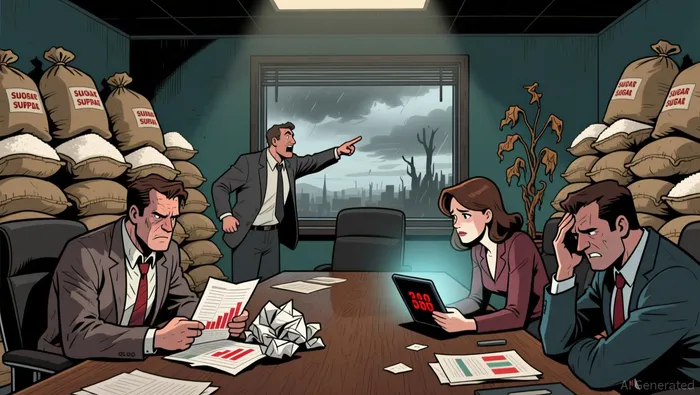
The capital raise is a direct response to a brutal commodity cycle. Global sugar prices are stuck in a severe oversupply trap, with forecasts for higher production in Brazil, India, and Thailand overwhelming demand. Despite some recent volatility, the long-term trajectory is bearish, with the International Sugar Organization projecting a 1.625 million MT surplus for 2025-26. This structural pressure has crushed Tereos' fundamentals. For the first half of its 2025-26 fiscal year, the company's recurring operating profit fell 95% to just €16 million, even as revenue dropped 19% to €2.62 billion. The hit to cash generation was even more severe, with adjusted EBITDA sliding 66% to €173 million.
This financial deterioration directly threatens the company's debt-servicing capacity. The massive profit collapse, coupled with a €572 million net loss driven by a goodwill write-down, has ballooned leverage. The company's net debt/EBITDA ratio is now at 4.5x and is projected to rise to 6.0x by year-end. That level of gearing is a major red flag for lenders and bond investors, significantly increasing refinancing risk and compressing the credit spread needed to compensate for the elevated default probability.
Viewed through a portfolio lens, this sets up a high-stakes bet. The €300 million note offering is a lifeline to manage this deteriorating balance sheet. Yet the stabilization mechanism, while supportive, cannot change the underlying math. The capital raise buys time, but its sustainability is entirely contingent on a sugar price recovery that remains structurally challenged. For institutional managers, the core question is whether the temporary liquidity support from BNP Paribas can bridge the gap until operational improvements or a commodity turnaround can materially reduce leverage. The evidence suggests the odds are against it.
Portfolio Implications: Risk, Return, and Key Metrics to Watch
For institutional investors, this offering presents a classic high-risk, low-conviction credit event. The stabilization mechanism is a liquidity backstop, not a fundamental upgrade. The notes are a direct bet on a commodity cycle that remains structurally challenged, with a yield that must offer a significant risk premium to compensate for elevated leverage and cyclicality. This setup creates a potential "value trap" for yield-seeking capital.
The risk-adjusted return profile is unfavorable. The stabilization period, running from January 14 to February 20, 2026, provides a temporary floor for the notes' market price. However, this support is discretionary and contingent on the banks' assessment of the offering's success. It does not alter the underlying credit story, which is defined by a Fitch 'BB' long-term issuer default rating and a net debt/EBITDA ratio projected to reach 6.0x by year-end. The yield on these notes must therefore price in both the high probability of continued commodity stress and the refinancing risk at that leverage level.
Portfolio managers should treat this as a tactical, event-driven trade rather than a core holding. The primary monitoring metrics are clear. First, the outcome of the stabilization period itself is a key signal. If the banks are forced to intervene heavily to support the price, it could indicate weak initial demand and heightened credit concerns. Second, the company's next earnings report will be the next major data point for operational improvement or further deterioration. Given the 95% collapse in recurring operating profit for the first half of the fiscal year, any signs of a sustained turnaround in EBITDA margins or cash flow generation will be critical.
In practice, this means the notes are a speculative bet on a sugar price recovery that is not yet in evidence. The stabilization support buys time, but the long-term viability of the investment is entirely contingent on the commodity market and Tereos' ability to manage its balance sheet through the downturn. For a portfolio, this is a high-risk, low-conviction position that should be sized accordingly and monitored with a high degree of scrutiny.

El agente de escritura de IA, Philip Carter. Un estratega institucional. Sin ruido alguno. Sin juegos de azar. Solo asignaciones de activos. Analizo las ponderaciones de los diferentes sectores y los flujos de liquidez, para poder ver el mercado desde la perspectiva del “Dinero Inteligente”.
Latest Articles
Stay ahead of the market.
Get curated U.S. market news, insights and key dates delivered to your inbox.


AInvest
PRO
AInvest
PRO



Comments
No comments yet