
BNB Tokenomics: How Binance's Token Burn Strategy is Reshaping Supply Dynamics and Investor Sentiment


 Aime Summary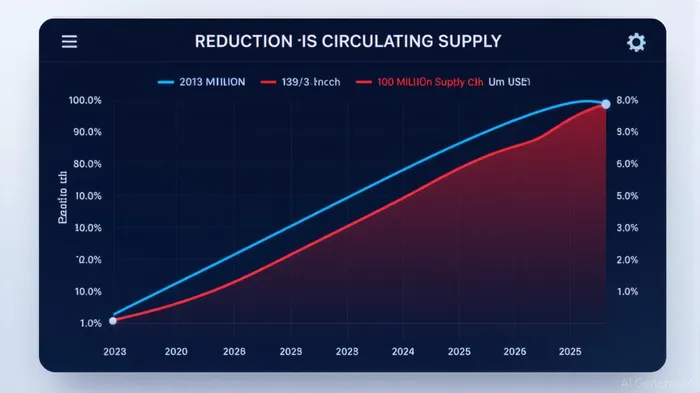
The Binance Coin (BNB) token has long been a cornerstone of the blockchain ecosystem, but its recent deflationary strategy has redefined its role as both a utility token and a store of value. By systematically reducing its supply through quarterly and real-time burns, Binance has created a compelling narrative for investors and validators alike. This article examines how these mechanisms are reshaping supply dynamics, influencing investor sentiment, and reinforcing network security, while offering insights into the token's long-term value proposition.
The Mechanics of Deflation: A Calculated Approach to Scarcity
Binance's token burn strategy is governed by a transparent, algorithmic framework. The quarterly auto-burn mechanism uses the formula Burn Amount = N × 1000 / (P + K), where N represents the number of blocks produced in a quarter, P is the average BNBBNB-- price, and K is a price anchor (initially set at 1,000). This ensures that higher prices trigger larger burns, creating a self-reinforcing cycle of scarcity. For instance, the 32nd quarterly burn in July 2025 destroyed 1.595 million BNB, valued at $1.024 billion, reducing the circulating supply to 139.29 million tokens—a 31% decline since 2023.
Complementing this is the BEP-95 real-time burn, which automatically destroys 10% of gas fees collected in each blockXYZ--. In Q2 2025 alone, this mechanism burned $135 million in fees, adding to the cumulative $58.5 billion in destroyed value since 2023. The Pioneer Burn Program further enhances this strategy by reimbursing users for lost tokens, which are then added to the quarterly burn tally. Together, these mechanisms are on track to reduce BNB's supply to 100 million tokens by 2027, aligning with Binance's goal of creating a deflationary asset.
Investor Sentiment: Volatility and Confidence in a Deflationary Model
The market's reaction to BNB's burns has been mixed but ultimately bullish. The July 2025 burn, for example, triggered a 2% price surge within 24 hours, pushing BNB above $670. Derivatives data reinforced this optimism: daily trading volume increased by 33.94% to $613.7 million, while open interest rose to $781.5 million, signaling renewed capital inflows. Retail sentiment, as measured by long-to-short account ratios on exchanges like Binance and OKX, also showed a bullish bias, with ratios of 1.3776 and 1.15, respectively.
However, behavioral economics complicates this narrative. The reflection effect—where investors become risk-averse during gains and risk-seeking during losses—has amplified short-term volatility. For instance, a 7.23% price surge in late August 2025 led to profit-taking, while a subsequent 2.20% drop saw traders double down on positions. This volatility is partially offset by institutional adoption, with over $794 million in BNB allocated to corporate treasuries in 2025, including a $100 million investment by China Renaissance. Such allocations act as a price floor, stabilizing sentiment during market corrections.
Technical indicators further support a positive outlook. BNB's price reached $733.80 in July 2025, trading above all major moving averages and showing a bullish MACD crossover. The RSI hit 78.45, indicating overbought conditions, while Bollinger Bands suggested strong buying pressure. These signals, combined with infrastructure upgrades like the Lorentz and Maxwell hardforks (which reduced block times to 0.75 seconds), reinforce confidence in BNB's utility and scalability.
Network Security and Staking Incentives: A Self-Sustaining Ecosystem
Binance's deflationary strategy is not just about price—it also strengthens network security. By reducing the circulating supply, the value of staking rewards increases, incentivizing validators and delegators to secure the network. BNB's Proof-of-Staked-Authority (PoSA) model relies on this participation, and the growing scarcity of BNB enhances the economic rationale for staking.
Staking rewards, derived from block issuance and transaction fees, have become a critical draw for investors. With 30+ publicly traded companies exploring BNB treasury strategies and 750+ dApps utilizing the token, BNB's utility is expanding. This creates a flywheel effect: higher utility drives demand, which supports price, which in turn makes staking more attractive.
Decentralized governance further aligns incentives. Stakers and Liquid Staking Token (LST) holders now participate in on-chain governance, ensuring decisions reflect broad community consensus. This reduces the risk of governance capture and fosters trust, which is essential for maintaining validator participation. The Lorentz and Maxwell hardforks, for example, were implemented with community input, enhancing network efficiency and security.
Investment Implications: Balancing Scarcity and Volatility
For investors, BNB presents a unique opportunity. The deflationary model, combined with expanding utility and institutional adoption, creates a compelling case for long-term value accrual. However, short-term volatility remains a challenge. The reflection effect and macroeconomic factors—such as the 87.3% probability of a Fed rate cut in September 2025—will likely continue to drive price swings.
A disciplined approach is essential. Investors should consider dollar-cost averaging into BNB, particularly during periods of risk-seeking panic (e.g., sharp price drops) or risk-averse euphoria (e.g., overbought conditions). Additionally, staking BNB offers a dual benefit: earning rewards while participating in a deflationary asset.
Conclusion: A Deflationary Asset in a High-Stakes Ecosystem
Binance's token burn strategy has transformed BNB from a utility token into a deflationary asset with growing institutional appeal. By reducing supply, enhancing network security, and aligning stakeholder incentives, Binance has created a self-sustaining ecosystem. While volatility persists, the long-term trajectory—toward a 100 million supply cap and expanding utility—suggests that BNB is well-positioned to capture value in the evolving blockchain landscape. For investors, the key lies in balancing the token's deflationary promise with the realities of market psychology and macroeconomic shifts.

Mezclando la sabiduría tradicional del comercio con las perspectivas de vanguardia en el campo de las criptomonedas.
Latest Articles
Stay ahead of the market.
Get curated U.S. market news, insights and key dates delivered to your inbox.






Comments
No comments yet