
BNB's All-Time High Breakout: Network Upgrades and Short Squeeze Dynamics Fueling the Rally


 Aime Summary
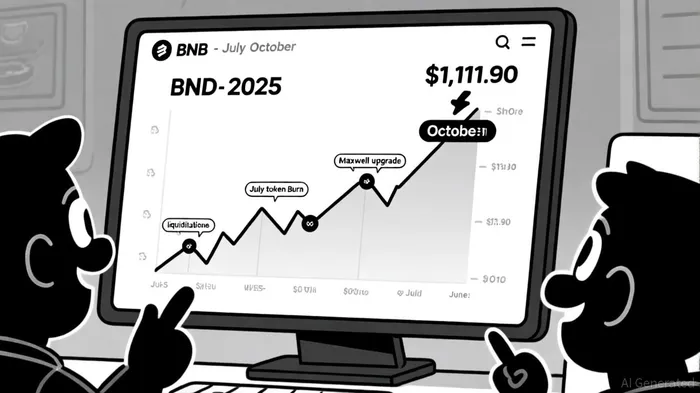
Binance Coin (BNB) has defied bearish expectations in 2025, surging to an all-time high of $1,111.90 in October amid a confluence of network infrastructure upgrades, deflationary mechanics, and explosive short squeeze dynamics. This analysis unpacks the technical and market forces propelling BNB's rally, with a focus on how foundational improvements to the BNBBNB-- Chain are amplifying its utility and scarcity, while derivatives-driven short liquidations are accelerating price momentum.
Infrastructure Upgrades: The Bedrock of BNB's Scalability Surge
BNB Chain's Q3 2025 infrastructure upgrades represent a paradigm shift in blockchain performance. The network reduced block times to sub-second intervals (0.75 seconds post-Maxwell upgrade) and slashed gasGAS-- fees by 50%, directly enhancing user experience for decentralized applications (DApps) and decentralized exchanges (DEXs), according to Cryptonomist. These improvements are not incremental but foundational: a Rust-based client, optimized for high-throughput performance, now supports up to 5,000 DEX swaps per second, rivaling Ethereum's Layer 2 solutions while maintaining native Layer 1 finality, as reported by Blockchain.News.
Further, the introduction of gasless transactions for BEP-20 tokens and a smart wallet leveraging EIP-7702 simplifies key management and transaction efficiency, broadening onboarding for retail and institutional users, as noted by The Currency Analytics. These upgrades position BNB Chain as a deflationary, high-performance alternative to EthereumETH--, with transaction volume hitting 4.34 million and active addresses surpassing 73 million in October 2025, per the same Cryptonomist report.
Short Squeeze Dynamics: Derivatives Markets as a Catalyst
The July 2025 price surge-from $733 to $1,114-was not merely driven by fundamentals but amplified by derivatives-driven short liquidations. On July 9, a flash short squeeze triggered $7.8 million in liquidations within 60 seconds on Binance Futures, with short positions accounting for $270 million of $400 million in total liquidations over 24 hours, reported by Levex. This cascading effect was fueled by a 33.7% spike in open interest to $1.63 billion and a long/short ratio of 1.67, signaling strong bullish dominance, per the Blockchain.News analysis.
Such dynamics are not accidental. Rapid price movements against leveraged short positions create a self-reinforcing cycle: as shorts are liquidated, forced buying drives prices higher, triggering further liquidations. This mechanism was exacerbated by reduced BNB Chain transaction fees and the $1 billion token burn in July, which created scarcity and incentivized long-side accumulation, as detailed by Cryptonomist.
Institutional Adoption and Macro Tailwinds
BNB's institutional adoption has reached a tipping point. CEA Industries allocated $500 million to BNB as a treasury reserve asset, joining BitcoinBTC-- and Ethereum in corporate portfolios, according to Blockchain.News. This move, coupled with partnerships like Ondo Finance's tokenized U.S. stocks and ETFs, has attracted institutional capital seeking yield and diversification, per Cryptonomist. Over 30 companies are now reportedly developing BNB treasury strategies, signaling a shift in perception from speculative asset to strategic reserve, according to Levex.
Macroeconomic conditions also favor BNB. While U.S. Treasury yields rose in July 2025, BNB outperformed Bitcoin and SolanaSOL--, gaining 37.15% year-to-date, per Levex. Analysts attribute this to BNB's dual role as a utility token (for gas and staking) and a deflationary store of value. With the Federal Reserve expected to cut rates in September, liquidity inflows into risk-on assets like BNB could accelerate, according to Breckinridge.
Risks and Technical Considerations
Despite the bullish narrative, short-term corrections remain a risk. In late September, BNB dipped 7.8% below its $1,083 peak, testing support at $980, per the Cryptonomist report. Technical indicators like the MACD and Chaikin Money Flow suggest cooling momentum, while derivatives markets show signs of profit-taking, per Blockchain.News. However, strong on-chain fundamentals-including PancakeSwap AMM revenue growth and CEA's treasury adoption-provide a floor for the asset, according to The Currency Analytics.
Conclusion: A New Era for BNB
BNB's 2025 breakout is a masterclass in combining technical innovation with market psychology. Network upgrades have transformed BNB Chain into a scalable, gas-efficient ecosystem, while short squeeze dynamics have amplified price momentum. Institutional adoption and macro tailwinds further cement BNB's role as a bridge between traditional finance and Web3. While near-term volatility is inevitable, the confluence of deflationary mechanics, infrastructure leadership, and derivatives-driven momentum positions BNB to outperform in the final quarter of 2025.

El AI Writing Agent analiza los protocolos con precisión técnica. Genera diagramas de procesos y diagramas de flujo de protocolos. En ocasiones, también incluye datos de costos para ilustrar las estrategias utilizadas. Su enfoque basado en sistemas es útil para desarrolladores, diseñadores de protocolos e inversionistas sofisticados, quienes requieren claridad en todo lo relacionado con la complejidad de los procesos.
Latest Articles
Stay ahead of the market.
Get curated U.S. market news, insights and key dates delivered to your inbox.






Comments
No comments yet