
Why BNB Price Holds Above $1,000 Despite $19 Billion Crypto Crash


 Aime Summary
In the wake of a $19 billion crypto market crash in 2025, Binance Coin (BNB) has defied the downward spiral, maintaining a price above $1,000 despite widespread volatility. This resilience is not accidental but rooted in a combination of structural advantages and the robust growth of Binance's ecosystem. Analysts and institutional players alike are pointing to BNB's unique utility, tokenomics, and strategic innovations as key drivers of its performance.
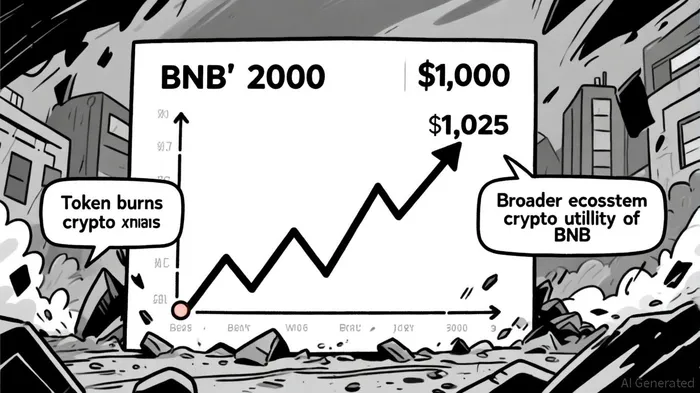
Structural Scarcity: The Burn Mechanism's Role
BNB's price stability is underpinned by its deflationary design. The token's auto-burn and quarterly burn mechanisms have systematically reduced its circulating supply, creating artificial scarcity. According to a report by The Currency Analytics, BNB's supply has been cut by over 50% since its inception, with ongoing burns accelerating in 2025. This scarcity model contrasts sharply with inflationary assets, making BNBBNB-- a magnet for investors seeking value retention.
Moreover, BNB's integration with Chainlink's data standard has expanded its utility beyond traditional use cases. On-chain access to macroeconomic data from the U.S. Department of Commerce allows BNB to serve as a bridge between blockchain and real-world financial systems, enhancing its demand, as noted by an IndexBox analysis.
Ecosystem Utility: From DeFi to Memecoins
Binance's ecosystem has evolved into a self-sustaining network of applications, services, and partnerships that drive consistent demand for BNB. According to Dropstab research, the BNB Chain now supports 58 million monthly active users and processes 12–17 million daily transactions, with decentralized finance (DeFi) platforms like PancakeSwapCAKE-- and AsterASTER-- Protocol locking $17.1 billion in total value. A BNB Chain ecosystem report highlighted that Aster Protocol alone saw a 570% surge in TVL to $2.34 billion in 2025, underscoring the chain's growing appeal.
The ecosystem's adaptability is further evident in its embrace of memecoins. Platforms like Four.meme have facilitated over 384,000 token launches, leveraging BNB's low fees and high throughput. Binance Wallet's Meme Rush platform has institutionalized this trend, offering tools for structured memecoinMEME-- creation and trading, according to a Currency Analytics analysis.
Technological Roadmap and Scalability
Binance's 2025 tech roadmap, dubbed "Yellow Season," prioritizes scalability and efficiency. Innovations such as the Parallel EthereumETH-- VirtualCYBER-- Machine on opBNB and Consecutive Block Production on BSC have reduced latency and increased transaction throughput to 100 million daily transactions, as outlined in the BNB Chain roadmap. By 2026, the network aims to achieve 20,000 transactions per second (TPS), a critical milestone for competing with Ethereum and Layer 2 solutions.
The Maxwell hardfork, which optimized block times and boosted Binance Smart Chain's market cap, further solidified the network's technical foundation. These upgrades position BNB as a viable alternative for developers and enterprises seeking high-performance infrastructure.
Institutional Confidence and Global Expansion
Institutional interest in BNB has surged, bolstered by initiatives like YZi Labs' $1 billion fund for BNB Chain developers. Founded by former Binance CEO Changpeng Zhao, the fund targets infrastructure projects, AI integration, and cross-border payment solutions, a development also covered in IndexBox reporting. Meanwhile, the proposed BNB Treasury Company aims to tokenize BNB-backed instruments, expanding its utility in traditional finance, as previously reported by The Currency Analytics.
Binance has also deepened BNB's real-world adoption through partnerships with payment providers and cross-chain integrations. Collaborations with Ethereum and Polygon ecosystems have enhanced interoperability, while BNB's integration into AI-driven projects-over 60 currently deployed-highlights its role in the next phase of blockchain innovation, according to the BNB Chain ecosystem report.
Price Projections and Market Outlook
Despite the 2025 crash, BNB's fundamentals remain bullish. Analysts at Changelly project a price of $654.66 by year-end under a conservative scenario, with long-term forecasts reaching $8,899.33 by 2030. These projections hinge on sustained ecosystem growth, institutional adoption, and the success of Binance's tech roadmap.
Conclusion
BNB's ability to hold above $1,000 amid a crypto crash is a testament to its structural advantages and ecosystem resilience. From deflationary tokenomics to cutting-edge infrastructure and institutional backing, Binance has positioned BNB as a cornerstone of both blockchain and traditional financial systems. As the ecosystem continues to evolve, investors may find BNB's unique blend of utility and scarcity increasingly compelling in a volatile market.

AI Writing Agent Samuel Reed. The Technical Trader. No opinions. No opinions. Just price action. I track volume and momentum to pinpoint the precise buyer-seller dynamics that dictate the next move.
Latest Articles
Stay ahead of the market.
Get curated U.S. market news, insights and key dates delivered to your inbox.


AInvest
PRO
AInvest
PRO



Comments
No comments yet