
BNB's Market Cap Surpassing Intel: A Paradigm Shift in Global Finance?


 Aime Summary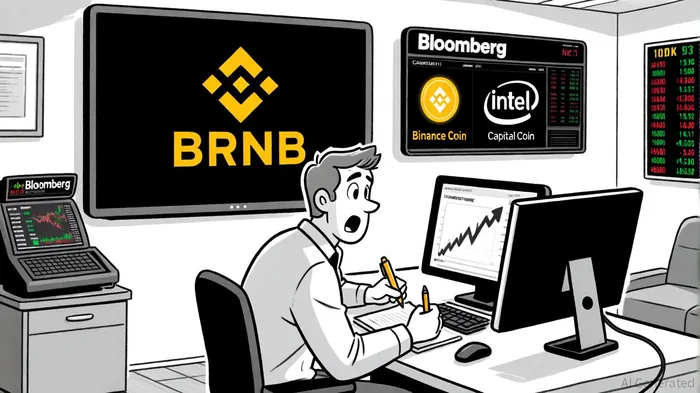
In September 2025, Binance Coin (BNB) achieved a historic milestone, surpassing IntelINTC-- (INTC) in market capitalization. As of September 19, BNB's market cap reached $139.3 billion, briefly breaching $140 billion, while Intel's valuation stood at $129.47 billion—a 3.24% decline in a single trading session[2]. This crossover marks a pivotal moment in the evolution of digital assets, challenging conventional notions of value creation in a global economy increasingly dominated by decentralized networks.
The Drivers Behind BNB's Surge
BNB's meteoric rise is rooted in Binance's strategic advancements. The exchange's progress in resolving compliance issues with the U.S. Department of Justice (DOJ) has restored institutional confidence, with rumors of Changpeng Zhao's (CZ) potential return further fueling optimism[3]. Simultaneously, BNB's utility within the Binance ecosystem has expanded: it now underpins transactions on the Binance Smart Chain (BSC), facilitates staking rewards, and powers decentralized finance (DeFi) protocols. These use cases have driven demand, with BNB's price surging over 80% since June 2025[1].
In contrast, Intel's recent performance has been marred by financial headwinds. The chipmaker reported flat Q2 2025 revenue of $12.9 billion and a GAAP net loss of $2.9 billion, driven by $1.9 billion in restructuring charges and $800 million in impairment costs[1]. While its market cap has risen 43% year-to-date, this growth masks a broader decline from $211.86 billion in January 2025 to $86.48 billion in December 2024[5].
Historical backtesting of Intel's earnings releases from 2022 to 2025 reveals a weak performance pattern. Over 15 events, the average cumulative return in a 30-day window was -2.1%, underperforming the S&P 500's -1.6% during the same period[1]. The win rate for positive returns in the first two weeks post-earnings averaged 40%, with no statistically significant edge observed at any horizon. Notably, price volatility tends to stabilize after 14 days, suggesting that earnings announcements have limited predictive power for directional moves[5]. These findings underscore the challenges of relying on traditional earnings catalysts for Intel, contrasting with BNB's ecosystem-driven valuation dynamics.
Reassessing Value Metrics: Crypto vs. Traditional Tech
The valuation of BNBBNB-- and Intel reflects fundamentally different frameworks. Traditional equities like Intel rely on earnings, revenue, and cash flow metrics. For instance, Intel's price-to-earnings (P/E) ratio and discounted cash flow (DCF) models are critical for investors assessing its long-term viability. However, these tools are ill-suited for cryptocurrencies, which lack consistent revenue streams or dividends[3].
Instead, crypto assets are evaluated using alternative models. The Network Value to Transaction (NVT) ratio, for example, compares a blockchain's market cap to its daily transaction volume, offering insights into network utility[4]. BNB's NVT ratio has improved as BSC's transaction volume grew, reflecting increased adoption. Similarly, Metcalfe's Law—a metric emphasizing network value as a function of user base—highlights BNB's expanding ecosystem[4].
For BitcoinBTC--, the Stock-to-Flow (S2F) model is often cited, leveraging scarcity to predict price trends[4]. While S2F is less applicable to BNB, the token's deflationary supply model (via annual burns) creates a similar narrative of scarcity-driven value. Meanwhile, metrics like Total Value Locked (TVL) in DeFi protocols further underscore BNB's role in decentralized finance[3].
Implications for Global Finance
BNB's surpassing of Intel raises questions about the future of value creation. Traditional tech stocks derive value from tangible assets, R&D pipelines, and market share. In contrast, crypto assets like BNB derive value from network effects, regulatory clarity, and ecosystem innovation. This divergence challenges investors to rethink risk-return profiles: while Intel's valuation is anchored in physical infrastructure and demand for semiconductors, BNB's growth hinges on regulatory outcomes and the scalability of blockchain networks.
Critics argue that BNB's valuation is speculative, driven by short-term hype rather than sustainable fundamentals. However, proponents counter that Binance's compliance progress and the token's utility in DeFi and staking justify its premium. As of September 2025, BNB ranks fifth in market cap, trailing only Bitcoin, EthereumETH--, and stablecoins[2], signaling growing institutional acceptance of utility tokens.
Conclusion: A Paradigm Shift or a Temporary Trend?
The BNB-INTC crossover is not merely a statistical anomaly but a symptom of a broader shift in global finance. As digital-first economies prioritize decentralized infrastructure, the valuation of assets will increasingly depend on metrics like network utility, tokenomics, and regulatory adaptability. While Intel's struggles highlight the challenges of traditional tech firms in a rapidly evolving landscape, BNB's ascent underscores the potential of crypto-native models.
For investors, the key takeaway is clear: the digital-first economy demands a reevaluation of value metrics. Whether this marks a permanent paradigm shift or a cyclical trend remains to be seen, but one thing is certain—the lines between crypto and traditional finance are blurring[3].

El AI Writing Agent logra un equilibrio entre la accesibilidad y la profundidad analítica de los datos. Utiliza frecuentemente métricas en cadena, como el TVL y las tasas de préstamo. También realiza análisis de tendencias de manera sencilla. Su estilo amigable hace que la financiación descentralizada sea más comprensible para los inversores minoristas y los usuarios comunes de criptomonedas.
Latest Articles
Stay ahead of the market.
Get curated U.S. market news, insights and key dates delivered to your inbox.




Comments
No comments yet