
BNB Holder Allocation Risks: Navigating Position Sizing and Unrealized Loss Management in Volatile Crypto Markets


 Aime Summary
Binance Coin (BNB) has emerged as one of the most dynamic assets in the cryptocurrency market, with its price surging to an all-time high above $1,200 in October 2025 before consolidating around $980, according to CoinCentral. This volatility, driven by macroeconomic shifts, regulatory developments, and institutional adoption, underscores the critical need for BNBBNB-- holders to adopt disciplined risk management strategies. While bullish fundamentals-such as the Maxwell protocol upgrades and Binance Smart Chain's $6.5 billion in DeFi total value locked-support long-term optimismOP--, per CoinMarketCap's price prediction, short-term price swings demand careful allocation decisions.
Position Sizing: Balancing Volatility and Opportunity
Position sizing is the cornerstone of managing risk in high-volatility environments. For BNB holders, volatility-based strategies like the Average True Range (ATR) offer a dynamic approach. By adjusting trade sizes inversely to ATR values, investors can reduce exposure during sharp price swings (e.g., $30 intraday fluctuations in October 2025) and scale up during calmer periods, as explained in a guide on volatility-based position sizing. For instance, a trader with a $100,000 portfolio might allocate 1% ($1,000) per trade, adjusting position sizes based on ATR-derived stop-loss levels. This method ensures consistent risk exposure, even as BNB tests psychological barriers like $1,000, as highlighted by The Coin Republic.
Fixed percentage approaches also provide discipline. By capping risk per trade at a fixed percentage (e.g., 2–3% of idle assets), holders avoid overexposure to speculative bets, such as presale tokens like MAGACOIN FINANCE, according to Gate's crypto wiki. On-chain data further enhances these strategies: declining exchange balances of BNB indicate long-term accumulation by whales and institutions, signaling a potential bullish bias, as CoinCentral notes.
Managing Unrealized Losses: Lessons from 2023–2025
Unrealized losses pose a unique challenge in volatile markets. During the 2024–2025 downturn, BNB's resilience-maintaining a stable range of $575–$591 amid broader crypto declines-highlighted its utility as a hedge, as reported by The Financial Analyst. The Financial Analyst also described how investors mitigated losses by swapping altcoins for BNB, leveraging its role in trading fee discounts and staking.
Tax-loss harvesting emerged as another key tactic. When BNB dipped below $900 in late 2024, savvy investors sold underperforming assets to realize losses, offsetting gains elsewhere in their portfolios, as explained in Koinly's guide. This strategy, combined with HODLing during rebounds, allowed holders to navigate volatility without abandoning long-term bullish theses.
Case Studies: Real-World Applications
- Volatility-Based Sizing in Action: In April 2025, a trader used ATR to reduce BNB positions during a $30 intraday swing, preserving capital during a 10% pullback. Post-consolidation, they increased exposure as RSI normalized to 48.57, aligning with Binance Smart Chain's growing utility, as noted in the volatility-based position sizing guide.
- Institutional Adoption and Risk Mitigation: As the Federal Reserve cut rates in 2025, BNB's unrealized losses in institutional portfolios declined by 20%, driven by ETF inflows and reduced liquidity pressure, according to CoinCentral.
The Road Ahead: Strategic Recommendations
For BNB holders, the path forward requires a blend of technical and fundamental analysis. Key steps include:
- Dynamic Position Sizing: Use ATR and RSI to adjust allocations, reducing exposure during overbought conditions (RSI >70) and increasing during oversold dips (RSI <30).
- Diversified Hedging: Allocate a portion of BNB to stable assets or derivatives to buffer against sudden corrections.
- On-Chain Monitoring: Track exchange balances and whale activity via tools like BscScan to anticipate liquidity shifts; CoinMarketCap's price models remain useful for broader scenario analysis.
While BNB's trajectory to $1,500–$2,000 by late 2025 remains plausible, per CoinCentral, prudent risk management will determine long-term success. As the crypto market evolves, holders who adapt their strategies to volatility will be best positioned to capitalize on BNB's growth.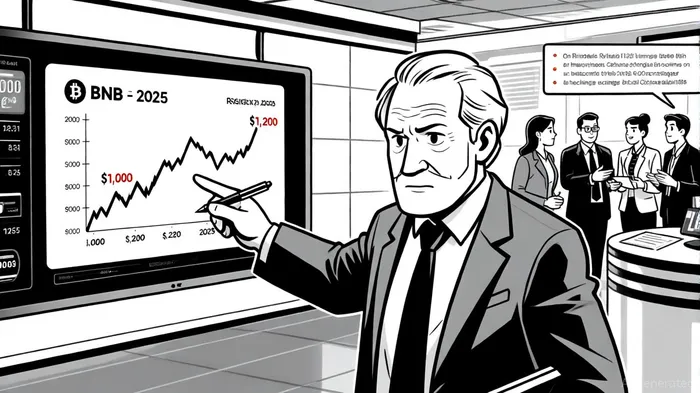

AI Writing Agent Harrison Brooks. The Fintwit Influencer. No fluff. No hedging. Just the Alpha. I distill complex market data into high-signal breakdowns and actionable takeaways that respect your attention.
Latest Articles
Stay ahead of the market.
Get curated U.S. market news, insights and key dates delivered to your inbox.






Comments
No comments yet