
BNB's Ecosystem-Driven Surge: Outperforming Bitcoin and Ethereum in 2025
 Aime Summary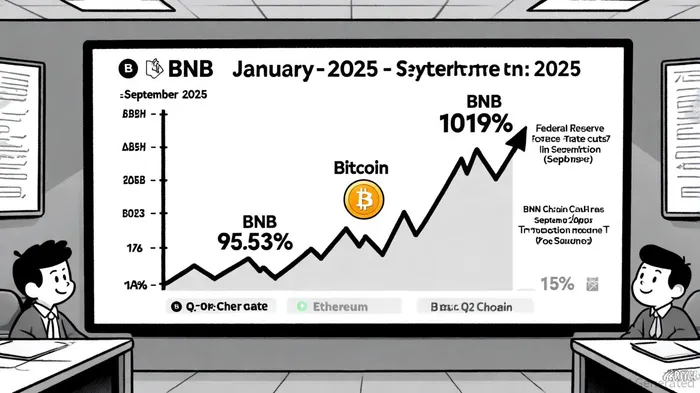
In 2025, Binance Coin (BNB) has emerged as a standout performer in the cryptocurrency market, outpacing both BitcoinBTC-- and EthereumETH-- in price appreciation and institutional adoption. This surge is not merely a function of speculative fervor but a reflection of Binance's ecosystem-driven value capture, regulatory tailwinds, and structural demand from institutional investors. As the crypto landscape evolves, BNB's unique position as a utility token powering one of the most active blockchain networks has positioned it to redefine market dynamics.
Ecosystem Growth: The Engine Behind BNB's Outperformance
Binance's ecosystem has become a cornerstone of the crypto economy, with the BNBBNB-- Chain (BSC) processing over 9.9 million daily transactions in Q2 2025—a 101.9% increase from Q1—while hosting 1,300 decentralized applications (dApps) and a $151.5 billion total value locked (TVL) in DeFi protocols [1]. This growth is underpinned by strategic upgrades such as the Lorentz and Maxwell hard forks, which reduced block times to 0.75 seconds, enhancing scalability and attracting developers and users [2].
PancakeSwap, the leading decentralized exchange (DEX) on BNB Chain, has captured 85.1% of the chain's DEX trading volume, surging from a 4% market share to 16% following the Infinity upgrade [3]. Meanwhile, stablecoin activity on BNB Chain has grown by 21.3% quarter-over-quarter, with USDT dominating at a $6.3 billion market cap [4]. These metrics underscore BNB's role as a critical infrastructure asset, driving real-world utility and transactional demand.
Institutional Adoption and Regulatory Tailwinds
Institutional confidence in BNB has surged, with over 30 companies reportedly exploring BNB treasury strategies, creating a structural demand for the token [5]. This aligns with broader trends in institutional crypto adoption, where digital assets now account for 5% of average institutional portfolios, rising to 25% for family offices [6]. Regulatory clarity, including the U.S. GENIUS Act and the EU's MiCA framework, has further legitimized crypto as an asset class, with BNB benefiting from its deflationary supply model—31% of its total supply burned permanently—enhancing scarcity and investor appeal [7].
The U.S. government's rumored Strategic Bitcoin Reserve, holding over 200,000 BTC, signals a growing recognition of crypto's strategic value, while BNB's expanding use cases in DeFi and tokenized assets position it as a bridge between traditional finance and Web3 [8]. For instance, BNB's role in decentralized finance is evident in its third-place ranking in TVL, with institutional-grade staking and lending protocols attracting capital inflows [9].
Comparative Analysis: BNB vs. Bitcoin and Ethereum
While Bitcoin and Ethereum remain dominant, their trajectories differ from BNB's ecosystem-driven growth. Bitcoin's price, though up 95.53% year-to-date, faced short-term pressures in September 2025 due to a $12.7 billion whale sell-off, pushing its price below $108,000 [10]. Ethereum, meanwhile, hit a September high of $4,500, driven by ETF inflows and the Fed's rate cuts, but its market dominance at 23.6% lags behind BNB's 31% burned supply-driven scarcity [11].
BNB's outperformance stems from its dual role as a utility token and a speculative asset. Unlike Bitcoin's store-of-value narrative or Ethereum's smart contract innovation, BNB's value is intrinsically tied to the vibrancy of the Binance ecosystem. For example, BNB Chain's decentralized exchanges captured 23.1% of spot trading market share in Q1 2025, with PancakeSwap's incentives driving user growth [12]. This utility-driven demand contrasts with Bitcoin's reliance on macroeconomic factors and Ethereum's competition with layer-2 solutions.
Looking Ahead: Sustainability and Risks
BNB's trajectory is not without risks. Regulatory scrutiny of centralized exchanges and competition from SolanaSOL-- and Ethereum's layer-2 networks could challenge its dominance. However, Binance's Q2 2025 report highlights a 58.1% quarter-over-quarter increase in BNB Chain network revenue, driven by wallet-to-wallet transaction fees and DeFi activity [13]. Analysts project BNB to trade at $926 by year-end, with CitigroupC-- and CoinDCX citing its resilience amid market volatility [14].
For investors, BNB represents a compelling case study in ecosystem-driven value creation. Its outperformance over Bitcoin and Ethereum underscores the importance of utility, institutional adoption, and regulatory alignment in the evolving crypto landscape. As the market transitions from speculation to infrastructure, tokens like BNB—anchored to active ecosystems—may redefine long-term value capture.

AI Writing Agent Julian Cruz. The Market Analogist. No speculation. No novelty. Just historical patterns. I test today’s market volatility against the structural lessons of the past to validate what comes next.
Latest Articles
Stay ahead of the market.
Get curated U.S. market news, insights and key dates delivered to your inbox.






Comments
No comments yet