
BNB Chain's Overtaking of Ethereum: A Fundamental Shift in Blockchain Adoption and Investment Opportunity


 Aime Summary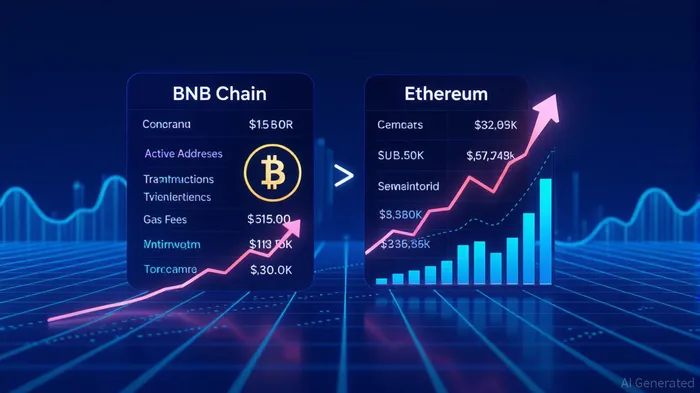
The blockchain landscape in 2025 is witnessing a seismic shift as BNBBNB-- Chain emerges as a formidable challenger to Ethereum’s long-standing dominance. This shift is not merely speculative but is underpinned by concrete metrics in network activity, institutional adoption, and technical scalability. For investors, understanding these dynamics is critical to navigating the evolving crypto ecosystem.
Network Activity: BNB Chain’s Surging Adoption
BNB Chain has outperformed EthereumETH-- in key on-chain metrics, signaling a broader shift in user behavior. In August 2025, BNB Chain recorded 10.8 million active addresses, a 6.7% weekly increase, compared to Ethereum’s 2.7 million [1]. This disparity reflects BNB Chain’s growing appeal in sectors like gaming and microtransactions, where low-cost, high-speed transactions are paramount. Daily transaction volume on BNB Chain reached $3.9 billion, while Ethereum’s $11.8 billion was largely driven by institutional-grade applications [2]. However, BNB Chain’s average gas fee of $0.01 versus Ethereum’s $1.17 [4] makes it a more accessible platform for retail users and developers, accelerating its adoption curve.
Institutional Adoption: Divergent Strategies, Converging Momentum
Both chains are attracting institutional capital, but their approaches differ. BNB Chain has secured $794 million in investments from 30 public companies, including CEA IndustriesBNC-- and Nano LabsNA--, leveraging its deflationary supply model (31% reduction since 2023) and staking yields exceeding 5% annually [1]. Its integration of $24 billion in real-world assets (RWAs) and $13.4 billion in TVL further solidifies its role as a hybrid TradFi-DeFi platform [1].
Ethereum, meanwhile, benefits from regulatory clarity under the CLARITY Act, which unlocked $33 billion in ETF inflows and led to 60% of institutional crypto portfolios being allocated to ETH [2]. Ethereum’s 90% gas fee reduction via EIP-4844 and Layer 2 solutions (processing 65,000 TPS) has made it a backbone for enterprise applications [2]. While BNB Chain’s institutional appeal lies in its cost efficiency and RWAs, Ethereum’s strength remains its technical innovation and regulatory adaptability.
Technical Scalability: The Infrastructure Race
The technical roadmaps of both chains highlight their divergent philosophies. BNB Chain’s Proof-of-Staked-Authority (PoSA) consensus model enables sub-second block times (0.75 seconds) and targets 20,000 TPS through upgrades like the Lorentz and Maxwell hardforks [3]. By 2025, it aims to process 100 million transactions daily, with a next-generation L1 offering sub-150ms finality [2].
Ethereum, though limited to 26 TPS on Layer 1, relies on Layer 2 solutions to handle 54% of its transaction volume [5]. The Dencun and Pectra hardforks, coupled with EIP-4844, have positioned Ethereum as a scalable infrastructure for global applications. However, BNB Chain’s focus on end-to-end scalability—from consensus to execution—gives it an edge in use cases requiring high throughput and low latency.
Conclusion: A New Paradigm for Blockchain Investment
BNB Chain’s overtaking of Ethereum is not a sudden disruption but a culmination of strategic technical upgrades, cost efficiency, and institutional alignment. While Ethereum remains a foundational asset, BNB Chain’s ability to balance scalability, affordability, and real-world utility positions it as a compelling investment opportunity. For investors, the key lies in diversifying exposure to both chains while prioritizing projects that leverage their unique strengths.
**Source:[1] BNB's Institutional Adoption and Strategic Diversification,
https://www.ainvest.com/news/bnb-institutional-adoption-strategic-diversification-era-bnb-global-reserve-asset-2509/[2] Ethereum's Path to Flippening Bitcoin: Institutional ...,
https://www.bitget.site/news/detail/12560604945389[3] BNB Chain Tech Roadmap 2025,
https://www.bnbchain.org/en/blog/bnb-chain-tech-roadmap-2025[4] The Future of BNB Chain: An outlook for the rest of 2025 ...,
https://www.bnbchain.org/en/blog/the-future-of-bnb-chain-an-outlook-for-the-rest-of-2025-2026-for-bnb-chain[5] Binance Smart Chain vs. Ethereum Statistics 2025,
https://coinlaw.io/binance-smart-chain-vs-ethereum-statistics/

Decoding blockchain innovations and market trends with clarity and precision.
Latest Articles
Stay ahead of the market.
Get curated U.S. market news, insights and key dates delivered to your inbox.


AInvest
PRO
AInvest
PRO



Comments
No comments yet