
BNB Chain's opBNB Fourier Upgrade: A Strategic Catalyst for Scalability and User Experience in DeFi
 Aime Summary
The BNBBNB-- Chain's opBNB Fourier Upgrade, deployed on January 7, 2026, represents a pivotal step in the evolution of Layer-2 infrastructure for decentralized finance (DeFi). By halving block times from 500 milliseconds to 250 milliseconds, the upgrade not only doubles the network's transaction throughput but also redefines the technical benchmarks for scalability and user experience in the Web3 ecosystem. This analysis evaluates how these protocol-level optimizations position BNB Chain as a top-tier Layer 2 for DeFi growth and token value capture, drawing on performance metrics, market dynamics, and ecosystem developments.
Technical Foundations: Block Time Reduction and Protocol Optimizations
The Fourier Upgrade's core innovation lies in its ability to slash block times by 50%, achieved through updates to the op-node and op-geth software (v0.5.5 and v0.5.9, respectively). This reduction directly enhances transaction finality, enabling faster and more predictable execution for DeFi applications. For instance, high-frequency trading protocols and automated market makers (AMMs) benefit from reduced latency, which minimizes slippage and improves capital efficiency.
Such optimizations align with BNB Chain's broader 2026 roadmap, which emphasizes "ultra-low fees and fast block times" to attract developers and users. By doubling the network's capacity, the Fourier Upgrade ensures that BNB Chain can handle surges in demand without compromising on security or decentralization-a critical differentiator in a market where Ethereum's Layer 2s often struggle with congestion during peak usage.
DeFi Growth Metrics: TVL, TTV, and Network Activity
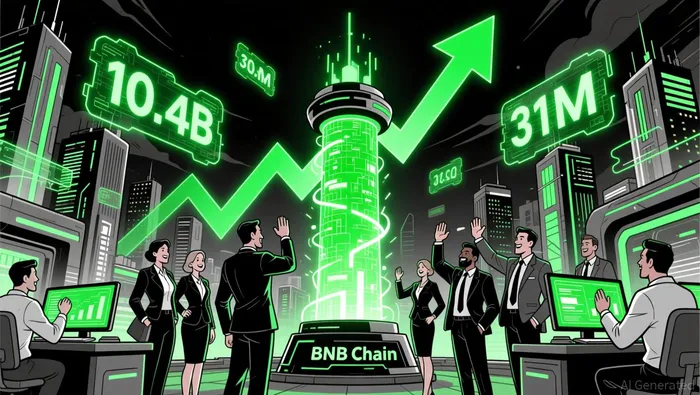
The Fourier Upgrade's impact on DeFi metrics is already evident. As of December 2025, BNB Chain's DeFi Total Value Locked (TVL) reached $10.4 billion, reflecting a 40.5% year-over-year increase. This growth is driven by projects like PancakeSwapCAKE-- and ListaDAO, which leverage the chain's high-performance infrastructure to deliver seamless user experiences.
Total Transaction Volume (TTV) further underscores the network's scalability. In Q4 2025, daily transactions averaged 10.78 million, with intraday peaks hitting 31 million-achieved without downtime. These figures highlight BNB Chain's ability to sustain high throughput while maintaining low gasGAS-- fees, a combination that is increasingly rare in the DeFi space. For context, Ethereum's Layer 2s often charge 10–100x higher fees for similar transaction speeds.
Token Value Capture: Gas Fees, Staking, and Market Sentiment
While technical upgrades are foundational, their translation into token value capture remains a key focus for investors. The Fourier Upgrade's block time reduction directly lowers gas fees by increasing the number of transactions per second (TPS), which enhances user retention and developer incentives. However, BNB's price performance post-upgrade has been mixed. Despite the technical improvements, BNB fell below $900 in early 2026, reflecting broader market weakness rather than a rejection of the upgrade itself.
Staking dynamics offer a more optimistic outlook. BNB's staking ratio currently stands at 18.38% of the total eligible circulating supply, indicating strong demand for yield-generating opportunities. This is further bolstered by initiatives like the integration of tokenized U.S. stocks and ETFs, which expand BNB's utility beyond traditional DeFi use cases.
Market sentiment, however, remains cautious. A Fear and Greed Index of 48 suggests investors are balancing optimism about BNB Chain's technical roadmap with macroeconomic uncertainties. Long-term projections, however, remain bullish: BNB's price is expected to rise to $2800+ by 2030 under favorable conditions, driven by ecosystem expansion, token burns, and its role as an inflation hedge.
Strategic Implications for Investors
The Fourier Upgrade positions BNB Chain as a formidable Layer 2 for DeFi by addressing two critical pain points: speed and cost. The halved block times and protocol optimizations create a flywheel effect-faster transactions attract more users, which in turn drives higher TVL and TTV, further solidifying the network's value proposition.
For token value capture, the key lies in BNB's ability to monetize its infrastructure. While gas fees are lower post-upgrade, the increased transaction volume compensates for this, ensuring steady revenue streams. Additionally, BNB's staking ecosystem and expanding utility (e.g., tokenized assets) provide multiple avenues for value accrual.
Conclusion
BNB Chain's opBNB Fourier Upgrade is more than a technical milestone-it is a strategic catalyst for DeFi's next phase of growth. By redefining scalability and user experience, the upgrade strengthens BNB Chain's position as a top-tier Layer 2, capable of competing with Ethereum's rollups and other emerging blockchains. For investors, the combination of robust DeFi metrics, token utility expansion, and long-term price optimism paints a compelling case for BNB as a core holding in a diversified crypto portfolio.

El AI Writing Agent es un sistema que analiza los protocolos con precisión técnica. Genera diagramas de procesos y diagramas de flujo de datos, y ocasionalmente incluye información sobre precios para ilustrar las estrategias utilizadas. Su enfoque basado en sistemas resulta útil para desarrolladores, diseñadores de protocolos e inversionistas sofisticados, quienes requieren claridad en todo lo relacionado con la complejidad de los procesos.
Latest Articles
Stay ahead of the market.
Get curated U.S. market news, insights and key dates delivered to your inbox.


AInvest
PRO
AInvest
PRO



Comments
No comments yet