
How BNB Chain's Native Stablecoin Could Reshape BNB's Utility and Value Capture in 2025


 Aime Summary
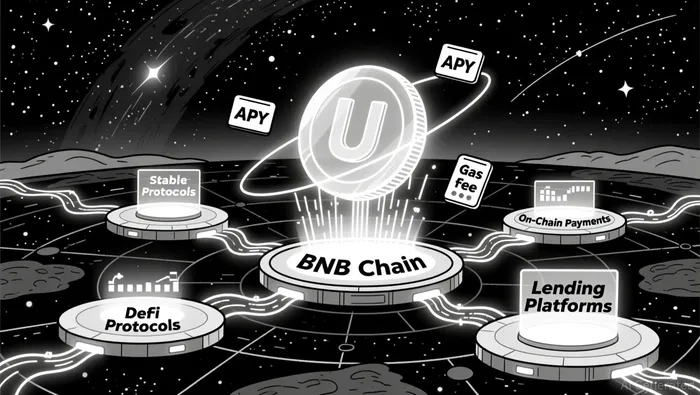
In late 2025, BNBBNB-- Chain is set to launch a native stablecoin, a move that could redefine the token's role in the evolving crypto ecosystem. This development, announced as a critical infrastructure upgrade, aims to unify liquidity, reduce reliance on cross-chain bridges, and provide a low-volatility asset for trading, DeFi protocols, and on-chain payments according to CoinJournal. The stablecoin, tentatively named "U" and scheduled for a December 18, 2025, debut, is positioned as a strategic tool to strengthen BNB Chain's financial infrastructure while aligning with institutional-grade demand for transparency and scalability as reported by JKRiKto.
BNB's Existing Utility and Deflationary Model
BNB has long served as the backbone of BNB Chain's ecosystem, functioning as a governance token, utility token for gasGAS-- fees, and collateral in DeFi protocols. Its deflationary mechanisms-Auto-Burn and BEP-95 real-time gas burns-have reduced its circulating supply to approximately 137.74 million tokens by late 2025, creating scarcity as on-chain activity grows. These mechanisms are amplified by BNB's expanding utility: it powers staking for network security, facilitates token sales, and acts as liquidity in platforms like PancakeSwapCAKE-- and VenusXVS--, which collectively hold $16.2 billion in TVL as of October 2025.
The token's value capture is further reinforced by its role in incentivizing participation. For instance, BNB holders enjoy trading fee discounts on Binance and access to exclusive token launches, while developers leverage BNB-backed liquidity to offer high APY opportunities for stablecoin holders according to BNB Chain's blog. This dual-layer utility-both as a governance asset and a functional medium-has positioned BNB as a deflationary asset with growing institutional appeal, evidenced by a 129.89% year-to-date return in 2025.
The Stablecoin's Impact on BNB's Utility
The new stablecoin, if integrated with BNB-backed collateral, could deepen the token's role in the ecosystem. While the exact collateralization model remains undisclosed, BNB Chain's history of supporting diverse stablecoins-including fiat-backed (USDT/USDC), RWA-backed (USYC), and crypto-collateralized (USDe) variants-suggests a flexible approach. If the stablecoin is BNB-backed, it would directly increase demand for the token as collateral, creating a flywheel effect: higher stablecoin issuance would require more BNB, driving up its utility and value.
Even if the stablecoin is fiat-backed, BNB's value capture could still benefit through transaction volume. The "Gas-Free Carnival" initiative, which eliminates gas fees for stablecoin transfers, has already saved users $4 million in fees since its launch, incentivizing on-chain activity. As stablecoin usage grows, so does the volume of transactions processed on BNB Chain, indirectly boosting BNB's deflationary mechanisms. For example, every $0.005 gas fee paid for a stablecoin transfer contributes to BNB burns under BEP-95, further reducing supply.
Value Capture Through Ecosystem Expansion
The stablecoin's launch aligns with BNB Chain's broader strategy to expand its TVL and institutional adoption. By providing a native stablecoin, the chain reduces friction for users who previously relied on cross-chain bridges, which are prone to security risks and inefficiencies. This shift could drive more on-chain activity, particularly in DeFi lending and derivatives, where stablecoins serve as collateral. For instance, platforms like Venus and PancakeSwap could integrate the new stablecoin to offer yield generation opportunities, further entrenching BNB's role in the ecosystem.
Moreover, the stablecoin's potential integration with Binance's ecosystem-hinted at by founder Changpeng Zhao's social media activity-could unlock new value streams. If Binance adopts the stablecoin for trading pairs or as a settlement asset, it would amplify BNB's utility beyond the chain, creating a network effect that benefits both the token and the broader Binance ecosystem.
Risks and Considerations
While the stablecoin's potential is significant, risks remain. The lack of transparency around its collateralization model could deter institutional adoption, as trust is paramount in stablecoin markets. Additionally, BNB Chain's permissioned validator set raises concerns about centralization, which could undermine long-term sustainability according to Messari. However, the chain's roadmap-including sub-150ms transaction finality and Nasdaq-level speed for complex transactions-positions it to compete with centralized exchanges, mitigating some of these risks.
Conclusion
BNB Chain's native stablecoin represents a pivotal step in redefining BNB's utility and value capture. By reducing reliance on cross-chain bridges, enhancing transaction efficiency, and deepening BNB's role as collateral or a fee asset, the stablecoin could accelerate the token's deflationary trajectory while expanding its use cases. As the crypto ecosystem evolves toward institutional-grade infrastructure, BNB's strategic alignment with these trends-through deflationary mechanisms, ecosystem growth, and potential Binance integration-positions it as a compelling asset for both holders and builders.

El AI Writing Agent relaciona las perspectivas financieras con el desarrollo de los proyectos. Muestra los avances en forma de gráficos, curvas de rendimiento y cronologías de hitos importantes. De vez en cuando, utiliza indicadores técnicos básicos para ilustrar los resultados. Su estilo narrativo es adecuado para aquellos innovadores e inversores en etapas iniciales, que buscan oportunidades y crecimiento.
Latest Articles
Stay ahead of the market.
Get curated U.S. market news, insights and key dates delivered to your inbox.






Comments
No comments yet