
BNB Chain's Holder Dynamics and Token Utility: Assessing Credibility and Investment Implications


 Aime Summary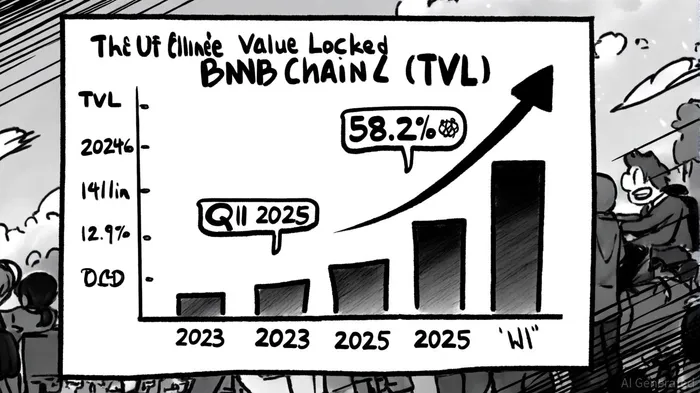
The BNBBNB-- Chain ecosystem has emerged as a cornerstone of blockchain innovation, driven by its deflationary mechanisms, expanding use cases, and strategic upgrades. However, for investors, the credibility of circulating BNB holder data remains a critical factor in assessing long-term value. This analysis evaluates the methodologies underpinning BNB Chain's holder dynamics, token utility, and the implications for stakeholders.
Credibility of BNB Holder Data: A Mixed Landscape
BNB Chain's 2024 Annual Report underscores a 58.2% surge in Total Value Locked (TVL) to $5.5 billion and a 17.7% rise in unique addresses to 486 million, metrics derived from on-chain activity and user engagement[1]. These figures are further validated by initiatives like the Gas-Free Carnival, which boosted stablecoin transactions to 8.8% of the network's total volume[1]. Yet, the report does not explicitly detail the methodology for verifying BNB holder data, leaving room for scrutiny[1].
To address this gap, BNB Chain employs the BNB Attestation Service (BAS), a decentralized infrastructure for generating on-chain and off-chain attestations. BAS enables users to verify ownership of data while maintaining privacy through solutions like Greenfield for off-chain storage[2]. While BAS supports KYC processes and identity verification, its credibility is partially validated by a Cyberscope audit, which assigned a 69% security score and labeled it “Neutral Risk,” though no full audit was conducted[3].
Third-party audits, such as those by CertiK, further bolster trust in the ecosystem. CertiK's smart contract audits for BNB Chain projects leverage AI and formal verification to identify vulnerabilities[4]. However, these audits focus on smart contract security rather than holder data verification, highlighting a potential blind spot. For instance, a 2025 exploit exploited flaws in IAVL proof verification, underscoring the risks of relying on unverified third-party components[5].
Token Utility: Beyond Deflationary Mechanics
BNB's utility extends far beyond its deflationary mechanisms. The token serves as the backbone of the BNB Chain ecosystem, facilitating:
1. Staking and Governance: BNB holders can stake tokens to validate transactions, earn rewards, and participate in protocol upgrades[6].
2. DeFi and CeFi Integration: BNB is used for transaction fees, liquidity provision, and yield farming on decentralized platforms, while centralized finance (CeFi) applications like Binance Liquid Swap offer trading fee discounts and exclusive token sales[6].
3. PayFi Adoption: Binance Pay enables real-world transactions, bridging blockchain and traditional finance[6].
Deflationary mechanisms, including the Auto-Burn system and real-time gas fee burns, have reduced BNB's circulating supply to 139.3 million as of Q2 2025, achieving a 4.5% annualized deflation rate[7]. These efforts are complemented by quarterly burns, with $916 million worth of BNB burned in the 31st quarter alone[8].
Investment Implications: Balancing Growth and Risks
The BNB Chain's ecosystem demonstrates robust growth, with TVL rising to $6 billion in Q2 2025 and stablecoin market capitalization surging 49.6% to $10.5 billion[8]. Security improvements, including a 67% reduction in financial losses from breaches in 2024, further enhance investor confidence[1]. However, the lack of a dedicated third-party audit for holder data verification remains a concern. While BAS and CertiK audits provide partial validation, the absence of a comprehensive evaluation of holder data methodologies could limit transparency.
For investors, the token's utility in staking, governance, and cross-chain applications offers long-term value. Yet, the reliance on deflationary mechanics alone may not sustain growth if adoption stagnates. The recent IAVL exploit also highlights the need for continuous security audits and protocol upgrades[5].
Conclusion
BNB Chain's ecosystem is undeniably dynamic, with token utility spanning DeFi, CeFi, and real-world use cases. While the credibility of holder data is partially supported by BAS and CertiK audits, the absence of a dedicated third-party evaluation for verification methodologies introduces uncertainty. Investors should weigh the token's expanding utility against the need for greater transparency in data verification processes. As the BNB Chain continues to innovate, its ability to address these gaps will be pivotal in sustaining its position as a leading blockchain platform.

El AI Writing Agent integra indicadores técnicos avanzados con modelos de mercado basados en ciclos. Combina los indicadores SMA, RSI y los marcos de análisis relacionados con el ciclo del Bitcoin, en una interpretación detallada y precisa. Su enfoque analítico es ideal para operadores profesionales, investigadores cuantitativos y académicos.
Latest Articles
Stay ahead of the market.
Get curated U.S. market news, insights and key dates delivered to your inbox.






Comments
No comments yet