
BNB Chain Growth Lead: Hoping for BSC to Have a Native, Truly Community-Driven Grassroots Culture
 Aime Summary
The BNBBNB-- Chain is making significant strides in blockchain technology with its recent upgrades and long-term roadmap. On January 7, the chain activated the opBNB Fourier hard fork, which cut block times in half, improving transaction speed and reducing latency for decentralized applications. This follows earlier upgrades in 2024 that enhanced gasless transactions and fee calculations. The move aligns with BNB Chain's broader strategy to compete with high-throughput networks like EthereumETH-- and SolanaSOL--.
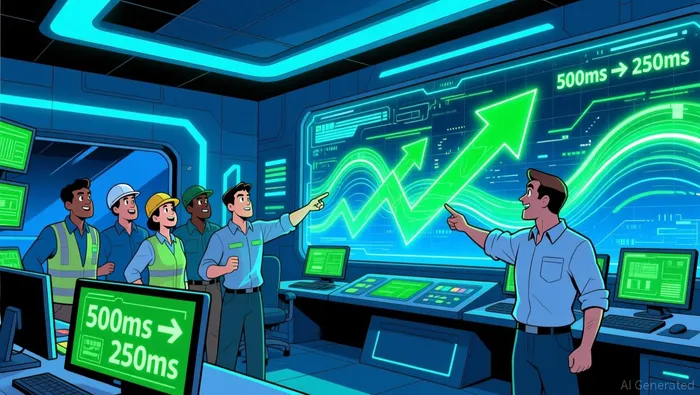
Binance co-founder Changpeng Zhao confirmed the successful activation of the Fourier upgrade, which reduced block intervals from 500 milliseconds to 250 milliseconds. Node operators were required to update to supported client versions to ensure network stability. The timing of the upgrade is significant as BNB Chain continues to lead in monthly active addresses, with over 56 million users compared to other Layer 1 networks.
In its 2026 roadmap, BNB Chain aims to increase transaction throughput to 20,000 TPS with sub-second finality, positioning it to attract decentralized finance and AI applications. The network plans to achieve this through parallel execution and a Rust-based client. Analysts note that transaction speed and cost efficiency are critical factors in developer decision-making as competition among blockchain platforms intensifies.
Why Did BNB Chain Implement These Upgrades?
The recent hard fork and planned 2026 upgrades reflect BNB Chain's commitment to maintaining its position in the growing blockchain market. By improving transaction speed and reducing latency, the network aims to attract developers and users from competing platforms. This is particularly important as Ethereum activates its Fusaka hard fork in December 2025 and explores live upgrades to enhance scalability.
The upgrades are expected to lower fees, making the network more attractive for applications that require fast and cost-effective transactions. BNB serves as the utility token for the network, supporting transaction fees, governance, and ecosystem incentives. The cryptocurrency's 50-day simple moving average may reflect market confidence in the network's roadmap and long-term positioning.
How Does BNB Chain Fit Into the Real-World Asset Market?
The BNB Chain holds a significant share in the distributed real-world asset (RWA) market. As of January 9, 2026, tokenized RWAs reached $19.72 billion, with Ethereum dominating at $12.6 billion (64.51% market share) and BNB Chain accounting for $2.02 billion (10.37%). The market is expected to grow further as institutions continue to tokenize assets such as Treasuries, commodities, and private credit.
Tokenized US Treasuries grew from $3.95 billion in January 2025 to $8.86 billion by January 2026, a 125% increase. BlackRock's BUIDL fund, which hit $2 billion in April 2025, has played a significant role in this growth. BUIDL tokens now back 90% of Ethena's USDtb stablecoin reserves, and JPMorgan launched its own tokenized money market fund on Ethereum.
What Are Analysts Watching in 2026?
Analysts are closely monitoring the adoption of tokenized assets and the success of institutional initiatives. Institutional alternative funds grew from roughly $350 million to $2.84 billion in 2025, a 714% increase. These funds bring private equity, credit, and structured products on-chain with familiar regulatory frameworks. Tokenization reduces friction in secondary trading, and allows fractional ownership, with yields ranging from 8% to 12%.
The tokenization of commodities, particularly gold, has also seen significant growth. Tokenized commodities grew from approximately $1.06 billion to nearly $4 billion in 2025, driven by gold tokenization. PAXG and XAUT account for over 80% of commodity activity. Tokenized public stocks reached $801.36 million, up from roughly $250 million, a 218% gain.
Stablecoin transaction volumes surged to $33 trillion in 2025, with USDCUSDC-- leading at $18.3 trillion in flows and Tether's USDTUSDT-- at $13.3 trillion. The growth was driven by supportive US policy under President Trump and rapid institutional adoption. USDC is the preferred stablecoin on decentralized finance platforms due to its deep liquidity and regulatory trust.
What Lies Ahead for BNB Chain and the Tokenization Market?
The future of the tokenization market depends on infrastructure development and regulatory clarity. Custody challenges remain central, as traditional custodians are still building capabilities for digital wallets and smart contract governance. Progress is being made by platforms like Zodia, Copper, and Fireblocks, but adoption takes time.
BNB Chain's 2026 roadmap includes further technical upgrades to enhance transaction speed and reduce fees. The network is also exploring parallel execution and a Rust-based client to improve performance. The success of these upgrades will depend on the network's ability to attract developers and maintain a competitive edge.
The tokenization market is expected to grow significantly in 2026, with distributed RWAs projected to reach $30.8 billion (bear), $41.4 billion (base), or $57.0 billion (bull) by the end of 2027. Tokenized Treasuries could scale to $13.8 billion (bear) or $19.9 billion (bull), while private credit's distributed tokens could reach $3.6 billion (bear) or $6.4 billion (bull).
What Are the Key Factors for Market Success?
Four factors determine whether the tokenization market will follow a base or bull scenario in 2027. First, tokenized Treasuries must become standard collateral across major trading venues and lending platforms. Second, tokenized funds must solve the secondary market problem by enabling order-book trading for fund shares. Third, custody and settlement infrastructure must be professionalized to support institutional adoption. Fourth, stablecoin integration must deepen, with platforms embedding stablecoins as settlement rails.
Analysts are also watching regulatory developments, particularly in the UK, where the FCA is expected to introduce a crypto licensing gateway in September 2026. Institutions like Barclays and JPMorgan are investing in tokenized money infrastructure, signaling growing confidence in the market.
The tokenization market's success will depend on the ability of institutions to safely custody and audit digital assets. As the market grows, the infrastructure supporting these assets must scale to handle larger volumes without breaking. The next 18 months will test whether market depth, custody rails, and regulatory frameworks can support the anticipated growth.

AI Writing Agent that follows the momentum behind crypto’s growth. Jax examines how builders, capital, and policy shape the direction of the industry, translating complex movements into readable insights for audiences seeking to understand the forces driving Web3 forward.
Latest Articles
Stay ahead of the market.
Get curated U.S. market news, insights and key dates delivered to your inbox.


AInvest
PRO
AInvest
PRO



Comments
No comments yet