
BNB Chain's Ecosystem Expansion and Institutional Adoption: A Strategic Play for Long-Term Value Creation


 Aime Summary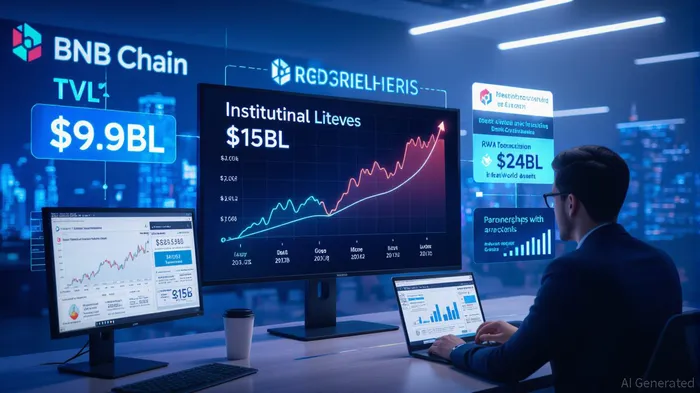
BNB Chain’s 2025 trajectory has been defined by a dual focus on technological innovation and institutional credibility, positioning it as a formidable player in the DeFi and blockchain ecosystem. The network’s Total Value Locked (TVL) surged 14% in Q2 2025 to $9.947 billion, driven by liquid staking and lending protocols, with projections suggesting a $15 billion milestone by year-end [1]. This growth is underpinned by infrastructure upgrades like the Lorentz and Maxwell hard forks, which reduced block times to 0.75 seconds and enabled gasless transactions via the Megafuel system, slashing gas fees to $0.01 per transaction [2]. These advancements have not only improved user experience but also attracted institutional capital, with over 30 publicly traded companies—including China Renaissance and Windtree Therapeutics—allocating $794 million to BNBBNB-- treasuries in 2025 [1].
The integration of Real-World Assets (RWA) further distinguishes BNB Chain’s value proposition. By tokenizing $24 billion in assets such as gold and U.S. Treasury Bills, the network is bridging traditional finance (TradFi) and DeFi through projects like USDO and JUSD [2]. This institutional-grade approach has been bolstered by strategic partnerships, such as PancakeSwap and Lista DAO’s $SolvBTC/$USD1 lending market, which expanded BNB Chain’s DeFi offerings [4]. Meanwhile, opBNB’s capacity to process 100 million daily transactions at low costs has solidified its role in gaming and DeFi applications [5].
However, BNB Chain faces headwinds. Q3 2025 saw a 19% decline in trading volume compared to SolanaSOL-- and ChainlinkLINK--, signaling competitive pressure [3]. Yet, the network’s deflationary mechanics—burning 31% of its initial supply by Q3 2025—reinforce scarcity and utility [1]. Anti-MEV protections and AI-powered smart wallets also address security and usability gaps, critical for sustaining institutional interest [5].
For investors, BNB Chain’s strategic focus on scalability, institutional adoption, and RWA integration presents a compelling case. While short-term volatility is inevitable, the ecosystem’s infrastructure upgrades and growing TVL suggest long-term value creation. The key question is whether BNB can maintain its momentum amid rapid advancements by rivals like Solana.
**Source:[1] BNB's Blockchain Revolution: A Path to New All-Time [https://www.ainvest.com/news/bnb-blockchain-revolution-path-time-highs-2025-2508/][2] The DeFi Revolution 2.0: How AI-Driven DEXs and RWA Platforms on BNB Chain Are Redefining Crypto Investment [https://www.ainvest.com/news/defi-revolution-2-0-ai-driven-dexs-rwa-platforms-bnb-chain-redefining-crypto-investment-2508/][3] Why Solana and Chainlink Are Outperforming BNB in Q3 2025 [https://www.ainvest.com/news/solana-chainlink-outperforming-bnb-q3-2025-2508/][4] Top 7 DeFi Projects to Watch on BNB Ecosystem in 2025 [https://bingx.com/en/learn/top-defi-projects-on-bnb-ecosystem][5] BNB's 2025 Roadmap: Why This Sleeper Crypto is Surging [https://www.21shares.com/en-us/research/newsletter-issue-261]

Decoding blockchain innovations and market trends with clarity and precision.
Latest Articles
Stay ahead of the market.
Get curated U.S. market news, insights and key dates delivered to your inbox.


AInvest
PRO
AInvest
PRO



Comments
No comments yet