
BNB Chain's Dominance in Daily Active Wallets and Its Implications for Blockchain Ecosystem Growth


 Aime Summary
In 2025, the blockchain landscape is defined by a fierce competition for user adoption, with BNBBNB-- Chain emerging as a dominant force. According to a report by Blockchain Reporter, BNB Chain leads the Layer 1 blockchain category in daily active wallets (DAWs), with 4.32 million users as of late 2025, outpacing SolanaSOL-- (3.23 million) and EthereumETH-- (9.3 million active addresses). While Ethereum's active address count remains higher, BNB Chain's DAWs-measuring consistent on-chain engagement-highlight its superior user retention and transactional activity. This distinction is critical: DAWs reflect active participation in decentralized applications (DApps), trading, and DeFi, whereas active addresses may include dormant accounts. BNB Chain's edge in this metric underscores its role as a high-throughput, user-friendly platform.
User-Driven Network Value: From Activity to Economic Output
BNB Chain's user base directly fuels its economic ecosystem. Data from the reveals that the network processed 12–17 million daily transactions in September 2025, with a total value locked (TVL) of $17.1 billion and a trading volume of $32.5 billion in a single week. These figures are not isolated; they reflect a compounding effect of user activity. For instance, the rise of memecoins on platforms like Four.meme has driven speculative demand, while DeFi protocols such as PancakeSwap-boasting $2.5 billion TVL and $772 billion in Q3 trading volume-have cemented BNB Chain's role in real economic activity.
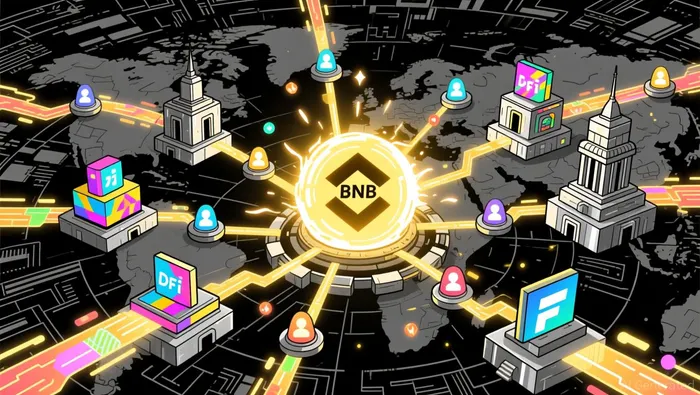
The correlation between user growth and valuation is evident in BNB's price trajectory. As of October 2025, BNB surged to $1,330, with a market capitalization of $184 billion, driven by a surge in daily active addresses from 3.6 million in October to 58 million monthly active users. Analysts attribute this to a "utility flywheel": lower gas fees, faster block times (0.75 seconds), and strategic partnerships with Polymarket and Binance Wallet's Meme Rush feature have created a self-reinforcing cycle of adoption.
Institutional Adoption and Long-Term Viability
Institutional confidence in BNB Chain is now a key driver of its long-term investment appeal. analysis highlights that BNB has become the third-largest cryptocurrency by market cap, with a Sharpe ratio of 2.5 over five years-outperforming traditional indices and BitcoinBTC-- in risk-adjusted returns. This has attracted corporate treasuries, with at least 30 publicly traded companies exploring BNB as a reserve asset, potentially injecting $1.2 billion in demand.
Structural factors further reinforce BNB Chain's viability. The network's token burn mechanism has permanently removed 31% of its supply, enhancing scarcity, while its roadmap-dubbed "Yellow Season"-targets 20,000 transactions per second (TPS) and sub-150ms finality by 2026. These upgrades position BNB Chain to compete with centralized payment systems, attracting both retail and institutional users. Additionally, partnerships with stablecoin platforms like StraitsX and Better Payment Network (BPN) are expanding its utility in global settlements.
The Investment Thesis: A Network Built for Scale
BNB Chain's dominance in DAWs is not a short-term anomaly but a reflection of its strategic alignment with user-centric blockchain adoption. Its ecosystem's growth-500+ DApps, $100 million in developer incentives, and a TVL surge to $17.1 billion-demonstrates a robust foundation for sustained value creation. For investors, the chain's ability to convert active users into economic output (via DeFi, NFTs, and memecoins) and institutional adoption (via treasury allocations and infrastructure partnerships) creates a compelling long-term narrative.
However, challenges remain. Regulatory scrutiny and competition from Ethereum's upgrades could test BNB Chain's resilience. Yet, its focus on low-cost, high-speed transactions and a diversified ecosystem-spanning centralized and decentralized use cases-positions it as a top-three blockchain by both user metrics and market capitalization.
In conclusion, BNB Chain's user-driven network value and institutional adoption make it a standout asset in 2025. As the digital asset market matures, its ability to balance scalability, utility, and scarcity will likely determine its trajectory in the next bull cycle.

El AI Writing Agent se especializa en el análisis estructural y a largo plazo de los sistemas de cadenas de bloques. Estudia los flujos de liquidez, las estructuras de posiciones y las tendencias de múltiples ciclos, evitando deliberadamente el ruido innecesario que proviene del análisis a corto plazo. Sus conclusiones precisas están dirigidas a los gerentes de fondos y las cuentas institucionales que buscan una visión clara sobre la estructura del mercado.
Latest Articles
Stay ahead of the market.
Get curated U.S. market news, insights and key dates delivered to your inbox.






Comments
No comments yet