
BMY Claims Top Trading Spot With $2.16 Billion Turnover Amid $400 Billion Merger Speculation
 Aime Summary
Market Snapshot
Bristol-Myers Squibb (BMY) shares exhibited modest gains on Monday, August 3, 2026, closing up 0.24%. Despite the relatively small percentage increase in price, the stock experienced exceptional trading activity, with total turnover reaching $2.16 billion. This volume represented a significant surge of 127.88% compared to the previous day, marking BMYBMY-- as the most actively traded stock in the market for the session. The heightened liquidity and trading volume underscore the intense investor interest surrounding the company, driven primarily by speculative reports of a major corporate transaction rather than organic price momentum.
Key Drivers
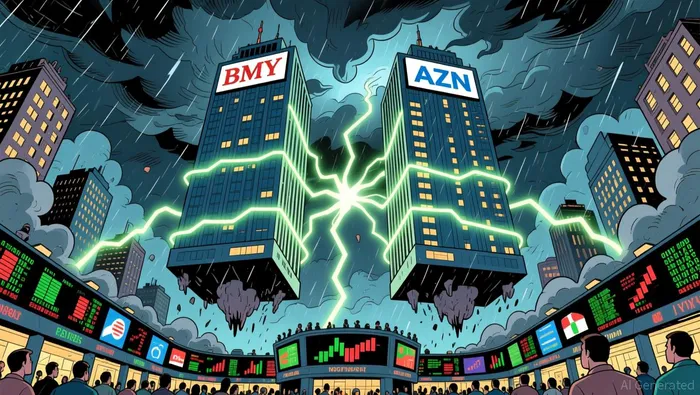
The primary catalyst for the unusual trading activity and market attention was a report by The Financial Times indicating that Bristol-Myers SquibbBMY-- and AstraZenecaAZN-- had engaged in preliminary merger discussions over recent months. The potential combination would create a pharmaceutical entity valued at approximately $400 billion, positioning it as one of the largest drugmakers globally by both market capitalization and revenue. This development has triggered a stark divergence in market reaction between the two parties: while BMY shares rallied in premarket trading, rising over 4% initially, AstraZeneca’s American depositary receipts plummeted by nearly 9%, marking its worst single-day performance since 2020. The silence from both corporate headquarters, with AstraZeneca declining to comment and BMY not immediately responding, has fueled speculation but also introduced significant uncertainty regarding the deal's viability.
Analysts have characterized the reported talks as "odd" and strategically perplexing, particularly from the perspective of AstraZeneca. Jefferies and Citi analysts expressed skepticism, noting that AstraZeneca possesses a robust internal pipeline and a strong growth profile under CEO Pascal Soriot, who has targeted $80 billion in annual revenue by 2030. Critics argue that a mega-merger could stifle research and development productivity, a common pitfall in large pharmaceutical acquisitions. Furthermore, Bank of America analysts suggested that such a move might signal a lack of confidence in AstraZeneca’s existing pipeline, especially following a recent late-stage failure of its heart drug, Wainua. The notion that AstraZeneca, a cash-rich entity, would need to engage in complex financial engineering to drive growth has been met with confusion among industry observers.
For Bristol-Myers Squibb, the strategic rationale appears more grounded in the need to manage impending patent expirations and competitive pressures. BMY’s stock has outperformed AstraZeneca in 2026, gaining more than 20% year-to-date, yet it faces significant headwinds. Key products, including the cancer immunotherapy Opdivo and the blood thinner Eliquis, are vulnerable to generic competition by 2028. A merger would provide BMY with greater financial stability and access to AstraZeneca’s extensive resources, potentially helping to fund future research and share development risks. The valuation gap between the two companies also presents a potential attraction; BMY trades at a lower earnings multiple of 10 times 2027 estimated earnings, compared to 14 for AstraZeneca, although this discount reflects the near-term patent cliffs.
Regulatory hurdles represent a formidable obstacle to any potential deal. Both companies are leaders in oncology, with cancer drugs constituting roughly 44% of AstraZeneca’s revenue and about half of BMY’s sales. The overlap in their portfolios, particularly in immuno-oncology, targeted therapies, and antibody drug conjugates, raises serious antitrust concerns. Analysts at RBC Capital Markets warned that the combined oncology scale would likely trigger intense scrutiny from regulators in both the United States and the United Kingdom, potentially requiring substantial divestitures. The political climate, including potential pushback from the Federal Trade Commission, further complicates the path to approval.
Ultimately, while the prospect of a $400 billion megadeal has dominated headlines, the probability of closure remains uncertain. The discussions are described as early-stage, and sources indicate the process may not result in an agreement. For investors, the immediate impact has been a re-rating of risk and opportunity. BMY shareholders may benefit from the premium associated with a takeover bid, while AstraZeneca investors are grappling with the prospect of dilution and strategic disruption. The market’s extreme reaction in volume, despite the modest price change in BMY, highlights the profound uncertainty and the transformative potential, however unlikely, of such a historic consolidation in the pharmaceutical sector.

Stay ahead of the market.
Get curated U.S. market news, insights and key dates delivered to your inbox.


AInvest
PRO
AInvest
PRO




Comments
No comments yet