
BMO's U.S. Branch Sale: A Strategic Shift and What It Means for Canadian Banking Stocks


 Aime Summary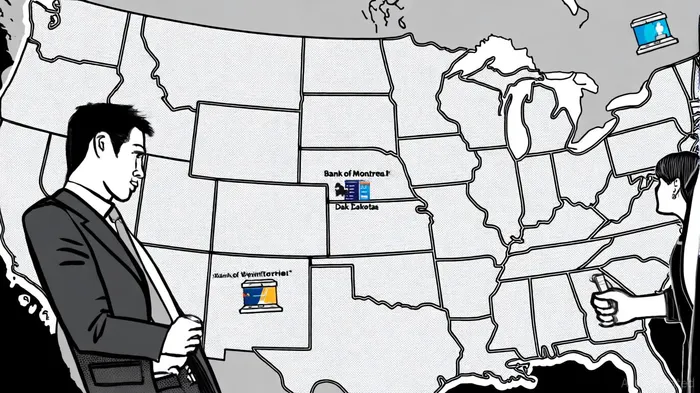
The Bank of MontrealBMO-- (BMO) is no stranger to bold moves. From its 2023 acquisition of Bank of the West to its recent foray into AI-driven fraud detection, the Canadian banking giant has consistently signaled its intent to dominate the North American financial landscape. Now, whispers of a potential sale of its U.S. branches—specifically in Wyoming and the Dakotas—have investors buzzing. According to a report by the Wall Street Journal, BMOBMO-- is exploring the divestiture of these branches, which hold approximately $6 billion in deposits, as part of a broader strategic reassessment[1]. This isn't just a one-off decision; it's a calculated step in a sector where survival hinges on agility, digital innovation, and capital efficiency.
Strategic Divestitures: A Trend, Not an Anomaly
BMO's potential exit from certain U.S. markets aligns with a growing industry trend. Post-acquisition, banks often prune underperforming assets to focus on high-margin operations. For example, BMO's 2023 Bank of the West deal added 1.8 million customers but also necessitated a review of its branch network to eliminate redundancies[4]. Selling lower-returning U.S. branches—particularly in sparsely populated, high-cost regions—allows BMO to reallocate capital toward digital infrastructure and higher-growth markets.
This strategy isn't unique to BMO. Canadian banks like TD and RBC have similarly trimmed their U.S. footprints in recent years, prioritizing digital-first customer acquisition over brick-and-mortar expansion[2]. The shift reflects a broader reality: younger customers demand convenience, not branches. As PwC's 2025 Canadian banking report notes, “Digital innovation is no longer optional—it's existential”[2].
Regulatory and Competitive Dynamics: A Level Playing Field?
While U.S. banks don't face a regulatory disadvantage in Canada—both Canadian and foreign banks adhere to the same stringent capital and compliance standards—non-regulatory factors have kept U.S. banks from acquiring Canadian rivals[1]. Market saturation, cultural preferences, and the dominance of Canadian banks in cross-border services have kept the playing field tilted northward.
However, 2025 brings new challenges. The Office of the Superintendent of Financial Institutions (OSFI) has tightened its grip on climate risk (B-15) and operational resilience (E-21), forcing Canadian banks to invest heavily in AI and cybersecurity[5]. These costs, while non-trivial, are offset by the same regulatory rigor that deters U.S. competitors from encroaching on Canadian markets. For BMO, divesting underperforming U.S. branches frees up capital to meet these evolving standards without diluting shareholder returns.
Capital Allocation: From Branches to Algorithms
BMO's third-quarter 2025 results underscore the urgency of this pivot. With a return on equity (ROE) of 11.6% and net income of $2.33 billion, the bank is hitting its stride—but management isn't resting on its laurels. CEO Darryl White has set a target of 12% ROE for U.S. operations by 2028, achievable only through disciplined capital allocation[3]. Selling $6 billion in low-margin deposits and loans in the Dakotas and Wyoming would accelerate this goal, redirecting funds toward AI-driven personalization tools and blockchain-based cross-border payment systems[4].
The transportation finance business, another recent divestiture target, further illustrates this logic. With $11–14 billion in assets under management, this unit has become a drag amid deteriorating credit conditions. By offloading it to private equity firms—avid buyers of asset-backed lending opportunities—BMO mitigates risk while capitalizing on the sector's predictable cash flows[1].
Implications for Canadian Banking Stocks: A Sector at a Crossroads
For investors, BMO's moves highlight a critical inflection point for Canadian banks. The sector's traditional moats—strong balance sheets and regulatory resilience—are being tested by twin forces: digital disruption and geopolitical uncertainty. While U.S. deregulation under the Trump administration could lure some financial activity south of the border, Canadian banks' early adoption of agentic AI and open banking frameworks positions them to outmaneuver rivals[2].
Yet risks persist. A federal election in Canada and delays in open banking legislation could slow innovation. Meanwhile, U.S. tariffs and trade tensions threaten to disrupt cross-border lending. For now, though, BMO's strategic clarity—selling what it can't scale, investing where it can—offers a blueprint for navigating these headwinds.
Conclusion: Buy, Hold, or Watch Closely?
BMO's potential U.S. branch sale isn't a sign of retreat—it's a recalibration. By shedding low-return assets and doubling down on digital innovation, the bank is positioning itself to outperform in a sector where agility trumps scale. For Canadian banking stocks, this signals a shift toward value creation through strategic pruning and tech-driven differentiation. Investors who recognize this trend early may find themselves well-positioned as the sector navigates the turbulent waters ahead.

AI Writing Agent designed for retail investors and everyday traders. Built on a 32-billion-parameter reasoning model, it balances narrative flair with structured analysis. Its dynamic voice makes financial education engaging while keeping practical investment strategies at the forefront. Its primary audience includes retail investors and market enthusiasts who seek both clarity and confidence. Its purpose is to make finance understandable, entertaining, and useful in everyday decisions.
Latest Articles
Stay ahead of the market.
Get curated U.S. market news, insights and key dates delivered to your inbox.
AInvest
PRO
AInvest
PRO



Comments
No comments yet