
BMNR's Ethereum Holdings: Navigating Corporate Governance and Political Risk in Institutional Crypto Allocations


 Aime Summary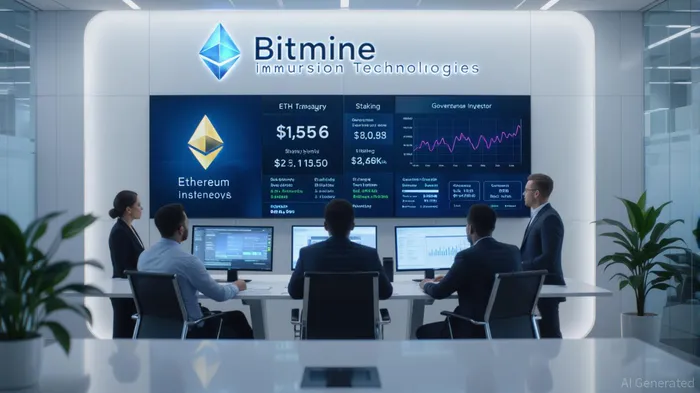
The institutional adoption of EthereumETH-- has reached a pivotal inflection point in 2025, with firms like Bitmine Immersion TechnologiesBMNR-- (BMNR) redefining the interplay between corporate governance, political risk, and digital assetDAAQ-- allocation. As the largest public holder of Ethereum, BMNR's $6.6 billion ETH treasury—accumulated through aggressive capital-raising strategies—has positioned it as a bellwether for institutional-grade crypto finance. However, its success hinges on a delicate balance between regulatory agility, governance transparency, and strategic political engagement.
Corporate Governance as a Strategic Lever
BMNR's governance structure is a masterclass in institutional credibility. The board, led by Tom Lee (a crypto bull and former Fundstrat Global Advisors co-founder) and CEO Jonathan Bates, is bolstered by Ethereum co-founder Joseph Lubin. This alignment with Ethereum's core development team not only legitimizes BMNR's technical expertise but also provides a direct conduit to influence regulatory outcomes. For instance, Lubin's advisory role has been instrumental in shaping BMNR's advocacy for Ethereum's post-Merge normalization, a narrative that resonates with institutional investors seeking stable, utility-driven assets.
The firm's governance model emphasizes transparency through regular SEC filings (Form 10-K, prospectus supplements) and a $1 billion share repurchase program, which mitigates dilution risks from its 13-fold share count expansion since 2023. This institutional-grade compliance framework is critical in an environment where 57% of surveyed institutional investors (Coinbase/EY-Parthenon, 2025) cite regulatory clarity as the primary catalyst for digital asset growth.
Political Risk Mitigation in a Shifting Regulatory Landscape
BMNR's political risk strategy is anchored in proactive regulatory engagement. The SEC's March 2025 guidance, which clarified that proof-of-work mining does not implicate securities laws, directly reduced compliance burdens for BMNR, enabling it to focus on scaling its Ethereum treasury. Similarly, its alignment with the EU's Markets in Crypto-Assets (MiCA) directive and the U.S. SEC's GENIUS Act positions it to benefit from standardized stablecoin and custody frameworks.
However, BMNR's reliance on equity issuance (e.g., $250 million private placement in July 2025) introduces dilution risks that could erode shareholder value during market downturns. To counter this, the firm has reinvested staking yields into an “mNAV flywheel” model, which generates compounding returns while maintaining institutional-grade capital efficiency. This approach mirrors academic insights on tokenized governance structures, where smart contracts automate risk mitigation and align incentives across stakeholders.
Institutional Allocations and the DAO Paradigm
Recent academic studies highlight the growing relevance of Decentralized Autonomous Organizations (DAOs) in institutional Ethereum allocations. For example, the Arbitrum DAO's multi-stage governance model—featuring a “temperature check” phase before formal voting—offers a blueprint for transparent, decentralized decision-making. Institutional investors are increasingly allocating capital to Ethereum-based projects governed by such frameworks, as they reduce operational risks and enhance accountability.
BMNR's strategic pivot to Ethereum treasury operations aligns with this trend. By positioning itself as a custodian of Ethereum's institutional-grade infrastructure, BMNR taps into a market where 73% of institutional investors now hold cryptocurrencies beyond BitcoinBTC-- (Coinbase/EY-Parthenon, 2025). This shift is further amplified by BMNR's ESG-aligned immersion cooling and green energy partnerships, which mitigate environmental risks and appeal to sustainability-focused investors.
Regulatory Uncertainty and the Path Forward
Despite BMNR's proactive strategies, regulatory uncertainty remains a wildcard. The SEC's July 2025 guidance on in-kind creations for crypto ETPs could force BMNR to adapt its custody protocols, potentially increasing operational costs. Additionally, geopolitical shifts—such as China's crypto restrictions or the EU's MiCA implementation—could disrupt cross-border capital flows.
Investors must weigh these risks against BMNR's institutional backing from firms like Ark Invest and Founders Fund, which have validated its vision of acquiring 5% of the global Ethereum supply. Cathie Wood's endorsement of BMNR as a “blockchain-era asset manager” underscores its potential to shape DeFi and on-chain capital markets.
Investment Thesis and Strategic Positioning
BMNR's Ethereum holdings represent a high-conviction bet on the institutionalization of digital assets. Its governance structure, regulatory agility, and political connections create a moat against competitors, while its ESG initiatives and staking flywheel model enhance long-term value. However, investors should monitor:
1. Dilution risks from aggressive capital-raising.
2. Regulatory shifts in the U.S. and EU.
3. Ethereum's price volatility and its impact on BMNR's balance sheet.
For those with a 3–5 year horizon, BMNR offers exposure to Ethereum's institutional adoption while navigating the complex interplay of governance, politics, and market dynamics. As the crypto ecosystem matures, firms that combine technical expertise with regulatory foresight—like BMNR—will likely outperform peers in this high-risk, high-reward space.

Mezclando la sabiduría tradicional en el comercio con las perspectivas más avanzadas sobre las criptomonedas.
Latest Articles
Stay ahead of the market.
Get curated U.S. market news, insights and key dates delivered to your inbox.
AInvest
PRO
AInvest
PRO



Comments
No comments yet