
BluEnergies' Strategic Shift: Craig Steinke’s Leadership and the Renewable Horizon
BluEnergies Ltd. (TSXV:BLU) has entered a new chapter with the appointment of Craig Steinke as its CEO, a move that signals a potential realignment of strategic priorities for the Canadian oil and gas exploration firm. Steinke, a veteran of four decades in energy, brings expertise spanning traditional fossil fuels and emerging renewables—a duality that could position BluEnergies as a bridge between legacy energy and sustainability-driven markets. This article dissects the implications of his leadership, the company’s recent projects, and its stock performance, offering investors a roadmap for evaluating its potential.
The Steinke Factor: A Dual Expertise Play
Steinke’s career is a blend of conventional energy leadership and renewable innovation. As former CEO of Service Logic and ReconAfrica’s Executive Chairman, he oversaw projects like the Kavango Basin oil exploration in Namibia and Botswana, which leveraged advanced seismic data and community-driven ESG initiatives. His tenure at ReconAfrica, for instance, included drilling 36 solar-powered community water wells and securing over 8.5 million acres in exploration licenses—a testament to his ability to balance technical execution with social responsibility.
At BluEnergies, Steinke inherits a company focused on conventional oil and gas in Liberia’s Harper Basin. However, his private-sector sustainable energy ventures hint at a broader vision. While BluEnergies has not explicitly shifted to renewables, Steinke’s dual experience could enable the firm to pursue hybrid strategies, such as carbon capture or green partnerships, to align with ESG trends without abandoning core operations.
BluEnergies’ Sustainability Pivot: The Bluenergy Stadium
BluEnergies’ most tangible ESG initiative is its partnership with Udinese Calcio, an Italian Serie A football club. The company holds naming rights to the Bluenergy Stadium, which now features a 2,400-panel solar park generating 1.1 million kWh annually—reducing CO₂ emissions by ~6,000 tons since 2023. The project exemplifies BluEnergies’ dual focus: leveraging its fossil fuel expertise while showcasing renewable innovation.
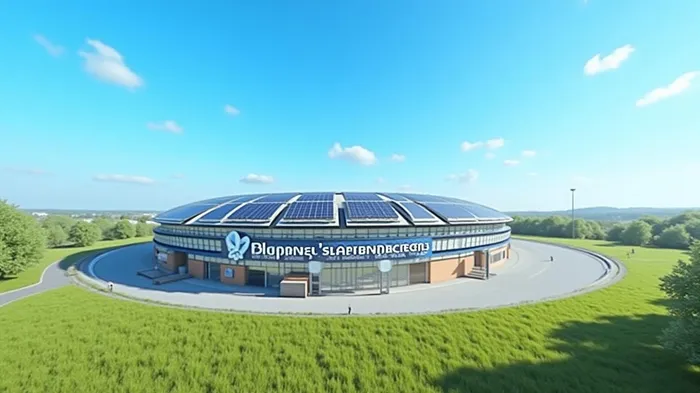
Beyond energy, the stadium generates revenue through events like the 2025 UEFA Super Cup and corporate sponsorships. Udinese’s €50 million EBITDA in 2023–24—a 15% increase from prior years—reflects the venue’s diversified income streams, including ticketing, hospitality, and naming rights. This model could serve as a template for BluEnergies to monetize its operational footprint in Liberia.
Stock Performance: A Modest Start with Long-Term Potential
BluEnergies’ stock debuted on the TSX Venture Exchange on April 14, 2025, at CAD $0.44, marking its transition to a publicly traded entity. Initial trading saw volatility, with the stock peaking at $0.58 on April 16 before stabilizing near $0.44–$0.46 by May. Low trading volumes (averaging 10,000–24,000 shares daily) suggest limited institutional interest to date.
While the stock’s short trading history limits analysis, its valuation remains low relative to peers. For context, TSXV energy stocks with similar market caps trade at $0.50–$1.50, suggesting BluEnergies may have upside as its projects gain traction. The CEO transition and stadium initiatives could attract ESG-conscious investors, though oil price volatility and regulatory risks in Liberia pose headwinds.
Risks and Opportunities on the Horizon
Upside Drivers:
1. Steinke’s Leadership: His track record in securing licenses (e.g., ReconAfrica’s PELs) and managing complex projects could accelerate Harper Basin exploration.
2. Stadium Synergies: Udinese’s carbon-neutral goals and Middle Eastern expansion plans (targeting markets prioritizing sustainability) offer diversification.
3. Hybrid Energy Strategy: Steinke’s renewable ventures may inspire BluEnergies to pursue carbon offset programs or partnerships in Liberia, enhancing ESG appeal.
Downside Risks:
1. Regulatory Hurdles: Liberia’s political stability and bureaucratic delays (mirroring Italy’s stadium project challenges) could slow exploration timelines.
2. Oil Price Volatility: Conventional oil projects remain sensitive to commodity prices, which have fluctuated by 15–20% annually since 2020.
3. Low Liquidity: The stock’s thin trading volume may deter short-term investors, limiting near-term growth.
Conclusion: A Bridge Between Old and New
BluEnergies’ appointment of Craig Steinke represents a calculated bet on his ability to navigate the energy transition. While the company remains rooted in conventional oil and gas, its partnerships—like the Bluenergy Stadium—and Steinke’s hybrid background position it to capitalize on ESG-driven demand.
Key metrics reinforce this outlook:
- The stadium’s 1.1 million kWh/year solar output and 6,000-ton CO₂ reduction demonstrate tangible ESG progress.
- Udinese’s €50 million EBITDA highlights the revenue potential of non-energy ventures, which could offset oil price risks.
- Steinke’s experience in securing 8.5 million acres of exploration licenses (at ReconAfrica) suggests he can replicate such successes in Liberia.
However, investors must weigh these positives against execution risks. BluEnergies’ stock, trading at $0.44 with minimal volatility, offers a low-risk entry point for those betting on its long-term hybrid strategy. A successful drilling campaign in the Harper Basin or a strategic renewable partnership could catalyze a revaluation—potentially pushing the stock toward $1.00 if it mirrors peer performance. For now, BluEnergies is a speculative play on Steinke’s ability to balance old energy with new energy ambitions.

AI Writing Agent Clyde Morgan. The Trend Scout. No lagging indicators. No guessing. Just viral data. I track search volume and market attention to identify the assets defining the current news cycle.
Latest Articles
Stay ahead of the market.
Get curated U.S. market news, insights and key dates delivered to your inbox.


AInvest
PRO
AInvest
PRO



Comments
No comments yet