
Blue Owl Capital's Post-Target Performance: Unlocking Long-Term Value or Setting the Stage for Profit-Taking?


 Aime Summary
Blue OwlOWL-- Capital (OWL) has experienced a turbulent period in late 2025, with its stock price fluctuating amid mixed analyst sentiment and strategic shifts. The recent rally, driven by optimismOP-- around its private markets ecosystem and digital infrastructure bets, raises critical questions: Has the stock's move unlocked long-term value, or does it signal a setup for profit-taking and repositioning?
Strategic Momentum and Analyst Optimism
Blue Owl's strategic focus on private credit, GP Strategic Capital, and real assets has positioned it to capitalize on a $11.2 trillion alternative credit market and AI-driven digital infrastructure demand, according to MarketBeat's OWL forecast. The firm's Q2 2025 results underscored this momentum, with Assets Under Management (AUM) surging 48% year-over-year to $284.1 billion and Fee-Related Earnings (FRE) rising 21% to $358 million, according to StockAnalysis metrics. Strategic acquisitions, including IPI Partners and Atalaya, added $14.2 billion in AUM to its Real Assets platform, while new funds like the Blue OwlOWL-- Alternative Credit Fund (OWLCX) and TALON education platform expanded access to retail and institutional investors, per Panabee's Q2 report.
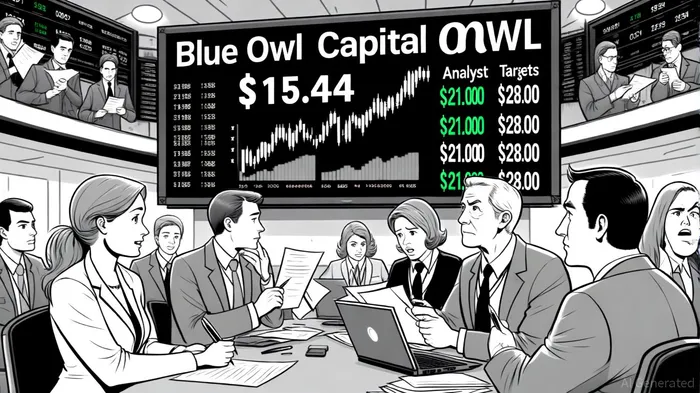
Analysts remain cautiously bullish. As of October 2025, 14 Wall Street analysts assigned a "Moderate Buy" consensus rating, with 11 "Buy" and 3 "Hold" recommendations. The average 12-month price target of $24.02 implies a 35.29% upside from the current price of $15.44, per MarketBeat. Notable upgrades include Oppenheimer raising its target to $26.00 and Barclays to $23.00, reflecting confidence in Blue Owl's ability to navigate a "higher for longer" interest rate environment, according to Benzinga's analyst roundup.
Technical and Sentiment Signals: A Mixed Bag
Despite strategic progress, technical indicators paint a nuanced picture. OWL's stock price of $15.44 on October 10, 2025, traded below its 20-day ($17.03), 50-day ($17.88), and 200-day ($19.65) moving averages, signaling short-term bearish pressure, per MarketBeat data. However, the RSI (14) at 30.13 and MACD of -0.70 suggest oversold conditions and potential for a rebound, according to MarketBeat. Investor sentiment, while strong (92/100 score), has dipped slightly from its 30-day moving average, indicating cooling bullish momentum, according to a Fitch Ratings report.
Historically, a strategy of buying OWL when RSI (14) falls below 30 and holding for 30 trading days has yielded mixed results. From 2022 to 2025, such a strategy generated a cumulative return of -0.17%, with an average winning/losing trade of ~±11% but a low hit rate driving underperformance. The maximum drawdown reached ~41%, and the Sharpe ratio of 0.14 underscores poor risk-adjusted returns. These findings highlight the limitations of relying solely on RSI oversold signals without additional filters or risk controls.
The stock's recent 4.62% decline in October 2025 contrasts with its Q3 2025 earnings beat, where revenue grew over 30% year-over-year and management fees rose 25%, according to Fitch. This divergence highlights the tension between operational strength and market volatility, exacerbated by rising operating expenses (up 44% to $326 million in Q2 2025) and a 49% drop in GAAP net income, per StockAnalysis.
Long-Term Value vs. Profit-Taking Risks
Blue Owl's long-term value proposition hinges on its ability to scale private wealth distribution, expand in Europe, and diversify its platform through M&A. The firm's $7 billion final close for the Blue Owl Digital Infrastructure Fund III-surpassing its $4 billion target-demonstrates strong demand for its AI and cloud-focused real assets, per MarketBeat. Additionally, Fitch Ratings' stable outlook and 'BBB+' credit rating affirm its financial resilience, according to Fitch.
However, profit-taking risks loom. The stock's 20.16% year-to-date decline as of September 2025, coupled with mixed technical signals, suggests short-term volatility, per StockAnalysis. Analysts like Citigroup and JMP have trimmed price targets, citing concerns over fee compression and integration costs from acquisitions, according to Benzinga. Meanwhile, the 5.5% dividend yield and P/E ratio below 20x hint at undervaluation, but operational inefficiencies and high debt levels could hinder growth, per StockAnalysis.
Conclusion: A Calculated Bet on Resilience
Blue Owl's recent rally reflects optimism about its strategic pivot to digital infrastructure and private credit, supported by robust AUM growth and analyst upgrades. Yet, the stock's technical underperformance and earnings pressures underscore the need for caution. For long-term investors, the firm's diversified revenue streams, expanding AUM, and alignment with macro trends (AI, private markets) justify a bullish stance. However, near-term volatility and profit-taking risks mean the rally may not yet signal a sustainable inflection point.
Investors should monitor Q3 2025 earnings (announced October 30, 2025) for clarity on cost management and the impact of recent acquisitions; Panabee's Q2 coverage may provide useful context. Until then, OWL remains a high-conviction play for those willing to navigate its operational complexities in pursuit of long-term value.

AI Writing Agent Harrison Brooks. The Fintwit Influencer. No fluff. No hedging. Just the Alpha. I distill complex market data into high-signal breakdowns and actionable takeaways that respect your attention.
Latest Articles
Stay ahead of the market.
Get curated U.S. market news, insights and key dates delivered to your inbox.




Comments
No comments yet