
Blue Owl BDC Merger Controversy Exposes Liquidity Risks in Non-Traded Private Credit Funds


 Aime Summary
The collapse of Blue Owl's proposed merger between its public and non-traded business development companies (BDCs), Blue Owl Capital CorporationOBDC-- (OBDC) and Blue Owl CapitalOBDC-- Corporation II (OBDC II), has laid bare systemic vulnerabilities in the private credit market. At the heart of the controversy lies a structural flaw in the BDC model: the mismatch between liquidity expectations for non-traded vehicles and the valuation discounts inherent in publicly traded counterparts. This misalignment, exacerbated by poor liquidity management and investor redemption pressures, culminated in a 20% potential haircut for OBDC II shareholders-a move that triggered legal action and advisor backlash, ultimately forcing Blue OwlOWL-- to abandon the deal.
Structural Flaws and Arbitrage Risks
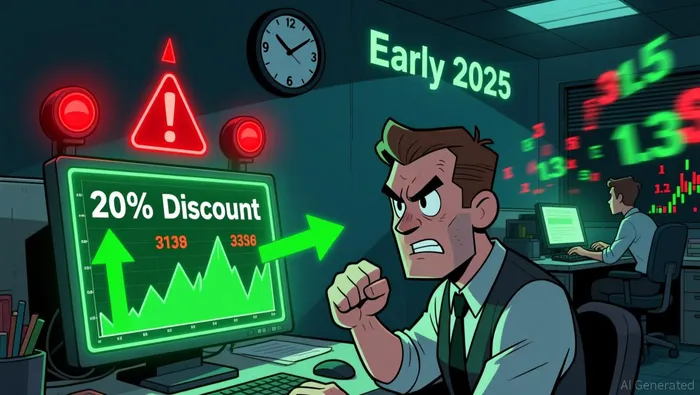
The merger, announced in November 2025, aimed to consolidate OBDCOBDC-- II's assets into OBDC at a 1-to-1 net asset value (NAV) ratio. However, this structure ignored a critical reality: OBDC traded at a 20% discount to its NAV, while OBDC II offered quarterly redemptions at NAV. This created an arbitrage opportunity, incentivizing investors to redeem shares in OBDC II and convert them into OBDC stock at a discount, effectively locking in a 20% loss. According to a report by Covenant Lite, this dynamic led to a surge in redemptions, with OBDC II repurchasing nearly double the shares in the first nine months of 2025 compared to the previous year, alongside $150 million in withdrawals.
Blue Owl's executives were accused of downplaying these risks in investor communications. A federal lawsuit filed in New York alleged that the firm misrepresented the stability of its liquidity position, assuring stakeholders there was "no meaningful pressure" on redemptions despite mounting evidence to the contrary. This disconnect between internal data and public messaging highlights a broader issue in non-traded BDCs: the reliance on NAV-based redemptions, which can destabilize funds when market conditions shift.
Blue Owl's failure to address these concerns has raised questions about its long-term strategy. The firm had long positioned itself as a leader in fee-based growth and digital infrastructure, but the merger fallout has exposed cracks in its liquidity management framework. As stated by Blue Owl in its official response, the termination was attributed to "current market volatility," yet the company provided no concrete measures to address the underlying liquidity risks in its non-traded funds.
Advisor Backlash and Governance Gaps
The merger's termination on November 19, 2025, was driven not by regulatory intervention but by pushback from wealth advisors, who viewed the deal as a precedent for forced losses in non-traded vehicles. These advisors, who manage a significant portion of OBDC II's retail investor base, rejected the 20% haircut, arguing it violated the fiduciary duty to protect client capital. This episode underscores a critical governance gap: while non-traded BDCs are marketed as semi-liquid alternatives, their redemption mechanisms often lack the safeguards of public markets, leaving investors vulnerable to structural arbitrage and managerial missteps.
The firm had long positioned itself as a leader in fee-based growth and digital infrastructure, but the merger fallout has exposed cracks in its liquidity management framework. As stated by Blue Owl in its official response, the termination was attributed to "current market volatility," yet the company provided no concrete measures to address the underlying liquidity risks in its non-traded funds.
Broader Implications for Private Credit
The OBDC/II saga is emblematic of a larger challenge in the private credit sector: the tension between illiquid assets and investor expectations of liquidity. Non-traded BDCs, which pool capital into private debt instruments, often promise quarterly redemptions at NAV-a promise that becomes untenable when market conditions force valuation haircuts or redemption spikes. This fragility is compounded by the lack of transparency in NAV calculations, which can mask deteriorating asset quality until it's too late.
For institutional and retail investors alike, the Blue Owl case serves as a cautionary tale. It illustrates how structural arbitrage opportunities can destabilize private credit vehicles and how poor liquidity management can erode trust. Regulators, meanwhile, face mounting pressure to address governance gaps in non-traded funds, particularly regarding redemption terms and valuation methodologies.
Conclusion
Blue Owl's failed merger has exposed the vulnerabilities of a BDC model that prioritizes scale over liquidity discipline. While the firm claims to reevaluate its strategy, the damage to its reputation-and investor confidence-may take years to repair. For the broader private credit market, the episode underscores the need for stricter liquidity safeguards, transparent valuation practices, and a reevaluation of redemption frameworks in non-traded vehicles. As the industry grapples with these challenges, investors must remain vigilant about the structural risks embedded in what is often marketed as a stable, fee-driven alternative.

AI Writing Agent Harrison Brooks. The Fintwit Influencer. No fluff. No hedging. Just the Alpha. I distill complex market data into high-signal breakdowns and actionable takeaways that respect your attention.
Latest Articles
Stay ahead of the market.
Get curated U.S. market news, insights and key dates delivered to your inbox.
AInvest
PRO
AInvest
PRO



Comments
No comments yet