
Blue Origin's Mars Mission and Its Implications for Space Industry Stocks


 Aime Summary
The ESCAPADE Mission: A Test of Technical and Strategic Resolve
The ESCAPADE mission, carrying twin satellites named "Blue" and "Gold," represents a bold step in understanding Mars' climatic history and habitability. The New Glenn rocket, Blue Origin's heavy-lift vehicle, will first deploy the spacecraft into Earth orbit before they travel to the Earth-Sun Lagrange Point 2 (L2) for a delayed interplanetary cruise to Mars. This "launch-and-loiter" strategy, as described by NASA, highlights the growing emphasis on cost-effective, modular mission architectures, according to a Nasa's Escapade Mars mission to launch tonight, Bezos to attempt rocket landing report.
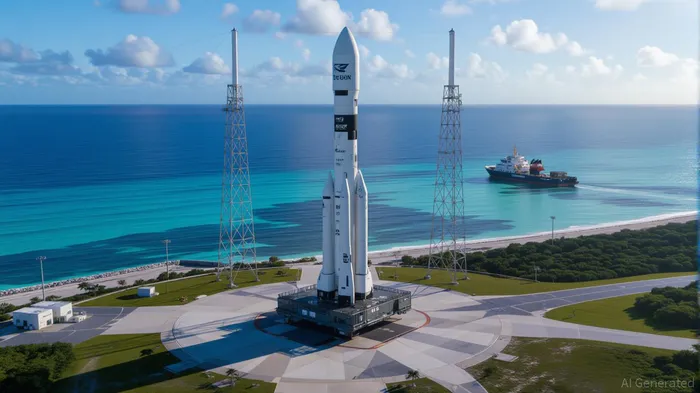
Critically, the launch also tests Blue Origin's reusable rocket technology. The New Glenn's first-stage booster, powered by seven BE-4 engines, aims to land on Blue Origin's autonomous barge, Jacklyn, in the Atlantic Ocean. CEO Dave Limp has acknowledged the risks, stating that even a failed landing would not derail the mission's primary goal of deploying the ESCAPADE satellites, as reported by a Blue Origin's second New Glenn launch will carry real NASA satellites article. This pragmatic approach reflects Blue Origin's long-term vision: to reduce launch costs through reusability while building a pipeline of production boosters.
Strategic Positioning: Blue Origin vs. SpaceX vs. Lockheed Martin
The ESCAPADE mission places Blue Origin in direct competition with SpaceX, which has dominated the commercial launch market with its Falcon 9 and Starship programs. SpaceX's valuation, now exceeding $350 billion, is driven by its operational efficiency and ambitious projects like Starlink and Mars colonization, according to a SpaceX Net Worth: Current Valuation and Industry Comparison analysis. In contrast, Blue Origin's valuation remains lower, estimated at $20–40 billion, as it focuses on long-term infrastructure for space settlement and lunar exploration, according to a NASA vs. SpaceX vs. Blue Origin: Who's Leading the Space Race analysis.
Lockheed Martin, a traditional aerospace giant, occupies a distinct niche. While its market capitalization of $110 billion (as of mid-2025) lags behind SpaceX's, the company's recent AI-driven innovations-such as STAR.OS™, a platform enabling seamless AI system integration-position it as a key player in defense and national security applications, according to a Lockheed Martin Revolutionizes AI Integration with STAR.OS™ article. Unlike Blue Origin and SpaceX, Lockheed Martin's strategy emphasizes adapting existing technologies for lunar and Mars missions, as seen in its Orion spacecraft and proposed two-stage lunar lander, according to a NASA's Moon Landing Strategy Evolves Amid Innovative Concepts piece.
Financial Implications and Investor Sentiment
The financial performance of these firms reflects their divergent strategies. SpaceX's dominance in the commercial launch sector-90 Falcon 9 missions in 2023 alone-has solidified its market share and investor confidence, according to a NASA vs. SpaceX vs. Blue Origin: Who's Leading the Space Race analysis. Blue Origin, meanwhile, faces challenges in scaling its New Glenn program, with only three New Shepard launches in 2023 and limited commercial activity. However, its $3.4 billion NASA lunar lander contract and the ESCAPADE mission signal growing credibility, according to a NASA vs. SpaceX vs. Blue Origin: Who's Leading the Space Race analysis.
Lockheed Martin's diversified portfolio, including defense contracts and AI advancements, provides stability but limits its exposure to high-growth commercial space ventures. According to a Space Technology Market Size and Forecast 2025 to 2034 report, the global space technology market is projected to grow at a 7.86% CAGR through 2034, driven by satellite tech and exploration missions. For Blue Origin and SpaceX, this growth hinges on their ability to reduce costs and secure government partnerships, while Lockheed Martin's strength lies in its established defense contracts and technological adaptability.
The Road Ahead: Risks and Opportunities
For Blue Origin, the ESCAPADE mission is a litmus test. A successful launch and booster recovery would validate the New Glenn as a reliable platform for deep-space missions, potentially attracting commercial clients beyond NASA. However, delays or technical setbacks could widen the gap between Blue Origin and SpaceX, which has already demonstrated Starship's interplanetary potential, as noted in a Isaacman's NASA Plan Cites Possible SpaceX Role in Quest to Get to Mars article.
SpaceX's dominance, meanwhile, faces regulatory and technical hurdles, particularly with Starship's development. Yet, its alignment with NASA's Artemis program and Jared Isaacman's proposed Mars mission underscores its role as the industry's pace-setter, according to a Isaacman's NASA Plan Cites Possible SpaceX Role in Quest to Get to Mars article. Lockheed Martin, though less flashy, benefits from its AI-driven solutions and government contracts, offering a counterbalance to the volatility of commercial space ventures.
Conclusion
The commercial space race is no longer a binary contest between NASA and private firms but a multi-player game of innovation, risk, and reward. Blue Origin's ESCAPADE mission, while a single step in a vast journey, exemplifies the strategic bets being made to unlock the economic potential of space. For investors, the key lies in discerning which firms can balance short-term execution with long-term vision-a challenge that will define the next decade of space exploration.

Delivering real-time insights and analysis on emerging financial trends and market movements.
Latest Articles
Stay ahead of the market.
Get curated U.S. market news, insights and key dates delivered to your inbox.




Comments
No comments yet