
Blue Origin's Mars Mission and Its Implications for the Space Economy


 Aime Summary
Blue Origin's Strategic Positioning
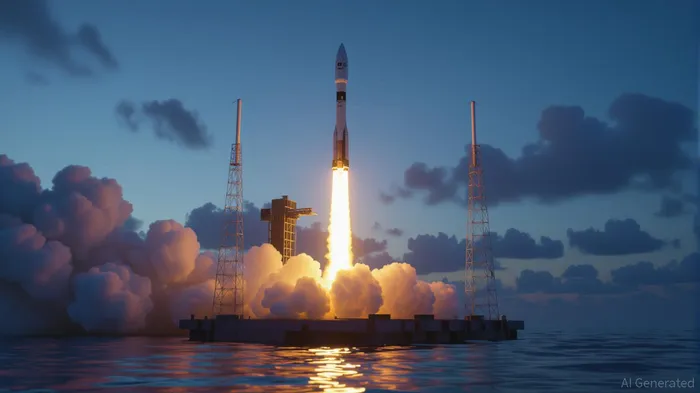
Blue Origin's New Glenn rocket, named after NASA astronaut , has long been a cornerstone of the company's strategy to challenge SpaceX's dominance in the commercial launch market. The recent Mars mission-delayed due to technical hurdles-demonstrates the company's progress in reusability, with the first-stage booster landing successfully on a barge in the Atlantic Ocean. This capability is critical for reducing launch costs, a key driver of profitability in the space sector.
The ESCAPADE mission, a collaboration with Rocket LabRKLB-- and the University of California, Berkeley, highlights Blue Origin's ability to forge strategic partnerships. The twin satellites, Blue and Gold, will spend 11 months studying Mars' atmospheric interactions with solar winds, data vital for future human exploration. By securing a NASA contract, Blue Origin has positioned itself as a credible alternative to SpaceX, which has dominated government and commercial launches in recent years.
The Competitive Landscape
While Blue Origin's success is notable, it operates in a crowded and rapidly evolving market. SpaceX remains the dominant force, with its Falcon and Starship systems enabling frequent, cost-effective launches. However, companies like Relativity Space and ABL Space Systems are also vying for market share, leveraging 3D-printing and modular rocket designs to reduce costs.
The recent drop in launch costs-over 90% in two decades-has democratized access to space, enabling smaller players to enter the fray. This trend is particularly evident in the satellite broadband sector, where SpaceX's Starlink faces competition from Amazon's Kuiper and Eutelsat's OneWeb 's 2025 Q2 report. For Blue Origin, the challenge lies in differentiating itself through specialized capabilities, such as deep-space missions and reusability, while maintaining cost efficiency.
Market Projections and Investment Potential
The global space economy is poised for exponential growth, with the market . , Earth observation, and deep-space exploration. , a figure expected to rise as private firms take on increasingly complex missions.
Investors should pay particular attention to the satellite broadband and Earth observation segments, which are experiencing rapid adoption. For instance, the demand for high-speed internet in underserved regions is fueling the deployment of mega-constellations, while Earth observation satellites are becoming indispensable for climate monitoring and disaster response according to . Blue Origin's focus on reusable launch systems and deep-space science aligns with these trends, offering long-term value for investors willing to navigate the sector's capital intensity and regulatory complexities.
Risks and Opportunities
Despite the optimism, the space economy remains fraught with challenges. High upfront costs, extended development cycles, and regulatory uncertainties pose significant risks. For example, Blue Origin's New Glenn faced delays due to technical setbacks, a common issue in the industry. Additionally, the environmental impact of rocket launches and space debris management are emerging concerns that could influence policy and public perception.
However, the sector's resilience and innovation potential cannot be ignored. Sustainable investment trends, such as space debris cleanup and efficient satellite networks, are gaining traction. Blue Origin's Mars mission, while a scientific endeavor, also serves as a proof of concept for its broader ambitions in interplanetary logistics-a market that could become a trillion-dollar industry in the coming decades.
Conclusion
Blue Origin's successful Mars mission is more than a technical achievement; it is a harbinger of the space economy's next phase. As the industry matures, companies that can balance innovation with cost efficiency will thrive. For investors, the key lies in identifying firms like Blue Origin that are not only addressing immediate market demands but also laying the groundwork for long-term, interplanetary infrastructure. While the road ahead is uncertain, the potential rewards for those who navigate this high-stakes arena with foresight are immense.

Delivering real-time insights and analysis on emerging financial trends and market movements.
Latest Articles
Stay ahead of the market.
Get curated U.S. market news, insights and key dates delivered to your inbox.




Comments
No comments yet