
Blue Origin's Mars Mission and Its Implications for Aerospace and Deep-Space Investment Opportunities


 Aime Summary
A New Era of Reusability and Mars Exploration
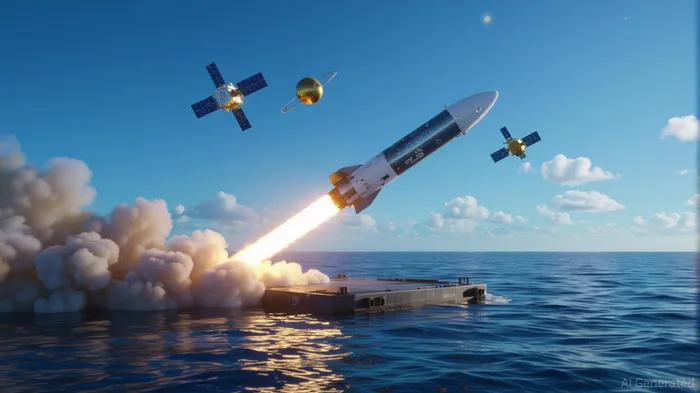
The New Glenn's reusable first-stage booster, which landed successfully on a floating platform in the Atlantic Ocean, exemplifies the cost-cutting potential of reusable rocketry-a sector projected to grow as companies like Blue Origin and SpaceX compete for commercial and military contracts. According to a report by Bloomberg, the rocket's seven methane-fueled BE-4 engines, which produced twice the thrust of SpaceX's Falcon 9, are a critical advancement in propulsion technology, enabling heavier payloads and longer missions. This capability is particularly vital for Mars exploration, where the ESCAPADE satellites will study solar wind interactions with the Red Planet's atmosphere, providing data critical to future human missions according to CBS News.
The mission's success also highlights the importance of government-backed contracts in de-risking high-cost ventures. The U.S. Federal Aviation Administration (FAA) recently concluded an investigation into earlier New Glenn launch issues, confirming that Blue Origin has implemented seven corrective actions to improve propellant management and engine performance. Such regulatory clarity is essential for attracting institutional investors, who often require stable policy environments before committing capital to nascent industries.
Investment Opportunities in Satellite Infrastructure and Propulsion
The ESCAPADE mission, developed by Rocket Lab for NASA, illustrates the expanding ecosystem of satellite infrastructure. , the project highlights demand for specialized spacecraft capable of deep-space operations. Rocket Lab, a publicly traded company (RKLB), has already demonstrated its ability to build cost-effective interplanetary probes, suggesting that firms with expertise in miniaturized satellite tech and deep-space communication systems could see increased investment inflows.
Meanwhile, propulsion technology remains a cornerstone of aerospace growth. Blue Origin's BE-4 and BE-3U engines, which power the New Glenn and its future lunar lander, are part of a broader industry trend toward methane-based fuels-a cleaner, more efficient alternative to traditional rocket propellants. According to The Economic Times, the successful landing of the New Glenn's booster underscores the viability of methane-fueled reusability, . Investors should monitor companies like Blue Origin's competitors and suppliers, including those involved in cryogenic fuel storage and engine testing, as these sectors are likely to see heightened activity.
Space Logistics: The Next Frontier
The logistics of transporting cargo and crew to Mars-and eventually beyond-present another compelling investment angle. according to Channel News Asia. While lunar missions dominate current headlines, the New Glenn's Mars-bound payload signals that deep-space logistics are no longer speculative. According to The BBC, the rocket's ability to carry heavy payloads to interplanetary destinations could eventually support supply chains for Mars colonies, scientific outposts, and even asteroid mining operations according to BBC News.
For investors, this means opportunities in orbital refueling stations, autonomous navigation systems, and AI-driven mission control platforms. The U.S. Department of Defense's growing interest in space-based assets for surveillance and defense further amplifies the sector's potential, with Blue Origin already vying for military launch contracts according to Channel News Asia.
Conclusion: A Strategic Inflection Point
Blue Origin's New Glenn rocket and its Mars mission are more than technical milestones-they are harbingers of a new era in commercial spaceflight. By combining government funding, reusable propulsion, and deep-space logistics, the company is creating a blueprint for sustainable interplanetary exploration. For investors, the key takeaway is clear: sectors like satellite infrastructure, advanced propulsion, and space logistics are transitioning from speculative bets to high-probability growth areas. As NASA and private firms continue to prioritize Mars and beyond, the companies that enable these missions-whether through engines, satellites, or supply chains-will define the next decade of aerospace innovation.

Delivering real-time insights and analysis on emerging financial trends and market movements.
Latest Articles
Stay ahead of the market.
Get curated U.S. market news, insights and key dates delivered to your inbox.






Comments
No comments yet