
Blue Origin's Mars Mission and the Growing Commercialization of Space: How Launch Infrastructure is Reshaping Aerospace Investments


 Aime Summary
The New Glenn Breakthrough: A Game Changer for Blue Origin
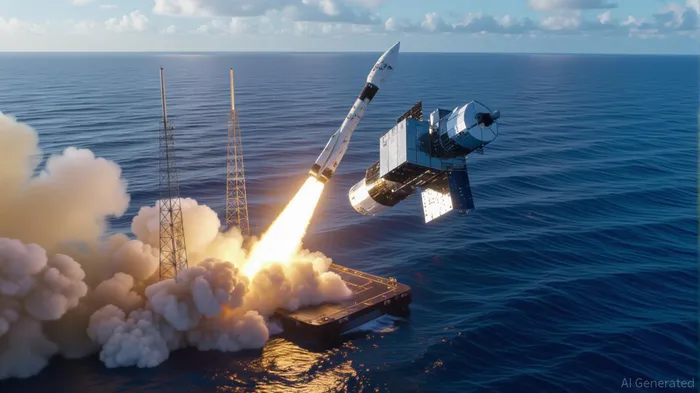
Blue Origin's New Glenn rocket, a 320-foot-tall heavy-lift vehicle, achieved two critical objectives during its November 2025 debut: a successful ocean-based booster landing and the delivery of twin Mars satellites to orbit. The mission, which carried NASA's EscaPADE (Escape and Plasma Acceleration and Dynamics Explorer) spacecraft, marks the first time Blue Origin has delivered a science payload for a paying customer. The satellites, nicknamed Blue and Gold, are en route to Mars to study the planet's space weather and atmospheric loss, with expected arrival in 2027 according to reports.
The successful landing of the New Glenn's first-stage booster, dubbed "Never Tell Me the Odds," is particularly significant. While SpaceX has pioneered reusable rocketry since 2015, Blue Origin's entry into this arena narrows the gap in launch capabilities between the two companies. According to a report by , this achievement positions Blue Origin to offer cost-effective launch services, a critical factor in attracting both government and commercial clients.
SpaceX's Dominance and the New Competitive Landscape
Despite Blue Origin's progress, SpaceX remains the dominant force in the space launch market. The company has completed over 280 Falcon 9 missions in the past two years alone, driven by its Starlink satellite network and the development of the fully reusable Starship rocket according to market analysis. However, Blue Origin's New Glenn rocket introduces a new dynamic. With its larger payload capacity and focus on high-value scientific missions, the New Glenn could carve out a niche in the market for interplanetary exploration and heavy-lift launches .
The competition between these two companies is not merely technical but also financial. As noted by Bloomberg, the cost reductions enabled by reusable rocketry are making space-based ventures more economically viable, from satellite constellations to lunar and Martian colonization efforts . This trend is attracting a wave of private investment, with venture capital and institutional funds increasingly allocating capital to aerospace startups and infrastructure projects.
Investment Implications: A Booming Aerospace Sector
The commercialization of space is accelerating, and the aerospace sector's growth projections reflect this momentum. According to a market analysis by , , . , , .
For investors, . Blue Origin's recent NASA contract and its collaboration with firms like Viasat in advancing space technology. Meanwhile, , with its potential to enable interplanetary travel, remains a high-conviction bet for long-term investors.
The Road Ahead: Innovation and Investment Synergies
As reusable rocket technology becomes more mainstream, the focus for both companies-and investors-will shift to next-generation systems. , according to market analysis. , , , and even permanent lunar or Martian bases.
For the aerospace sector, the implications are profound. According to a report by The Information, . , .
Conclusion: A New Era for Aerospace Investing
Blue Origin's Mars mission and the broader race to perfect reusable rocketry are not just technical milestones-they are catalysts for a new era in aerospace investment. , the sector is poised to deliver outsized returns for investors who position themselves early. , , , the opportunities are vast.
The key takeaway for investors is clear: the commercialization of space is no longer a distant dream but an emerging reality, .

Delivering real-time insights and analysis on emerging financial trends and market movements.
Latest Articles
Stay ahead of the market.
Get curated U.S. market news, insights and key dates delivered to your inbox.






Comments
No comments yet