
Blue Origin's Mars Mission: A New Era in Space Commercialization


 Aime Summary
Technical Breakthroughs and Market Positioning
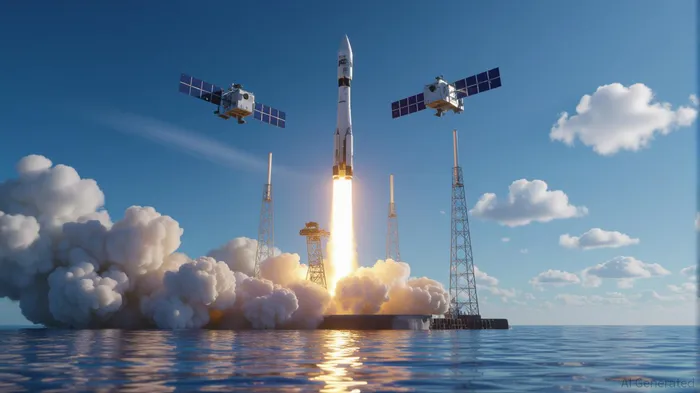
The New Glenn rocket, a two-stage heavy-lift vehicle, demonstrated reusability by landing its first-stage booster on a floating barge in the Atlantic-a feat once reserved for SpaceX according to reports. This capability is critical for reducing launch costs, which have long been a barrier to commercial viability. The rocket's seven BE-4 engines and two BE-3U upper-stage engines reflect Blue Origin's engineering rigor, validated by a successful hotfire test in December 2024. By securing a NASA contract for the ESCAPADE mission, Blue Origin has positioned itself to compete directly with SpaceX in the $10 billion global launch services market, a sector projected to grow as demand for satellite constellations and interplanetary missions intensifies.
NASA's role in this mission is both symbolic and strategic. While the agency acts as a client for launch services, it also signals trust in Blue Origin's ability to deliver complex payloads. The ESCAPADE satellites, developed by Rocket Lab, will study Mars' interaction with solar winds, providing data critical for future human missions and commercial ventures. This collaboration exemplifies the hybrid model of public-private partnerships that are now central to space exploration.
Market Growth and Investment Trends
The broader space technology market is poised for exponential growth. According to Mordor Intelligence, the global space tech market is expected to expand from $290.45 billion in 2025 to $392.73 billion by 2030, driven by miniaturization, satellite constellations and in-orbit services. Key segments like launch vehicles and communication services are leading this charge, with reusable rockets like New Glenn and SpaceX's Falcon 9 reducing costs and enabling more frequent missions.
Investor sentiment remains robust, despite warnings of over-exuberance. Chad Anderson of Space Capital notes that the space economy is growing at a "super-exponential pace," fueled by the 10,000+ satellites now in orbit, which generate data for industries ranging from agriculture to defense. Mike Collett of Promus Ventures adds that fundraising for space startups-particularly in seed and Series A rounds-remains strong, with 2025 already outpacing 2024 in Series C investments. However, Delian Asparouhov of Founders Fund cautions that consolidation is inevitable, with 80% of venture capital likely to flow to SpaceX and a handful of other players by 2030.
Strategic Investment Sectors
For investors, the privatization of space offers opportunities across three key sectors:
1. Satellite Constellations: Companies like Rocket Lab and OneWeb are building networks for global broadband, while dual-use technologies (serving both commercial and defense markets) are gaining traction.
2. In-Orbit Services: Blue Origin's Blue Ring initiative, which aims to provide satellite servicing for the Pentagon, is a case study in this emerging field.
3. Lunar/Martian Infrastructure: Blue Origin's Artemis V contract with NASA and its Mars-focused missions like ESCAPADE highlight the growing demand for infrastructure to support human exploration.
Recent funding trends reinforce these opportunities. From 2023 to 2025, global space tech investments surged to $9.1 billion in 2024 and $1.6 billion in Q1 2025, driven by cost reductions in launch services and advancements in miniaturization. Startups with clear paths to profitability-measured by metrics like Total Addressable Market (TAM)-are attracting attention, particularly those addressing orbital debris or enabling sustainable space tourism.
Risks and Regulatory Hurdles
Despite optimism, challenges persist. High capital expenditures, regulatory bottlenecks and the risk of orbital debris remain significant restraints. Blue Origin's recent FAA license for New Glenn launches is a step forward, but the company must still prove its reliability for national security payloads-a hurdle it aims to clear with its upcoming certification flight.
Conclusion: A K-Shaped Future
The ESCAPADE mission is more than a scientific endeavor; it is a harbinger of a K-shaped market where SpaceX dominates, and a few consolidated players like Blue Origin, Rocket Lab, and others carve niche roles. For investors, the key is to balance exposure to high-growth startups with established players that can weather regulatory and technical risks. As Jeff Bezos' vision of a multiplanetary future gains traction, the privatization of space is no longer speculative-it is a commercial reality with tangible returns.

Delivering real-time insights and analysis on emerging financial trends and market movements.
Latest Articles
Stay ahead of the market.
Get curated U.S. market news, insights and key dates delivered to your inbox.






Comments
No comments yet