
Blue Origin's New Glenn Rocket and Its Strategic Implications for the Space Economy


 Aime Summary
Technical Success and Cost-Reduction Potential
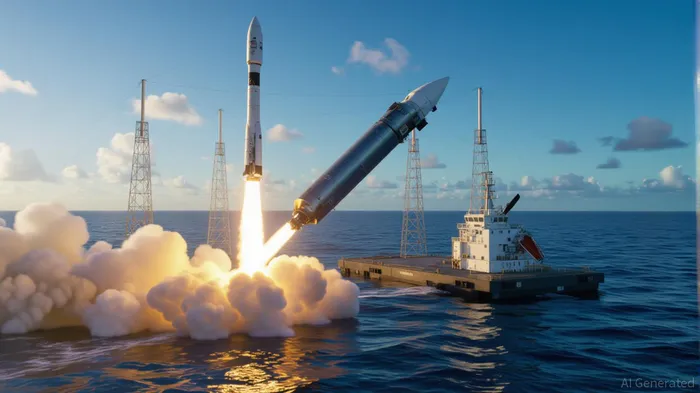
The NG-2 mission's technical achievements cannot be overstated. The New Glenn's first stage, powered by seven BE-4 methane-fueled engines, executed a precision landing after delivering the ESCAPADE spacecraft to the Earth-sun L2 Lagrange point-a critical step in its journey to Mars, according to AccuWeather. This success follows a failed landing attempt during the rocket's January 2025 debut, where the booster was lost due to propellant management issues. Blue Origin's CEO, David Limp, emphasized that the modifications made to the rocket's systems-including adjustments to its propellant tanks and landing thrusters-were instrumental in achieving this breakthrough, according to AccuWeather.
The ability to recover and reuse the New Glenn booster is central to Blue Origin's business model. According to a Bloomberg report, the company aims to reduce launch costs by up to 80% through reusability, a strategy that mirrors SpaceX's Falcon 9 rocket, according to Bloomberg. If Blue Origin can achieve a high rate of booster reuse, it could undercut competitors on price while maintaining reliability, a critical factor for both government contracts and commercial payloads.
Strategic Implications for the Space Economy
The NG-2 launch is more than a technical achievement-it is a strategic pivot for Blue Origin. The mission carried NASA's ESCAPADE (Enhanced Stellar Collaborations for Atmospheric and Planetary Exploration) twin satellites, which will study Mars' magnetosphere and its interaction with solar wind, according to SpaceFlightNow. This partnership with NASA not only validates Blue Origin's capability to handle complex interplanetary missions but also aligns the company with the U.S. government's broader goals for Mars exploration.
Jeff Bezos, Blue Origin's founder, has long envisioned a future where space becomes a hub for human activity, from orbital manufacturing to interplanetary colonization. At Italian Tech Week 2025, he reiterated his belief that the space economy could surpass $1.8 trillion by 2035, driven by advancements in reusable launch systems, lunar infrastructure, and orbital data centers, according to Observer. The success of New Glenn is a foundational step toward this vision. By demonstrating reliability, Blue Origin can attract private-sector partners for projects such as lunar fuel depots, space tourism, and even orbital factories, all of which require cost-effective access to space.
Investment Opportunities and Risks
For investors, the NG-2 success raises the question: How should capital be allocated in a rapidly evolving space economy? The commercial launch market is projected to grow from $9.4 billion in 2025 to $36.7 billion by 2035, with heavy-lift vehicles like New Glenn capturing 45% of the revenue share, according to Future Market Insights. Blue Origin's ability to secure a significant portion of this market will depend on its ability to maintain a high launch cadence and demonstrate consistent reliability.
However, risks remain. The market is highly competitive, with SpaceX's Falcon Heavy and Starship programs dominating the heavy-lift segment. Additionally, regulatory hurdles-such as the FAA's recent restrictions on commercial launches during nighttime hours-could delay missions and inflate costs, according to SpaceNews. Financial analysts like Greg Sadlier of Know Space caution that Blue Origin must navigate these challenges while scaling production of its New Glenn boosters, which are currently in limited supply, according to Bloomberg.
Despite these risks, the potential rewards are substantial. Blue Origin's partnership with Amazon on the Kuiper satellite project and its upcoming 2026 lunar mission with the Blue Moon Mark 1 lander, according to Observer, position the company to diversify its revenue streams. Investors who bet on Blue Origin's ability to execute its reusability strategy may find themselves well-positioned as the space economy matures.
Conclusion
The NG-2 launch represents a turning point for Blue Origin, proving that its New Glenn rocket can deliver both scientific payloads and cost-effective reusability. As the company moves forward with its lunar and Mars ambitions, the reliability of its launch systems will be the linchpin of its commercial viability. For the space economy, this means a more competitive and accessible market, where private firms can drive innovation alongside government agencies. Investors who recognize the strategic value of reusable rocketry-and the broader implications for orbital infrastructure-may find Blue Origin's journey to be a compelling long-term opportunity.

Delivering real-time insights and analysis on emerging financial trends and market movements.
Latest Articles
Stay ahead of the market.
Get curated U.S. market news, insights and key dates delivered to your inbox.






Comments
No comments yet