
Blue Origin's New Glenn Mars Mission and Its Implications for the Space Economy


 Aime Summary
A Technical Milestone with Strategic Implications
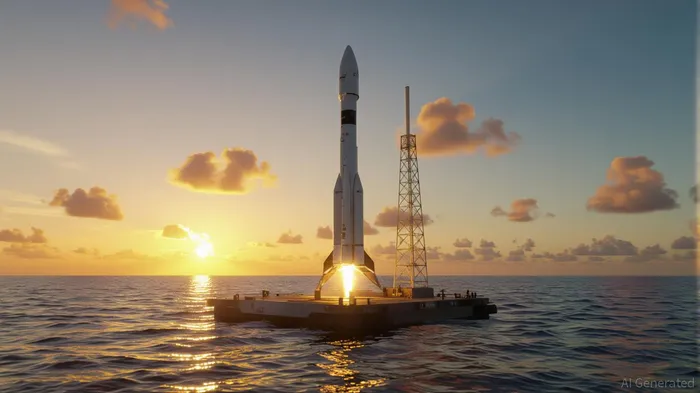
The New Glenn's second flight, designated NG-2, achieved two critical objectives. First, it delivered the EscaPADE spacecraft to Mars, where they will study solar winds and atmospheric loss-a $55 million NASA mission with scientific value. Second, the rocket's first-stage booster landed safely on a barge in the Atlantic, a feat previously unattained during its January 2025 debut. This reusability milestone is foundational for reducing launch costs, a domain long dominated by SpaceX. According to a report by , the successful landing positions Blue Origin to offer "a more cost-effective option for launching scientific payloads," directly challenging SpaceX's Falcon 9 in the commercial market.
The economic implications are profound. Reusable rockets drastically cut the cost per launch by minimizing hardware expenditure. For context, SpaceX's Falcon 9 has reduced orbital launch costs by over 90% compared to traditional expendable systems. If Blue Origin replicates this model, it could democratize access to deep-space missions, enabling smaller nations, startups, and research institutions to participate in interplanetary exploration.
From Suborbital Tourism to Deep-Space Commerce
Blue Origin's trajectory has evolved from suborbital tourism to ambitious orbital and interplanetary ventures. The EscaPADE mission represents a strategic pivot toward high-value scientific and commercial contracts. As noted by , this launch is Blue Origin's first mission for paying customers, signaling its intent to capture a share of the $44.66 billion LEO satellite market and beyond. The inclusion of a commercial payload from Viasat further highlights the rocket's versatility, bridging the gap between government-funded science and private-sector applications.
Experts argue that the New Glenn's reusability and heavy-lift capacity (capable of carrying 45 metric tons to low Earth orbit) position it as a viable platform for lunar and Mars missions. While Blue Origin's lunar lander proposals for NASA's Artemis III program remain in development, the company's Mars-focused capabilities suggest a long-term vision: to become a cornerstone of the space economy by enabling frequent, affordable access to deep space.
The Broader Space Economy: Accessibility and Commercialization
The New Glenn's success aligns with a broader industry trend: the commoditization of space infrastructure. As launch costs decline, the economic barriers to deep-space missions erode, fostering innovation in areas like asteroid mining, interplanetary logistics, and off-world manufacturing. According to a Bloomberg analysis, reusable rockets could reduce the cost of sending payloads to Mars by up to 70% by 2030. This would catalyze investments in technologies such as in-situ resource utilization (ISRU) and autonomous robotics, which are critical for sustained human presence beyond Earth.
Moreover, Blue Origin's $10 billion backlog of customer contracts indicates growing confidence in its ability to deliver reliable, cost-effective launch services. This financial runway, combined with its focus on reusability, could accelerate the commercialization timeline for deep-space ventures. For investors, the company's progress represents a dual opportunity: capitalizing on near-term revenue from satellite deployments while positioning for long-term gains in interplanetary commerce.
Risks and Considerations
Despite these positives, challenges remain. Blue Origin's delayed engine tests and licensing hurdles have historically slowed its progress. Additionally, the company's reliance on Jeff Bezos' personal funding-rather than public market capital-introduces financial opacity. However, the recent EscaPADE mission demonstrates operational maturity, mitigating some of these concerns.
Conclusion: A New Era of Space Accessibility
Blue Origin's New Glenn Mars mission is more than a technical achievement-it is a harbinger of a new economic paradigm. By proving the viability of reusable deep-space launch systems, the company is laying the groundwork for a future where Mars missions are routine rather than exceptional. For the space economy, this means expanded opportunities for scientific discovery, commercial innovation, and global collaboration. As the industry shifts from government-led exploration to market-driven expansion, Blue Origin's role as a cost-efficient, reliable launch provider could become indispensable.
Investors should monitor the company's upcoming missions, particularly its ability to secure commercial contracts beyond NASA. The New Glenn's success in reducing costs and increasing accessibility is not just a win for Blue Origin-it is a catalyst for the next phase of humanity's journey into the cosmos.

Delivering real-time insights and analysis on emerging financial trends and market movements.
Latest Articles
Stay ahead of the market.
Get curated U.S. market news, insights and key dates delivered to your inbox.






Comments
No comments yet