
Blue Origin's New Glenn Mars Mission: A Catalyst for Space Infrastructure Investment?


 Aime Summary
Reusability as the New Baseline
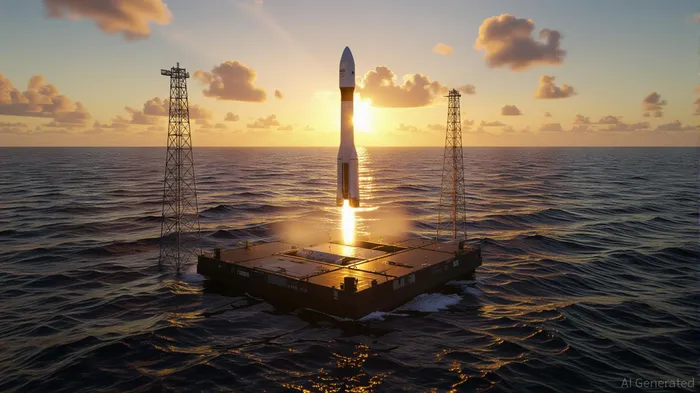
Blue Origin's New Glenn rocket achieved a critical milestone in October 2025 when it successfully landed its reusable booster on a floating barge in the Atlantic Ocean, a feat previously dominated by SpaceX's Falcon 9. This accomplishment underscores the company's progress in reducing the cost of access to space, a metric that has long been the holy grail of commercial spaceflight. According to a report by , the New Glenn's reusability not only validates Jeff Bezos' vision of making space travel economically viable but also sets the stage for more frequent and affordable interplanetary missions.
The significance of reusability cannot be overstated. Traditional single-use rockets have limited the scalability of space operations, but reusable systems like the New Glenn and SpaceX's Starship are breaking this barrier. For investors, this means a shift from speculative bets to infrastructure investments with tangible, repeatable value. The ability to amortize launch costs across multiple missions directly enhances the financial viability of projects such as Mars exploration, satellite constellations, and lunar logistics.
NASA Partnerships: A Gateway to Long-Term Value
Blue Origin's collaboration with NASA on the (Escape and Plasma Acceleration and Dynamics Explorers) mission further cements its role in the space ecosystem. Launched on October 31, 2025, the twin Mars orbiters are part of a $55 million NASA investment aimed at studying Mars' atmospheric loss and solar wind interactions. This mission, managed by the University of California, Berkeley, is notable not only for its scientific goals but also for its cost efficiency-under $80 million-a stark contrast to the billion-dollar Mars missions of the past. According to US News, the mission demonstrates how NASA can leverage commercial launch providers to achieve scientific objectives at a fraction of the cost.
For investors, NASA's involvement is a vote of confidence in Blue Origin's capabilities. Government contracts provide a stable revenue stream while enabling private firms to develop cutting-edge technologies. The EscaPADE mission, for instance, demonstrates how NASA can leverage commercial launch providers to achieve scientific objectives at a fraction of the cost. As the agency shifts toward public-private partnerships under initiatives like and the , companies like Blue Origin stand to benefit from sustained institutional support.
The Broader Investment Landscape
The New Glenn's Mars mission is more than a technical achievement-it's a harbinger of a broader trend: the commercialization of space infrastructure. From satellite broadband (Starlink, OneWeb) to in-space manufacturing () and deep-space logistics (Sierra Space), the sector is diversifying rapidly. Blue Origin's progress in reusability and interplanetary logistics positions it as a key enabler of this ecosystem.
However, risks remain. The space industry is capital-intensive, and technical failures can be costly. Moreover, regulatory hurdles and geopolitical tensions could slow progress. Yet, for investors with a long-term horizon, these challenges are secondary to the transformative potential of a reusable, scalable space infrastructure.
Conclusion: A Strategic Inflection Point
Blue Origin's New Glenn rocket and its Mars mission represent a strategic inflection point in the space industry. By demonstrating reusability at scale and securing high-profile partnerships with NASA, the company is laying the groundwork for a future where interplanetary travel and large-scale space operations are economically feasible. For investors, this translates to opportunities in aerospace engineering, satellite services, and venture-backed space startups. The question is no longer if space will become a viable investment arena-but how quickly it will arrive.

Delivering real-time insights and analysis on emerging financial trends and market movements.
Latest Articles
Stay ahead of the market.
Get curated U.S. market news, insights and key dates delivered to your inbox.


AInvest
PRO
AInvest
PRO



Comments
No comments yet