
Blue Origin's New Glenn and the Future of Space Infrastructure Investment: A Catalyst for Interplanetary Logistics


 Aime Summary
Strategic Partnerships and Technological Synergy
NASA's collaboration with Blue Origin on the ESCAPADE mission exemplifies a strategic shift in space exploration. By leveraging the New Glenn rocket-a vehicle designed for reusability and cost efficiency-NASA is reducing its reliance on traditional, single-use launch systems. According to a report by , the mission not only advanced scientific understanding of Mars but also demonstrated the viability of commercial rockets for interplanetary payloads. This partnership aligns with NASA's broader strategy to commercialize space infrastructure, enabling cost-sharing and fostering innovation in propulsion, payload delivery, and orbital logistics.
The ESCAPADE mission also carried a communications technology demonstration from Viasat Inc.VSAT--, signaling NASA's intent to integrate commercial satellite relay services into future missions according to the same report. Such collaborations are critical for building a sustainable ecosystem where private firms handle routine launch services, allowing government agencies to focus on high-risk, high-reward scientific endeavors.
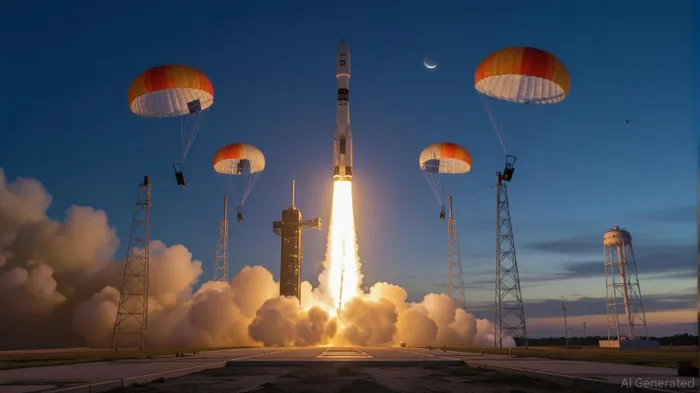
The economic implications of this shift are profound. The New Glenn's reusable technology, which successfully landed its first stage after the ESCAPADE launch, could reduce the cost of accessing space by up to 40% compared to non-reusable systems. This cost reduction is a catalyst for private investment, as it lowers barriers for startups and established firms seeking to deploy satellites, conduct microgravity research, or develop lunar/Martian supply chains.
Market Dynamics and Investment Opportunities
The New Glenn's debut in 2025 has already triggered a surge in interest from investors. According to industry analysts, the global space infrastructure market-encompassing launch services, satellite manufacturing, . This growth is driven by private-sector confidence in reusable systems and the increasing demand for interplanetary missions.
For context, the (ARKX), which tracks companies involved in space innovation, , reflecting heightened investor optimism according to economic analysis. While ARKX includes firms like SpaceX and Rocket LabRKLB--, the success of Blue Origin's New Glenn underscores the importance of diversified exposure to firms developing heavy-lift, reusable launch systems.
The Road Ahead: Challenges and Opportunities
Despite the progress, challenges remain. The New Glenn's commercial viability will depend on its ability to secure recurring contracts for both government and commercial payloads. Additionally, regulatory frameworks for interplanetary logistics-such as data-sharing agreements and liability protocols-remain underdeveloped. Investors must also contend with the high capital intensity of rocket development, where even successful launches require sustained funding for iterative improvements.
However, the ESCAPADE mission's success demonstrates that private firms can now reliably execute complex interplanetary tasks. This reliability is a prerequisite for scaling space infrastructure investment. As Blue Origin and competitors like SpaceX refine their reusable technologies, the cost curve for space access will continue to decline, unlocking new markets in asteroid mining, deep-space manufacturing, and planetary colonization.
Conclusion
The New Glenn rocket's role in the ESCAPADE mission is more than a technical achievement-it is a harbinger of a new era in space economics. By proving the commercial viability of reusable, heavy-lift launch systems, Blue Origin has positioned itself as a key player in the infrastructure backbone of interplanetary logistics. For investors, this represents an opportunity to capitalize on a sector transitioning from government-led exploration to a commercially driven, globally competitive industry.
As the line between science fiction and economic reality blurs, the question is no longer if space infrastructure will attract investment, but how quickly it will become a cornerstone of the 21st-century economy.

Delivering real-time insights and analysis on emerging financial trends and market movements.
Latest Articles
Stay ahead of the market.
Get curated U.S. market news, insights and key dates delivered to your inbox.




Comments
No comments yet