
Blue Origin: The Disruptor Set to Dominate the Emerging Space Economy
The commercial space race is no longer a distant dream—it's a booming reality, and Blue OriginBLUE-- stands at its vanguard. With recent advancements in both suborbital tourism and heavy-lift orbital capabilities, the company is primed to capitalize on a $1.2 trillion space economy projected by 2040. Here's why investors should pay attention now.
Space Tourism: A Diverse Playground for Innovation
Blue Origin's New Shepard program has quietly turned suborbital tourism into a legitimate market. Since 2024, missions like NS-32 (May 2025) and NS-31 (April 2025) have carried astronauts from diverse backgrounds—educators, adventurers, and even the first all-female crew since 1963. These flights, reaching 100 km altitude, offer 3–4 minutes of weightlessness and a transformative “overview effect” for passengers. With 58 people flown by mid-2025 and 175 scientific payloads tested, Blue Origin isn't just selling thrills; it's building an ecosystem for research and education.
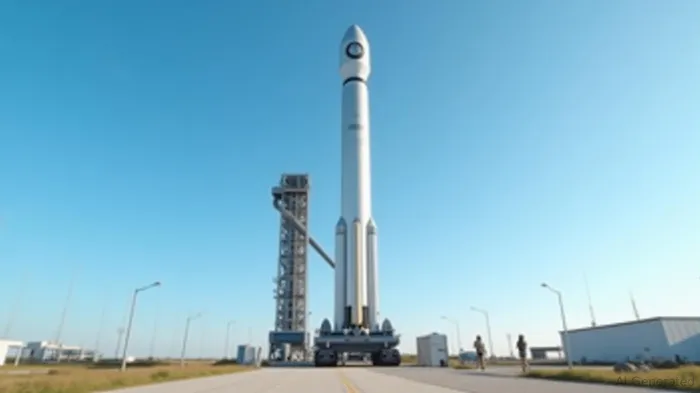
While SpaceX and ULA dominate headlines, Blue Origin's strategic focus on reusability and government partnerships positions it as a cost-efficient disruptor. Its New Glenn rocket, now certified for national security missions, is set to rival Falcon 9 and Vulcan Centaur with a reusable first stage designed for 25 flights, cutting per-launch costs to $68M—just $8M above SpaceX's Falcon 9.
Orbital Ambitions: New Glenn's Pivot to Profitability
The January 2025 success of New Glenn's NG-1 mission marked a turning point. Though the booster wasn't recovered, the rocket's payload—the Blue Ring Pathfinder—validated its role in orbital logistics, a $15B market by 2030. The upcoming NG-2 mission (late 2025) aims to refine booster recovery and secure its status as a National Security Space Launch (NSSL) Phase 3 Lane 2 provider. With 7 contracted missions starting in 2026 and 12 dedicated flights for Amazon's Kuiper satellites, New Glenn is already booked through the decade.
Strategic Partnerships: Building a Lunar and LEO Ecosystem
Blue Origin's vision extends beyond Earth's orbit. Its Blue Moon lunar lander is NASA's pick for the Artemis V crewed mission (2029), while its Orbital Reef space station project with Sierra Space aims to create a commercial hub in low Earth orbit (LEO). These ventures align with NASA's $95B Artemis program and the Pentagon's push for space domain awareness, ensuring steady demand for Blue Origin's services.
The Investment Case: Why Now?
The stars are aligning for Blue Origin:
1. Government Contracts: Its $2.38B NSSL Phase 3 award and 54 mission slots through 2029 guarantee recurring revenue.
2. Commercial Traction: Kuiper's 12+ launches and partnerships like Project Kuiper ensure a steady payload pipeline.
3. Cost Leadership: Reusable boosters and in-house BE-4 engine production (with 5,000+ test firings) minimize dependency on SpaceX's monopoly.
4. Market Timing: As suborbital tourism grows at 15% annually and governments allocate $300B+ to space defense programs, Blue Origin is at the intersection of two booming sectors.
Risk Considerations: Delays in New Glenn's booster recovery (NG-1's failure to land) and competition from SpaceX's Starship could pose hurdles. However, Blue Origin's incremental testing and 5-year FAA launch license reduce regulatory risks, while its 7-engine BE-4 propulsion system offers unmatched reliability.
Conclusion: The Next Moonshot is Here
Blue Origin is no longer a side player—it's a strategic imperative for investors betting on the next aerospace revolution. With a proven track record in reusability, a pipeline of government and commercial contracts, and a roadmap to Mars via its lunar infrastructure, this is the moment to act. The sky is no longer the limit.
Invest now—or risk missing the launch.

Stay ahead of the market.
Get curated U.S. market news, insights and key dates delivered to your inbox.


AInvest
PRO
AInvest
PRO



Comments
No comments yet