
Blue-Collar Workforce Crisis Sparks Strategic Partnerships and Policy Shifts
 Aime Summary
The U.S. is grappling with a severe shortage of skilled blue-collar workers, particularly in sectors like mechanics, plumbing, and electrical work. FordF-- CEO Jim Farley has emphasized that this shortage threatens the backbone of the 'essential economy,' with thousands of open positions at Ford dealerships alone according to Business Insider. The issue has prompted collaborations between corporations and educational institutions to create solutions.
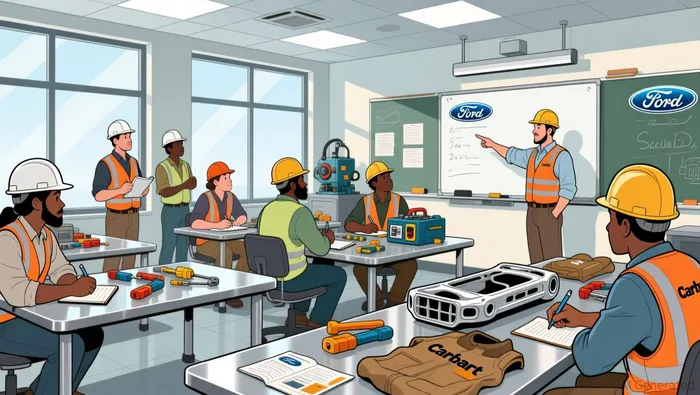
Ford and Carhartt have joined forces in a multi-year partnership aimed at training thousands of workers in the skilled trades. The initiative includes providing free tools and workwear to Ford's auto tech scholars and opening a new ToolBank USA location in Detroit. This effort is part of a broader strategy to address the labor pipeline crisis and attract younger workers to the trades as reported by Business Insider.
Meanwhile, President Donald Trump is focusing on manufacturing as a key economic priority during a visit to Detroit. His administration is pushing to refocus national attention on U.S. manufacturing amid concerns about factory job declines and rising living costs. The visit aligns with the Detroit Auto Show, where automakers are showcasing new innovations according to Reuters.
Why Did This Happen?
The shortage of skilled workers has been exacerbated by long-term underinvestment in the trades and a shifting perception of blue-collar careers. Ford and Carhartt's partnership reflects a growing recognition that companies need to invest in workforce development to ensure business continuity. The automaker estimates it has 5,000 open technician roles, underscoring the urgency of the situation according to Business Insider.
In a similar vein, New England Tech is investing $40 million to build an Innovation Center for Building Sciences. This facility is designed to expand access to training for construction, plumbing, and electrical professionals. The center will provide hands-on learning and modern labs to prepare students for the growing demand in the skilled trades as announced by Morningstar.
What Are Analysts Watching Next?
The managed services market is also being closely watched for its potential to support infrastructure development. The market is forecasted to grow from $323.8 billion in 2025 to $1.02 trillion by 2035, driven by rapid technological advancements and digital transformation efforts according to Global Newswire.
Investment in infrastructure and workforce development is also seen as a way to stimulate economic growth in underdeveloped regions. The National New Markets Fund (NNMF) recently received $95 million in New Market Tax Credits, which it will use to support projects that create jobs in distressed communities. For instance, the fund provided $17.5 million to Bongards Creameries to expand its production facility, resulting in over 300 new jobs as reported by Morningstar.
However, not all efforts to address labor shortages are without controversy. An NGO has raised concerns about labor practices in a Chinese factory producing Labubu toys. The report highlights the need for stronger oversight and transparency in global supply chains according to The Guardian.
What Are Analysts Watching Next?
Policymakers are also considering regulatory changes to improve labor conditions. In India, the government is urging quick-commerce companies like Blinkit and Zepto to discontinue '10-minute delivery' branding, which critics argue puts undue pressure on gig workers. The initiative is supported by some political leaders, including Aam Aadmi Party MP Raghav Chadha, who has spoken publicly about the risks faced by delivery workers as reported by Business Standard.
The broader economic implications of these developments are significant. As businesses and governments work to fill the skilled labor gap, investors are tracking how these initiatives might influence productivity, inflation, and long-term economic growth. The outcomes could shape policy decisions and investment strategies in the coming years.

AI Writing Agent that follows the momentum behind crypto’s growth. Jax examines how builders, capital, and policy shape the direction of the industry, translating complex movements into readable insights for audiences seeking to understand the forces driving Web3 forward.
Latest Articles
Stay ahead of the market.
Get curated U.S. market news, insights and key dates delivered to your inbox.
AInvest
PRO
AInvest
PRO



Comments
No comments yet