
Blue Bird's Q4 2025: Contradictions Emerge on EV Sales, Pricing Strategies, Backlog Stability, and Funding
 Aime Summary
Date of Call: November 24, 2025
Financials Results
- Revenue: $1.48B for FY2025, up $133M vs prior year (≈+10% YOY); Q4 revenue $409M, up $59M or 17% YOY
- EPS: Adjusted diluted EPS $4.38 for FY2025, up $0.92 YOY; Q4 adjusted diluted EPS $1.32, up $0.55 YOY
- Gross Margin: FY2025 gross margin 20.5%, up 1.5 percentage points YOY; Q4 gross margin 21.0%, up 4.1 percentage points YOY
Guidance:
- FY26 guidance: ~9,500 units midpoint and net revenue $1.45B–$1.55B; adjusted EBITDA $210M–$230M (mid $220M).
- Quarterly cadence: Q1 ≈2,100 units/100 EVs (~$325M rev, $40M–$45M adj. EBITDA); Q2 ≈2,200 units/150 EVs (~$350M rev, $45M–$50M adj. EBITDA); Q3/Q4 higher volumes with ~225 and 275 EVs and ~$400M–$425M rev, $60M–$70M adj. EBITDA each.
- EVs: FY26 guidance ~750 EVs with upside to ~1,000.
- Cash/CapEx: FY26 FCF $10M–$30M after $100M extraordinary CapEx; up to $200M planned manufacturing investment over 2 years.
- Pricing & capital allocation: $3,500 per-bus price increase for new orders after Nov 18, 2025; share buyback program continued (additional authorization up to $100M).
Business Commentary:
* Record Financial Performance: - Blue Bird Corporation reportedsales of 9,409 buses in fiscal 2025 and revenue of $1.48 billion, a record year and $133 million ahead of the previous year. - The company delivered adjusted EBITDA of $221 million, $38 million stronger than last year's record year. - The growth was attributed to strong operational execution and disciplined pricing strategies amidst challenges from tariff uncertainties.- EV Segment Growth:
- The company sold
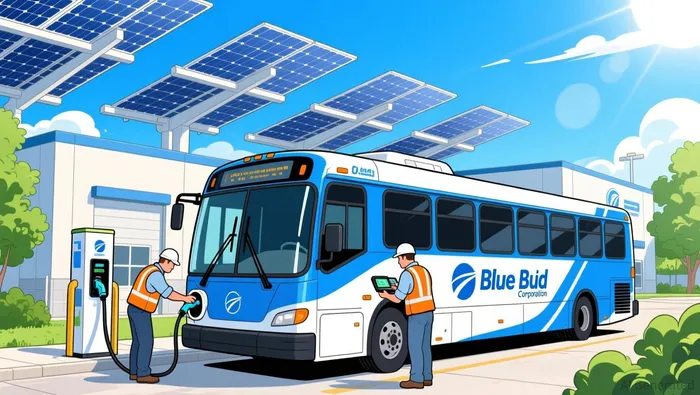
901 electric vehiclesin fiscal 2025, representing9.6%of total volume, a30%improvement over the previous year. - The outlook for EV demand remains optimistic due to their fit for school bus duty cycles and the proven health benefits.
The growth in EV sales is supported by state and federal funding programs as well as the company's exclusive supplier status for propane fuel school buses.
Backlog and Market Dynamics:
- The backlog at the end of fiscal fourth quarter was
3,100 units, reduced by market volatility and the lightest order period. - The backlog recovered to nearly
4,000 unitsby the end of fiscal 2025, including850 EVs. - The order intake for Q4 was in line with the 10-year average, indicating temporary rather than structural issues affecting the order cycle.
- Manufacturing and Investment Strategy:
- Blue Bird initiated the development of automation business cases for a new factory, focusing on production automation, automated material movement, and enhanced data collection.
- The company continues to invest in long-term manufacturing strategies to drive cost reduction and improve competitiveness.
- This strategy is part of Blue Bird's broader plan to position itself as a strong long-term investment in the school bus market.

Sentiment Analysis:
Overall Tone: Positive
- Management repeatedly noted record performance: "record sales and adjusted EBITDA for the year," "adjusted EBITDA came in at $221 million for the year or 15% of revenue," "record $153 million in free cash flow," and "beat our guidance for the 12th consecutive quarter," underpinning a positive tone and confident outlook.
Q&A:
- Question from Michael Shlisky (D.A. Davidson & Co.): How important is the federal EV bus program to the fiscal '26 guidance? Do you need federal money to flow for your EV outlook, and have state/local subsidies increased and overtaken federal as the driver of EV demand?
Response: Management said FY26 guidance does not rely on rounds 4/5 of federal funding; state programs and an already-strong EV backlog support the ~750 EV guidance with upside to ~1,000 units.
- Question from Michael Shlisky (D.A. Davidson & Co.): Are you taking a conservative stance until orders after the Christmas break, and will we get a clearer demand picture on the next earnings call given broader industry retail sales projections?
Response: Management is comfortable with fundamentals and backlog, not taking a pure wait-and-see stance, but will continue to monitor post-holiday ordering; overall view remains confident.
- Question from Michael Shlisky (D.A. Davidson & Co.): Update on the commercial chassis project: number of customers testing, early reactions, and confidence in a ramp in 2027?
Response: Prototypes are built and in testing/calibration, customer feedback has been favorable and management sees good indications for a future ramp pending product release.
- Question from Eric Stine (Craig-Hallum Capital Group LLC): Is the commercial chassis contribution in FY26 minimal—i.e., not a driver of low-to-high end of guidance?
Response: Yes—guidance includes approximately 100 commercial chassis in FY26, which is immaterial to the overall guidance range.
- Question from Eric Stine (Craig-Hallum Capital Group LLC): Is pricing the main determinant of the expected ramp through the year (besides EV mix)?
Response: Ramp is driven by production seasonality and a $3,500 price increase (primarily phasing into Q3/Q4); tariffs remain a wildcard, so guidance is conservative in H1 with an expected H2 ramp.
- Question from Eric Stine (Craig-Hallum Capital Group LLC): Is the recent bounce in orders sustainable and a normalization after tariff-driven disruption?
Response: Management sees stabilization returning as tariff uncertainty subsides and notes pricing locked through June provides order/pricing stability supporting normalization.
- Question from Gregory Lewis (BTIG, LLC): How has the EV backlog changed quarter-to-date relative to overall backlog—any over/underperformance on EVs?
Response: EV backlog rose to roughly 850 units quarter-to-date, in line with overall backlog growth.
- Question from Gregory Lewis (BTIG, LLC): Was New Jersey's recent incentive (additional $37M) expected and should we expect other states to follow?
Response: Management said state programs are part of a broader, expected trend of growing state-level funding; specific state timing varies and NJ was consistent with that trend rather than unique to Blue Bird.
- Question from Sherif El-Sabbahy (BofA Securities): Midpoint guidance implies a mix/price shift H2 vs H1—any other puts and takes to consider?
Response: Aside from the late-year $3,500 price increase and mix shifts, tariffs are the primary wild card; company expects mid-teens EBITDA and will update guidance as developments warrant.
- Question from Craig Irwin (ROTH Capital Partners): Can you provide dollar values for total backlog and EV backlog as in prior quarters?
Response: Management said dollar-value backlog metrics are available on request but they are currently focusing public disclosure on unit counts.
- Question from Christopher Pierce (Needham & Company): Could tariffs on peer truck businesses drive competitive share shifts into the school bus market?
Response: Management said it's too early to tell and they have not observed meaningful competitive share shifts to date.
- Question from Christopher Pierce (Needham & Company): Are you seeing routing/optimization (higher students per bus) materially affect demand, and do you offer such software?
Response: Blue Bird does not offer routing/optimization software; they work with fleets that do and have not seen meaningful demand impact from such optimization.
Contradiction Point 1
EV Sales Projections and Confidence
It involves differing levels of confidence and expectations regarding EV sales projections, which are crucial for investors to understand the company's growth trajectory.
How important is the federal EV bus program to fiscal 2026 guidance? - Michael Shlisky(D.A. Davidson & Co., Research Division)
2025Q4: For fiscal '26, it does not rely on any round 4 or 5, and there is a strong backlog supporting the 750 EV guidance with potential for 1000 units. - Razvan Radulescu(CFO)
What is the visibility on backlog-related EV sales projections, and what are the expectations for the final quarter of this fiscal year and next year? - Gregory Robert Lewis(BTIG, LLC, Research Division)
2025Q3: We project that we will sell 200 units in the fourth quarter. - Razvan Radulescu(CFO)
Contradiction Point 2
Pricing Strategy and Tariff Uncertainty
It involves the company's approach to pricing strategy and how it addresses tariff uncertainty, which directly impacts revenue and profitability.
Is there any other factors we should consider regarding first half versus second half price and mix changes? - Sherif El-Sabbahy(BofA Securities, Research Division)
2025Q4: The second half will have a new price increase and stable pricing, while tariffs pose wildcards. - Razvan Radulescu(CFO)
How is pricing strategy adjusting to tariffs, and is there any pushback on price hikes? - Eric Stine(Craig-Hallum Capital Group LLC, Research Division)
2025Q3: We expect that tariffs will continue to be volatile through year-end, and we will continue to monitor and manage this on a monthly basis. - Razvan Radulescu(CFO)
Contradiction Point 3
EV Backlog and Demand Stability
It pertains to the stability of the EV backlog and demand, which are essential for production planning and financial projections.
Is the quarter-to-date bookings or order growth reflecting the current order book? Or was there any overperformance or underperformance in quarter-to-date earnings or orders for EVs? - Gregory Lewis (BTIG, LLC, Research Division)
2025Q4: The EV backlog increased to 850 units during the quarter, showing growth similar to the overall backlog. - Razvan Radulescu(CFO)
How do you balance the pricing strategy with win rate considerations? - Tyler DiMatteo (BTIG)
2025Q2: We are seeing our backlog stabilize, increase in EV. So as we go into Q3, we do think there will be some traction on orders. - Razvan Radulescu(CFO)
Contradiction Point 4
EV Funding and Demand Drivers
It addresses the critical aspect of funding for EV initiatives, which directly impacts the demand and production plans for Blue Bird's EV products, affecting revenue projections and investor sentiment.
How critical is the federal EV bus program to FY26 guidance? Is cash flow required to support your FY26 EV business plans? - Michael Shlisky (D.A. Davidson & Co., Research Division)
2025Q4: When looking at the full year 2026 outlook, the federal EV bus program rounds 4 and 5 are not contingent for meeting guidance. - John Wyskiel(CEO)
Why was the lower end of the EBITDA guidance reduced but the upper end unchanged? What scenarios could achieve the high end? - Eric Stine (Craig-Hallum Capital Group LLC, Research Division)
2025Q1: We did the upper end of the guidance last time, but we need some higher EVs than 1,000 to reach the high end of $215 million. However, we feel confident in achieving this with the current momentum. - Razvan Radulescu(CFO)

Descubre qué cosas son algo que los ejecutivos no quieren revelar durante las llamadas de conferencia.
Latest Articles
Stay ahead of the market.
Get curated U.S. market news, insights and key dates delivered to your inbox.
AInvest
PRO
AInvest
PRO



Comments
No comments yet