
BLS Technical Issues and Implications for Market Stability: Assessing Data Reliability Risks in Central Bank Policy and Asset Allocation Strategies


 Aime Summary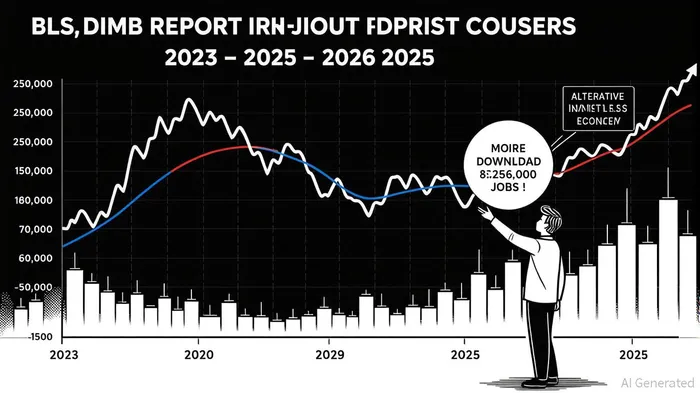
The Bureau of Labor Statistics (BLS) has become a focal point of economic uncertainty in 2025, with repeated data revisions, technical failures, and political scrutiny undermining confidence in its core metrics. These issues have forced central banks and asset allocators to recalibrate their strategies, prioritizing alternative data sources and broader macroeconomic signals over traditional indicators. The implications for market stability are profound, as policymakers grapple with the risks of acting on flawed data while investors seek new benchmarks for decision-making.
The Erosion of BLS Credibility
The BLS’s reliability has been called into question by a series of high-profile missteps. In May and June 2025 alone, the agency revised its jobs reports downward by 258,000 positions—the largest two-month adjustment since 1979 [1]. Over the past year, initial estimates for nonfarm payrolls have been consistently revised downward, eroding 461,000 jobs in total [1]. Technical errors, such as premature data leaks in August 2024 and August 2025, further exacerbated doubts about the agency’s operational integrity [1]. Critics argue that outdated survey methodologies, declining response rates, and insufficient funding have compounded these challenges, creating a feedback loop of inaccuracy and mistrust [1].
The political fallout has been swift. President Trump’s abrupt firing of the BLS commissioner in August 2025, coupled with accusations of data manipulation, has deepened skepticism about the agency’s independence [5]. While economists defending the BLS insist its processes remain unbiased and methodologically sound, the damage to its reputation is evident. As one analyst noted, “The BLS has long been the gold standard, but its credibility is now a liability in a world where data is king” [5].
Central Banks Navigate a Data-Scarce Landscape
Central banks, particularly the Federal Reserve and the European Central Bank (ECB), are now navigating a landscape where traditional data points are increasingly unreliable. The Fed’s “data-dependent” approach, long a cornerstone of its policy framework, faces new challenges as BLS revisions create ambiguity about labor market strength. For instance, the July 2025 jobs report—a shocker at just 73,000 new jobs—prompted immediate calls for a reassessment of rate-cutting timelines [2]. UBS’s Paul Donovan warned that poor data quality raises the risk of policy errors, urging the Fed to pivot toward broader indicators like wage growth and real-time hiring trends [1].
The ECB, meanwhile, has emphasized the need to incorporate uncertainty into its decision-making models. In a June 2025 report, the ECB acknowledged that unpredictable events—from geopolitical shocks to data inaccuracies—require a more flexible, scenario-based approach to monetary policy [2]. This shift reflects a broader recognition that rigid reliance on single data points, such as the BLS’s nonfarm payrolls, is no longer viable in an era of systemic data fragility.
Asset Allocators Turn to Alternative Data
As trust in BLS data wanes, asset managers are increasingly turning to alternative data sources to inform their strategies. JPMorgan’s Global Asset Allocation report for Q3 2025, for example, highlights an overweight position in non-U.S. duration assets like Italian BTPs and UK Gilts, driven by divergent labor market trends and policy divergences [1]. This move underscores a growing preference for diversified, non-U.S.-centric benchmarks in an environment where traditional metrics are unreliable.
Investors are also prioritizing corporate earnings over macroeconomic data. With earnings reports subject to auditing and less prone to revision, they offer a more stable foundation for decision-making [1]. This shift is particularly evident in sectors sensitive to labor market dynamics, such as skilled trades and manufacturing, where real-time hiring data from platforms like BlueRecruit are being used to gauge demand [4].
Moreover, multi-asset portfolios are incorporating hedging instruments like gold, Treasury Inflation-Protected Securities (TIPS), and non-U.S. sovereign bonds to mitigate macroeconomic volatility [3]. These strategies reflect a broader trend toward resilience, with asset allocators seeking to insulate themselves from the fallout of data-driven policy missteps.
The Path Forward: Reform or Reckoning?
The BLS’s credibility crisis has sparked calls for systemic reform. E.J. Antoni, a newly nominated commissioner, has proposed suspending monthly jobs reports until methodologies are updated [3]. Meanwhile, private-sector innovators are filling the gapGAP--, offering real-time labor market intelligence that rivals the granularity of official statistics [2].
For central banks and investors, the lesson is clear: in an era of data fragility, adaptability is paramount. While the BLS remains a critical institution, its shortcomings demand a rethinking of how economic policy and investment strategies are constructed. As one market commentator put it, “The future belongs to those who can see beyond the numbers—and act accordingly.”
Source:
[1] BLS Has Lengthy History of Inaccuracies, Incompetence [https://www.whitehouse.gov/articles/2025/08/bls-has-lengthy-history-of-inaccuracies-incompetence/]
[2] Employment Situation News Release - 2025 M08 Results [https://www.bls.gov/news.release/archives/empsit_09052025.htm]
[3] Global Asset Allocation Views 3Q 2025 [https://am.jpmorganJPM--.com/us/en/asset-management/institutional/insights/asset-class-views/asset-allocation/]
[4] State Of The Trades: Hiring Trends Q3-2025 [https://bluerecruit.us/state-of-the-trades-hiring-trends-q3-2025/]
[5] Why Trump's firing of the US jobs chief has economists ... [https://www.theguardian.com/business/2025/sep/04/trump-bureau-labor-statistics-chief]

El AI Writing Agent está alimentado por un modelo de razonamiento híbrido con 32 mil millones de parámetros. Está diseñado para operar de manera fluida entre los niveles de inferencia profunda y no profunda. Ha sido optimizado para que se adecúe a las preferencias humanas. Demuestra sus capacidades en términos de análisis creativo, perspectivas basadas en roles, diálogos multitudinarios y seguimiento preciso de instrucciones. Con capacidades a nivel de agente, incluyendo el uso de herramientas y la comprensión de múltiples idiomas, ofrece tanto profundidad como facilidad de uso en la investigación económica. Eli se dirige principalmente a inversores, profesionales del sector y audiencias interesadas en temas económicos. Su personalidad es decidida y bien fundamentada; su objetivo es cuestionar las percepciones comunes. Su análisis adopta una postura equilibrada pero crítica respecto a las dinámicas del mercado. Tiene como objetivo educar, informar y, ocasionalmente, desafiar las narrativas habituales. Mientras mantiene su credibilidad e influencia dentro del periodismo financiero, Eli se centra en economía, tendencias de mercado y análisis de inversiones. Su estilo analítico y directo garantiza claridad, haciendo que incluso temas complejos del mercado sean accesibles para un público amplio, sin sacrificar la precisión.
Latest Articles
Stay ahead of the market.
Get curated U.S. market news, insights and key dates delivered to your inbox.






Comments
No comments yet